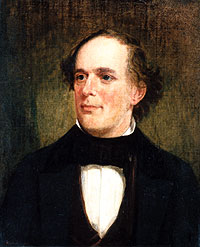
 I don't know whether Abram Smith, Sherman Booth or Byron Paine ever met Salmon Portland Chase, but they had clearly absorbed Chase's arguments about the constitutionality of the Fugitive Slave Acts. You will recall that one of Associate Justice Smith's principal arguments was that the Fugitive Slave Clause did not delegate any power to Congress. The Clause was simply a compact between the States, unenforceable by Congress.
Well, this was exactly the argument that Chase had been making and popularizing since the late 1830s, as part of his thesis that the founders loathed slavery and provided in the Constitution that the federal government should have nothing to do with it:
"Chase . . . tried to interpret the [fugitive slave] clause almost out of existence. The section . . ., Chase pointed out, differed from other clauses in neglecting to delegate to Congress power to enforce it by appropriate legislation. Since all powers not delegated to the federal government were reserved to the states, Chase insisted that the clause was really a compact between the northern and southern states, and that 'each State must judge for itself as to the character of the compact, and the extent of the obligation created by it.' The laws of 1793 and 1850 involving the federal government in the capture of fugitives were unconstitutional, since Congress had no power on the subject."
Eric Foner, Free Soil, Free Labor, Free Men: The Ideology of the Republican Party Before the Civil War (Oxford Univ. Press 2d Ed. 1995) at 77.
Sound familiar?
This helps us understand, by the way, why many members of the Reconstruction Congress believed that it had the power to enforce the Thirteenth Amendment via civil rights legislation, even though that amendment contained no provision specifically delegating power to Congress to do so. It also helps explain why many members of the Reconstruction Congress believed that Section 1 of the Fourteenth Amendment was unnecessary. In Prigg v. Pennsylvania (1842), the Supremes had held -- contrary to Chase's arguments, that the Fugitive Slave Act of 1793 was constitutional: the Fugitive Slave Clause necessarily gave Congress, by implication, the power to enforce it. Members of the Reconstruction Congress reasoned or assumed that the Thirteenth Amendment similarly carried the necessary implication that Congress had the power it enforce it.
It was John Bingham of Ohio who drove his colleagues to include Section 1 in the Fourteenth Amendment because he was one of the few who understood that the implication of Barron v. Baltimore was that Congress did not have the power to enforce the provisions of the Bill of Rights against the States.


