Showing posts with label Daniel Webster. Show all posts

Friday, November 12, 2010

"The Top 100 Influential Figures in American History"


Apart from poor Millard, whom I didn't expect to make the new Atlantic list, several others immediately spring to mind as worthy of consideration. In more or less chronological order:

Andrew Jackson may have been the figurehead, but it was Martin Van Buren who invented the Democratic Party and the Second Party System, then abandoned the party he had created to serve as the presidential candidate for the first non-trivial anti-slavery party, the precursor to the Republican Party.

Daniel Webster's stirring oratory focused and inspired among a generation of Americans unionist sentiment that they would rise to defend when the crisis came.

Abolitionists get all the press, but it was David Wilmot who rose in the House in 1846 to move the famous Proviso that set the country on the road to Civil War.

After crafting and pushing through Congress the Compromise legislation of 1850 that averted civil war for ten years, Stephen A. Douglas's decisions to introduce the Kansas-Nebraska Act and later oppose the Lecompton Constitution gave birth to the Republican Party and placed it on the road to victory in 1860, sparking the war he sought to avoid.

Ann Althouse's musings on the list are worth your time.

About the illustration, entitled Marriage of the Free Soil and Liberty Parties (1848):
A comic portrayal of the alliance between Free Soil Democrats and Whigs and the more extremist abolitionist Liberty party interests during the election campaign of 1848. The factions joined to form the Free Soil party and nominated a presidential candidate in a convention at Buffalo in August. That union is lampooned here as the wedding of Free Soil presidential candidate Martin Van Buren (center left) and a ragged black woman (center right). Van Buren ally Benjamin F. Butler presides over the "marriage." Van Buren, reluctant to embrace the aged bride, is shoved forward by antislavery editor Horace Greeley (left), who says, "Go, Matty, and kiss the bride That is an indispensable part of the ceremony." Van Buren's son John (far left, here called "John Van Barnburner") also urges him on, "Walk up, dad. You can hold your breath till the ceremony is over, and after that you can do what you please." Van Buren says, "I find that politics, as well as poverty, make one acquainted with strange bedfellows." In contrast, the woman beckons with open arms, "Come here, my flower. You is a great stranger, and I want to get acquainted wid you." A black man behind her says of Van Buren, "I nebber hab berry good pinion ob the gemman; but if he ax pardon for all he hab done and said agin us, I will shake hands wid de genman." A black woman (further right) remarks, "Mercy on me! How bashful he is!" Butler, with arms raised and book in one hand, intones, "Who giveth this man to be married to this woman?"

Thursday, April 01, 2010

"The compromise [of 1850] could never have passed had Zachary Taylor lived"


I've argued before that the decisive strategy and firm statesmanship of our nation's least appreciated president, Millard Fillmore, was crucial to the passage of the Compromise of 1850, by which the country avoided civil war for ten crucial years.

I'm in the midst of reading Michael F. Holt's brief (133 pages of text) and so far excellent biography of Franklin Pierce, and I see that Prof. Holt agrees:
Despite the odd alignment in Congress [of the coalitions supporting and opposing the Compromise], the compromise could never have passed had Zachary Taylor lived, but he died on Jul 9, 1850. Taylor's death brought New York's Millard Fillmore to the presidency, and after some hesitation Fillmore named Daniel Webster, a strong pro-compromise man, as his secretary of state. In early August, Fillmore and Webster publicly announced their support for the compromise package, but even before that they had privately pressured northern Whig senators and representatives to allow passage of the concessions to the South. As a result of their pressure, usually involving threats about federal patronage allotment, a sufficient number of northern Whigs abstained on crucial roll-call votes to allow the prosouthern compromise bills to pass.
My chief quibble with Prof. Holt concerns his assertion that Fillmore named Daniel Webster as his secretary of state only "after some hesitation." To the extent this suggests that Fillmore was unsure of who he wanted in that position, I must dissent. Fillmore learned that president Taylor had died late in the evening of July 9, 1850. He was sworn in at noon the next day. Fillmore's biographer Robert J. Rayback relates that Millard settled on Webster his first night as president:
During his first sleepless night as President, Fillmore had settled on Webster as his cabinet's premier. On the day of his inauguration the two went into conference. The aged statesman from Massachusetts, Fillmore learned, was still willing to abide by the principles of his March 7 speech and was willing to take the post of Secretary of State.
What held up the announcement of Webster's appointment was not Millard's indecision but "[d]oubt about who would replace Webster in the Senate and whether Webster's financial friends would continue to pay for his services in the new position." Fillmore and Webster placed "extreme pressure" on Massachusetts governor George N. Briggs (who wanted the post for himself) to appoint Webster's protege Robert C. Winthrop as Webster's replacement in the Senate, while "Webster's friends . . . raised a fund for him, and by July 17 all was arranged for Webster to enter the cabinet."

And before you start howling that the Compromise of 1850 was a monstrous outrage against the laws of Nature and of Nature's God, for which Millard should be execrated rather than hymned, please read Was the Compromise of 1850 a Good Thing or a Bad Thing? and "Civil War between North and South would then have likely erupted".

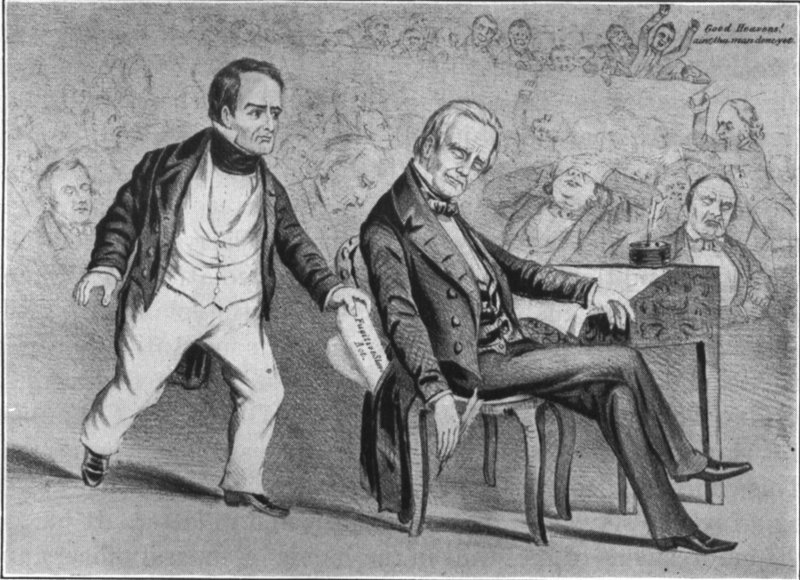
How many of the men in the print at the top can you identify?

Sunday, August 23, 2009

The Rights, Advantages and Immunities of Citizens of the United States


Section 1 of the Fourteenth Amendment includes the so-called Privileges or Immunities Clause, which provides that “No State shall make or enforce any law which shall abridge the privileges or immunities of citizens of the United States.” Most scholars have come to agree that, if the Fourteenth Amendment applies the Bill of Rights to the States, it was the Privileges or Immunities Clause that was supposed to do the job. This, in turn, has set off a scholarly search for the meaning of and antecedents to the mysterious phrase, “the privileges or immunities of citizens of the United States.”

Most legal historians have, not surprisingly, pointed to a clause in Article IV, Section 2 that contains similar language. The Privileges and Immunities Clause provides that “The Citizens of each State shall be entitled to all Privileges and Immunities of Citizens in the several States.”

In his important new article, The Origins of the Privileges or Immunities Clause, Part I: “Privileges and Immunities” as an Antebellum Term of Art, constitutional historian Kurt T. Lash identifies a different source. It turns out that treaties and treaty-related documents in the period between the founding and the Civil War repeatedly referred to the rights, privileges and immunities “of citizens of the United States.” What is more, we have contemporary explanations of what the terms were understood to mean.

Since my purpose here is to whet your appetite, not rehash Prof. Lash's entire article, I want to cut to the chase and focus on one example to which Prof. Lash points. Article III of the Louisiana Purchase Treaty provided that inhabitants of acquired territory (which included Missouri) would enjoy “all these rights, advantages and immunities of citizens of the United States”:
The inhabitants of the ceded territory shall be incorporated in the Union of the United States and admitted as soon as possible according to the principles of the federal Constitution to the enjoyment of all these rights, advantages and immunities of citizens of the United States, and in the mean time they shall be maintained and protected in the free enjoyment of their liberty, property and the Religion which they profess.

During the Missouri Crisis of 1819-1821, this provision became the focus of discussion and argument. Anti-restrictionists (that is, those who contended that Missouri should be admitted as a state without restriction as to the form of its state constitution) maintained that restriction violated Article III.

Among those who denied the charge was Daniel Webster, who in December 1819 authored A Memorial to the Congress of the United States, on the subject of restraining the increase of Slavery in New States to be admitted into the Union.

In the Memorial, Webster countered the Article III argument by drawing a distinction between “the rights, advantages and immunities” granted under state law and those “of citizens of the United States.” The constitution and laws of a particular state might or might not grant all sorts of rights; but “the rights, advantages and immunities of citizens of the United States” were those set forth in the federal Constitution and common to all:
The rights, advantages, and immunities here spoken of [in Article III], must, from the very force of the terms of the clause, be such as are recognized or communicated by the Constitution of the United States; such as are common to all citizens, and are uniform throughout the United States. The clause cannot be referred to rights, advantages, and immunities derived exclusively from the State Government, for these do not depend upon the Federal Constitution. Besides, it would be impossible that all the rights, advantages, and immunities of citizens of the different States, could be at the same time enjoyed by the same persons. These rights are different in different States; a right exists in one State which is denied in others, or is repugnant to other rights enjoyed in others. In some of the States, a freeholder alone is entitled to vote in elections; in some a qualification of personal property is sufficient; and in others, age and freedom are the sole qualifications of electors. In some States, no citizen is permitted to hold slaves: in others, he possesses that power absolutely; in others, it is limited.

Webster then went on to describe some of “the rights derived under the Federal Constitution”:
The obvious meaning, therefore, of the clause is, that the rights derived under the Federal Constitution, shall be enjoyed by the inhabitant of Louisiana in the same manner as by the citizens of other States. The United States, by the Constitution, are bound to guarantee to every State in the Union a republican form of government; and the inhabitants of Louisiana are entitled, when a State, to this guarantee. Each State has a right to two Senators, and to Representatives according to a certain enumeration of population, pointed out in the Constitution. The inhabitants of Louisiana, upon their admission into the Union, are also entitled to these privileges.

Saturday, July 11, 2009

"Zachary Taylor . . . is no more"


I have missed the anniversary by a day, but want to note it anyway. One hundred fifty-nine years ago yesterday, on Wednesday July 10, 1850, Millard Fillmore became the 13th president of the United States.

Fillmore had virtually no notice or time to prepare. Zachary Taylor had initially become ill late in the day on Thursday July 4, and his condition rapidly grew worse. On Sunday July 7, Taylor predicted that “In two days I shall be a dead man.”

However, early in the morning of Tuesday July 9 Taylor rallied, and people thought he was out of danger. John C. Waugh recounts the scene:
At 3:30 Tuesday morning – it was now July 9 – the crisis miraculously seemed to pass and the crowds were told he was out of immediate danger. Bells were rung and bonfires lit in celebration. Officials flocked to the White House with congratulations.

Daniel Webster saw the president at about noon. Satisfied with the president’s condition, he left to return to the Senate. Immediately thereafter, the president suffered a relapse. “[A]s [Webster] was returning to the Senate, word followed him that Taylor had abruptly plunged into a relapse and was unlikely to live through the day. The doctors had taken him off the medicine and said he was in God’s hands.”

Webster proceeded to the Senate, where Fillmore was presiding, and interrupted a speech by South Carolina’s Andrew Butler:
An hour into his speech, [Butler] abruptly stopped. A foreign visitor in the gallery described the scene. Daniel Webster, standing before Butler, was staring sadly at him out of those two cavernous eyes and “indicating with a deprecatory gesture that he must interrupt him on account of some important business.” Butler bowed and fell silent. “A stillness as of death reigned in the house, and all eyes were fixed upon Webster, who himself stood silent for a few seconds, as if to prepare the assembly for tidings of serious import. He then spoke slowly and with that deep and impressive voice which is peculiar to him.”

“A very great misfortune is now immediately impending over the country,” Webster said. “The President of the United States cannot live many hours.” “A thrill, as if from a noiseless electric shock,” the foreign visitor in the gallery later wrote, “had passed through the assembly.” She felt herself grow pale. Webster moved that the Senate adjourn, and it was immediately agreed to.

Zachary Taylor died at 10:30 that night. According to Robert J. Rayback, Vice President Fillmore was informed of Taylor’s death sometime before midnight. A messenger came to Fillmore’s room at the Willard Hotel and delivered a message from the cabinet: “Sir: The . . . painful duty devolves on us to announce to you that Zachary Taylor . . . is no more.”

“Reality,” Rayback recounts, “now burst upon Fillmore with terrible force.” Fillmore composed a message for the cabinet: “I have no language to express the emotions of my heart. The shock is so sudden and unexpected that I am overwhelmed. . . . I . . . shall appoint a time and place for taking the oath of office . . . [at the] . . . earliest moment.”

After a sleepless night, Fillmore formally assumed the presidency on Wednesday July 10, 1850. “At noon before a joint session of both houses, with cabinet present, Judge Branch of the district court administered the Presidential oath of office.”

It can be argued that Fillmore’s first day in office was as productive as any presidential first day in history. Although in shock, Fillmore promptly accepted the resignations of Taylor’s entire cabinet. He also met with Daniel Webster and determined to appoint him as the new Secretary of State. These key moves would lay the groundwork for the new president’s successful resolution of the crisis that had been building for almost four years, ever since David Wilmot first introduced his famous proviso on a hot night in August 1846.

Addendum:

After posting this, I realized that Ed Darrell, who never misses a significant Millard event, had almost certainly noted Millard's accession. And indeed he has: Historical anniversary: July 10, 1850, Millard Fillmore succeeds to the presidency


Sunday, June 21, 2009

John Calhoun's Pakenham Letter: The Background


Scholars have long puzzled over why John Caldwell Calhoun chose to write the Pakenham Letter. But first, some background.

In September 1841, members of the Whig caucus read “His Accidency” John Tyler out of the Whig party. Although now a man without a party, Tyler continued to harbor dreams of a second term. Perhaps he could persuade the Democrats to nominate him in 1844, or maybe he could form a third party or run as an independent backed by a coalition of southern Democrats disenchanted with the probable Democratic candidate, Martin Van Buren and conservative, state-right Whigs.

As part of this pipe dream, Tyler conceived the idea of boldly pushing for the annexation of the Republic of Texas. Both Democrats and Whigs had studiously avoided the issue for years because they recognized how hot a potato it would likely become. In particular, the annexation of Texas, in which slavery was legal, threatened to ignite disputes over the peculiar institution and sectional tensions. In addition, Mexico had never conceded the independence of what it viewed as a rebellious province. Annexation thus presented the likelihood of war. Andrew Jackson had therefore contented himself with recognition of Texas rather than annexation before he left office in March 1847, and his Democratic successor Martin Van Buren (in office March 1837- March 1841) had avoided the issue like the plague.

In May 1843, Daniel Webster, the last member of the original cabinet that Tyler inherited from William Henry Harrison, resigned his position as Secretary of State after completing negotiation of the Webster-Ashburton Treaty. Tyler responded by nominating as Webster’s successor his Secretary of the Navy and old friend and confidante, Abel P. Upshur. Upshur, who hailed from the eastern shore of Virginia, was, like Tyler, a conservative, state-rights Whig. He also was an enthusiastic advocate of annexation. Upshur assumed office in July 1843 and promptly entered into secret negotiations designed to result in the annexation of Texas via a treaty to be presented to the Senate.

Fast-forwarding eight months or so, Upshur’s negotiations and the proposed treaty were virtually complete by late February 1844. At that point, as I mentioned in the last post, chance intervened. On February 28, 1844, Upshur was killed by an explosion on board the USS Princeton. Tyler, who could turn to neither mainstream Democrats nor Whigs for a replacement, reached out (reluctantly or otherwise – it is not clear) to the quintessential anti-party man, none other than John Caldwell Calhoun of South Carolina, who assumed his duties at State a month later on April 1, 1844.

Meanwhile, however, news of the secret negotiations had leaked. Based on an inadvertent hint from Upshur before his death, Daniel Webster had figured out in February that a treaty was imminent, and he relayed the information to Whig allies. In March, Robert C. Winthrop introduced a resolution in the House demanding information. It quickly became apparent that the issue threatened to become a sectional one, with northern Whigs in particular denouncing the rumored treaty as a conspiracy of the slave interests.

Without admitting the existence of the negotiations, the administration backed efforts by friends who endorsed annexation as a commercial and strategic boon to nation as a whole. on a non-sectional basis. Tyler reportedly believed that any mention of the slavery issue or attempt to push annexation as a protection for the south would be fatal to ratification. Indeed, it appears that, for this reason, Tyler pushed to have the treaty signed and submitted for ratification before Calhoun became Secretary.

Such was not to be, because the Texas envoy did not arrive in Washington to sign the treaty until the last day of March, just as Calhoun assumed his new post. After final details were worked out, the treaty was signed Friday April 12, 1844.

The treaty was not, however, submitted to the Senate until Monday April 22. There were certainly understandable and legitimate reasons for the delay. Calhoun used the intervening ten days to approach the Mexican minister in an unsuccessful attempt to reduce the likelihood of war after the treaty was formally announced. On a more practical level, in a world without word processors, faxes and email, documents had to be transcribed and cover letters had to be composed and approved.

But the delay was also occasioned in part by Calhoun’s apparently inexplicable decision to write a letter concerning Texas to the British minister to the United States, Richard Pakenham. Here we must take a step back.

Five months earlier, George Hamilton-Gordon, Lord Aberdeen, the British Foreign Secretary, had sent a dispatch dated December 26, 1843 to the British ministry in the United States, the contents of which were intended to be conveyed to the American Secretary of State. When the newly-appointed Pakenham arrived in Washington in February 1844, he discovered that Aberdeen’s message had not been communicated to Upshur. Pakenham remedied the omission by reading the message to Upshur and then sending him a copy. Upshur did not respond before he was killed on February 28, and acting secretary of state John Nelson apparently did not regard a response as necessary during his brief tenure (from the end of February to the end of March).

In fact, the Aberdeen message (the full text of which may be found in the Congressional Globe) was quite benign and conciliatory. In brief, Aberdeen confirmed (as the British Government had previously expressed) that the government preferred that slavery be abolished in Texas. However, he made clear that Britain had no designs on Texas and would take no actions to achieve that result. Norma Lois Peterson describes the dispatch in somewhat greater detail:
Aberdeen’s tone was courteous, not hostile. He admitted that his government had pressed Mexico to acknowledge the independence of Texas, but it had done so with “no occult design, either with reference to the slavery which now exists, and which we desire to see abolished in Texas.” It was well known to the United States and to every other nation, Aberdeen explained, that Great Britain desired and was “constantly exerting herself to procure the general abolition of slavery throughout the world.” But in attempting this, Britain would do nothing in a secret or underhanded manner. “We should rejoice if the recognition of that country [Texas] by the Mexican Government should be accompanied by an engagement on the part of Texas to abolish slavery eventually and under proper conditions”; but Britain did not intend to exercise improper authority on either Mexico or Texas. “We shall counsel, but we shall not seek to compel, or unduly control, either party. So far as Great Britain is concerned, provided all other States act with equal forbearance,” Mexico and Texas were at liberty “to make their own unfettered arrangements,” in regard to slavery or any other matter.

President Tyler reportedly took the message for what it was – an attempt to be conciliatory notwithstanding a difference in principle. As Calhoun told Pakenham, the president expressed his appreciation for the British government’s disavowal of any intention to disturb the internal tranquility of slaveholding states, although he regretted that Great Britain had officially transmitted its policy of abolition.

Calhoun, however, would not take yes for an answer and decided to escalate matters. In response, he composed and sent to Pakenham an incendiary reply dated April 18, 1844. Remarkably, I have not been able to locate a copy the “Pakenham Letter” online. For those with access to specialized databases or research or law libraries, it may be found at Senate Documents, 28th Cong., 1st Sess. 50-53 and Richard K. Cralle (ed.), The Works of John C. Calhoun, Vol. 5, pp. 333-347. Here is William W. Freehling’s description:
The administration, wrote the Secretary of State, “regards with deep concern the avowal” that England was “constantly exerting herself” to procure world-wide antislavery. The administration was also appalled that England was urging emancipation as “one of the conditions on which Mexico should acknowledge” Texas. “It would be difficult for Texas in her actual condition,” emphasized Calhoun, “to resist” this pressure, even “supposing the influence and exertion of Great Britain” remained within Lord Aberdeen’s “limits.”

An emancipated Texas, continued the Carolinian, would give “Great Britain the most efficient means of effecting in the neighboring States of this Union what she avows to be her desire to do in all countries where slavery exists.” A free labor Texas “would expose the weakest and most vulnerable portions” of slaveholders’ “frontiers” to inroads. But while England’s hope is to end what she calls our evil, warned Calhoun, our mission is to perpetuate what we consider our blessing. Under southern Christian slavery, bragged the American Secretary of State, “the negro race” has attained an unprecedented “elevation in morals, intelligence,” and “civilization.” The United States, concluded Calhoun, “acting in obedience” to racial “obligation,” and “as the most effectual if not the only means of guarding against the threatened danger . . . has concluded an annexation treaty.”


In a subsequent letter, dated April 27, 1844, Calhoun drove home the point that annexation “was made necessary in order to preserve domestic institutions . . . deemed essential to their safety and prosperity.”

“It was,” Merrill D. Peterson has coyly noted, “an unusual diplomatic dispatch.”

Meanwhile, on Monday April 22, 1844, four days after the dispatch of the first letter, the Secretary of State formally transmitted the proposed treaty with Texas to the Senate under seal. Based on precedent, and apparently presuming that the Senate would immediately call for production of supporting materials in any event, Calhoun also sent with the treaty itself copies of related documents and correspondence – including the Pakenham Letter.

Ironically, President Tyler’s letter of transmittal to the Senate emphasized the importance of the treaty to the nation as a whole, not its sectional benefit to the south. The inclusion of the Pakenham Letter, however, insured that there would be a sectional explosion and virtually guaranteed defeat of the treaty, which required ratification by two-thirds of the Senate under Article II, Section 2.

The question, then, is why Calhoun wrote the letter. Merrill D. Peterson summarizes the conundrum:
Politicians then and historians since have debated Calhoun’s motives for writing the Pakenham Letter. The administration line on annexation was that it was strictly a question of national interest unconnected with slavery. Calhoun’s letter, which went to the Senate along with the treaty and became public knowledge on April 27 [,1844], placed annexation on pro-slavery grounds. Could he have been oblivious to the effect of this?

In the next post, I will survey some possible answers.

Sunday, May 03, 2009

Andrew Jackson's Proclamation Regarding Nullification 4: The Union is "coeval with our political existence"


Both Daniel Webster and Abraham Lincoln famously held that the Union was older than the Constitution. By way of a refresher, here they are:

Daniel Webster, February 16, 1833:
In 1789, and before this Constitution was adopted, the United States had already been in a union, more or less close, for fifteen years. At least as far back as the meeting of the first Congress, in 1774, they had been in some measure, and for some national purposes, united together. Before the Confederation of 1781, they had declared independence jointly, and had carried on the war jointly, both by sea and land; and this not as separate States, but as one people. When, therefore, they formed that Confederation, and adopted its articles as articles of perpetual union, they did not come together for the first time; and therefore they did not speak of the States as acceding to the Confederation, although it was a league, and nothing but a league, and rested on nothing but plighted faith for its performance. Yet, even then, the States were not strangers to each other; there was a bond of union already subsisting between them; they were associated, united States; and the object of the Confederation was to make a stronger and better bond of union. Their representatives deliberated together on these proposed Articles of Confederation, and, being authorized by their respective States, finally "ratified and confirmed" them. Inasmuch as they were already in union, they did not speak of acceding to the new Articles of Confederation, but of ratifying and confirming them; and this language was not used inadvertently, because, in the same instrument, accession is used in its proper sense, when applied to Canada, which was altogether a stranger to the existing union. "Canada," says the eleventh article, "acceding to this Confederation, and joining in the measures of the United States, shall be admitted into the Union."

Abraham Lincoln, March 4, 1861:
Descending from these general principles, we find the proposition that in legal contemplation the Union is perpetual confirmed by the history of the Union itself. The Union is much older than the Constitution. It was formed, in fact, by the Articles of Association in 1774. It was matured and continued by the Declaration of Independence in 1776. It was further matured, and the faith of all the then thirteen States expressly plighted and engaged that it should be perpetual, by the Articles of Confederation in 1778. And finally, in 1787, one of the declared objects for ordaining and establishing the Constitution was "to form a more perfect Union."

I mention this because one of the more remarkable aspects of Andrew Jackson’s December 10, 1832 Proclamation Regarding Nullification is that he anticipated them both:
[The South Carolina nullification ordinance has] for its object the destruction of the Union – that Union, which, coeval with our political existence, led our fathers, without any other ties to unite them than those of patriotism and common cause, through the sanguinary struggle to a glorious independence – that sacred Union, hitherto inviolate, which, perfected by our happy Constitution, has brought us, by the favor of Heaven, to a state of prosperity at home, and high consideration abroad, rarely, if ever, equaled in the history of nations.

Saturday, March 07, 2009

"I know of no man who lives in such utter intellectual solitude"


My last post on Daniel Webster brought to mind the Great Triumvirate, and Harriet Martineau's arresting descriptions of them. Here she describes a typical evening affair held during the winter of 1835. I have added paragraph breaks for readability:
Our pleasantest evenings were some spent at home in a society of the highest order. Ladies, literary, fachionable, or domestic, would spend an hour with us on their way from a dinner, or to a ball. Members of Congress would repose themselves by our fire side.

Mr. Clay, sitting upright on the sofa, with his snuff-box ever in his hand, would discourse for many an hour, in his even, soft, deliberate tone, on any one of the great subjects of American policy which we might happen to start, always amazing us with the moderation of estimate and speech which so impetuous a nature has been able to attain. Mr. Webster, leaning back at his case, telling stories, cracking jokes, shaking the sofa with burst after burst of laughter, or smoothly discoursing to the perfect felicity of the logical part of one's constitution, would illuminate an evening now and then.

Mr. Calhoun, the cast-iron man, who looks as if he had never been born, and never could be extinguished, would come in sometimes to keep our understandings upon a painful stretch for a short while, and leave us to take to pieces his close, rapid, theoretical, illustrated talk, and see what we could make of it. We found it usually more worth retaining as a curiosity than as either very just or useful. His speech abounds in figures, turly [truly?] illustrative, if that which they illustrate were but ture [true?] also. But his theories of government, (almost the only subject on which his thoughts are employed,) the squarest and compactest theories that ever were made, are composed out of limited elements, and are not therefore likely to stand service very well.

It is at first extremely interesting to hear Mr. Calhoun talk; and there is a never-failing evidence of power in all he says and does, which commands intellectual reverence: but the admiration is too soon turned into regret,—into absolute melancholy. It is impossible to resist the conviction that all this force can be at best but useless and is but too likely to be very mischievous. His mind has long lost all power of communicating with any other. I know no man who lives in such utter intellectual solitude. He meets men and harangues them, by the fire-side, as in the Senate: he is wrought, like a piece of machinery, set a-going vehemently by a weight, and stops while you answer: he either passes by what you say, or twists it into a suitability with what is in his head, and begins to lecture again. Of course, a mind like this can have little influence in the Senate, except by virtue, perpetually wearing out, of what it did in its less eccentric day: but its influence at home is to be dreaded. There is no hope that an intellect so cast in narrow theories will accommodate itself to varying circumstances: and there is every danger that it will break up all that it can, in order to remould the materials in its own way.

Mr. Calhoun is as full as ever of his Nullification doctrines; and those who know the force that is in him, and his utter incapacity of modification by other minds,(after having gone through as remarkable a revolution of political opinion as perhaps any man ever experiences,) will no more expect repose and self - retention from him than from a volcano in full force. Relaxation is no longer in the power of his will. I never saw any one who so completely gave the idea of possession. Half an hour's conversation with him is enough to make a necessarian of any body. Accordingly, he is more complained of than blamed by his enemies. His moments of softness, in his family, and when recurring to old college days, are hailed by all as a relief to the vehement working of the intellectual machine; a relief equally to himself and others. Those moments are as touching to the observer as tears on the face of a soldier.

About the illustration:
A satire on the surprising alliance, forged early in the presidential campaign of 1840, between the Van Buren administration and southern or "nullification" Whigs in the circle of John Calhoun. At left editor Francis Preston Blair embraces Calhoun saying, "Now we will see if Pikens [i.e., South Carolina Congressman Francis W. Pickens] dare say again that I am a Galvanized Corps &c &c.' I think this will cause Nulification Stock to raise." Calhoun replies, "It gives me great pleasure to say that the best part of the Measures of the present Cheif Magistrate, are approved of by me, and I am happy of the opportunity of making these declarations, and I will stand by them." Van Buren, dancing in the background, exults, "Hurrah for Nullification Stock. I am delighted, what will the D---d Whigs say, who cares for Granny-Harrison." An obese Dixon Hall Lewis (right) adds, "I say Matty, you will find Cataline and myself, of some weight." Calhoun is characterized as a traitor (thus Lewis's reference to the Roman Catiline) because of his shift in allegiance from Whig to Democrat. Weitenkampf tentatively dates this as 1836. Its close similarity to "Expansion & Contraction" (no. 1840-47) and its commentary on the Calhoun-Van Buren alliance make 1840 more likely.

The Seventh of March


Today is the one hundred fifty ninth anniversary of Daniel Webster's Seventh of March Speech.

John C. Waugh sets the scene. On the morning of March 7, 1850, Isaac P. Walker, a Democrat from Wisconsin, was a concluding a speech, begun the day before, in support of the slave-free status of the territories wrested from Mexico. By noon, the Senate was "teeming" and "packed" with spectators in anticipation of the next speaker. "Every seat on the floor and in the gallery was occupied, every space where a human being could stand was filled."

Senator Walker graciously ceded the floor. "Mr. President," he said, "this vast audience has not assembled to hear me, and there is but one man, in my opinion, who can assemble such an audience. They expect to hear him, and I feel it to be my duty, as well as my pleasure, to give the floor to [him]."
Walker sat down and Daniel Webster began to rise. The sight of Webster rising on the floor of the Senate was one of the most riveting images in American politics. One observer explained, "the getting up of Daniel Webster was not a mere act; it was a process. . . . The beholder saw the most wonderful head that his vision ever rested on rising slowly in the air; he saw a lionlike countenance, with great, deep-set, luminous eyes, gazing at him with solemn majesty; in short, he saw the godlike Daniel getting on his feet, and his heart thrilled at the thought of what might be coming.

And then the godlike Daniel began:
Mr. President, - I wish to speak to-day, not as a Massachusetts man, nor as a Northern man, but as an American, and a member of the Senate of the United States. It is fortunate that there is a Senate of the United States; a body not yet moved from its propriety, not lost to a just sense of its own dignity and its own high responsibilities, and a body to which the country looks, with confidence, for wise, moderate, patriotic, and healing counsels.

It is not to be denied that we live in the midst of strong agitations, and are surrounded by very considerable dangers to our institutions and our government. The imprisoned winds are let loose. The East, the North, and the stormy South combine to throw the whole sea into commotion, to toss its billows to the skies, and disclose its profoundest depths.

I do not affect to regard myself, Mr. President, as holding, or as fit to hold, the helm in this combat with the political elements; but I have a duty to perform, and I mean to perform it with fidelity, not without a sense of existing dangers, but not without hope. I have a part to act, not for my own security or safety, for I am looking out for no fragment upon which to float away from the wreck, if wreck there must be, but for the good of the whole, and the preservation of all; and there is that which will keep me to my duty during this struggle, whether the sun and the stars shall appear, or shall not appear for many days.

I speak to-day for the preservation of the Union. "Hear me for my cause." I speak to-day, out of a solicitous and anxious heart for the restoration to the country of that quiet and harmonious harmony which make the blessings of this Union so rich, and so dear to us all. These are the topics I propose to myself to discuss; these are the motives, and the sole motives, that influence me in the wish to communicate my opinions to the Senate and the country; and if I can do any thing, however little, for the promotion of these ends, I shall have accomplished all that I expect.

Friday, March 06, 2009

"If those are Whig doctrines, I'm a Loco-foco"


I’m about half way through John C. Waugh’s On the Brink of Civil War: The Compromise of 1850 and How It Changed the Course of American History, and it’s a delight.

You won’t find any shattering revelations about the Compromise of 1850 in this relatively brief book (195 pages of text and footnotes). But the book lays out clearly the issues, the players and the developments during the crisis. If you don’t know much about the Compromise, it seems to be a fine introduction.

But even if you know a good deal about the Compromise, the book is a lot of fun and well worth reading. Mr. Waugh is a journalist by trade, not a professional historian. What he excels at is providing vivid portraits of the people involved and the dramatic moments that peppered the year 1850. Using memoirs and published personal recollections of participants and onlookers, Mr. Waugh paints arresting pictures of (for example) Henry Clay rising in the Senate to give one of his great speeches, or Daniel Webster acknowledging John C. Calhoun with a bow during his Seventh of March speech.

I said earlier that the book contains no shattering revelations. But it does contain a number of vivid, colorful anecdotes, previously unknown to me, that shed light on the players, large and small, and bring them to life in a way that academic history often does not. On the theory that one example is worth a thousand words (or something like that), here is a vignette that I just finished reading.

To set the scene, William Seward has just given his famous “higher law” speech. Waugh then describes the usually affable Willie Mangum (Whig – North Carolina) storming into Zachary Taylor’s office, and Taylor’s reaction:
[Mangum] denounce[ed] what he saw as “monstrous declarations,” telling the president that “if such were the doctrines of the administration, I was its decided opponent henceforth, and if those were Whig doctrines, I was a Loco-foco.” Taylor hurried in alarm to see A.C. Bullitt, the editor of the Republic, and stammered, “A-aleck, this is a nice mess Governor Seward has got us into. Mangum swears he’ll turn Democrat if Seward is the mouthpiece of my administration. The speech must be disclaimed at once, authoritatively and decidedly. Don’t be mealy-mouthed about it, but use no harsh language. We can’t stand for a moment on such principles. The Constitution is not worth one straw if every man is to be his own interpreter, disregarding the exposition of the Supreme Court.”

Isn’t that wonderful? It really gives you a feel for Mangum and Taylor, and on top of that it’s a hoot!

Wednesday, January 14, 2009

Maybe We Should Give Them Back the Southwest


U.S. military report warns 'sudden collapse' of Mexico is possible.

About the illustration:
An indignant James K. Polk takes issue with Massachusetts senator Daniel Webster's public attacks on his Texas policy. In 1844 Webster had been opposed to the annexation of Texas and in 1846 he criticized attacked the war with Mexico over Texas as highly unjustifiable. Webster's first public speech on the war was made in late June, and the print probably did not appear before that. In the center, Polk (left) confronts Webster, warning, "If you say the Mexican War is a War of my own makeing you tell a falshood!" Raising his fists, Webster retorts, "I did say it & say it again!" To the left of Polk stand Thomas Ritchie and James Watson Webb, newspaper editors supporting the administration. Webb holds a bottle of "Tom and Jerry" and a sponge, commenting, "Principles, not men!" The Whig editor had opposed the annexation of Texas, but once hostilities commenced he urged military action to bring about a speedy termination. Webb's insistence on "principles" reflects his uneasiness in an alliance with a Democratic administration which stood to gain politically from the conflict. Ritchie reassures Polk, "In Union [a double entendre referring to his newspaper the "Washington Union&1] there is strength, Nous Verrons!" To the right of Webster stand an unidentified man (probably another journalist) and Horace Greeley, editor of the New York "Tribune. "Greeley, who was severely critical of Polk's policies, holds a bottle of "Lemon Soda" and (like Webb) a sponge, and remarks, "I wish Dan had eaten more Graham bread he's too fat for Polk!" (Graham bread was a well-known Greeley dietary preference.) The unidentified man remarks, "A Daniel come to blows, if not Judgment." The sponges and bottles are apparently intended for the relief of the fighters, much as the port and the "Old Monongohala Whiskey" figured in Anthony Imbert's "Set to between Old Hickory and Bully Nick"(no. 1834-4), on which "The Issue Joined"seems to be based. The precise significance of the "Tom & Jerry" and "Lemon Soda" is unclear. "The Issue Joined"is executed in a style similar to that of Edward Williams Clay. The faces of the characters may in fact be attributable to Clay, but the drawing of the figures and costumes are not up to that artist's standard.

Friday, November 14, 2008

"Civil War between North and South would then have likely erupted"


Several weeks ago, I highlighted Mark J. Stegmaier’s discussion of the firm and statesmanlike leadership that President Millard Fillmore and his hand-picked Secretary of State Daniel Webster displayed in bringing about the Compromise of 1850. I thought I’d take one more post to emphasize how much was at stake.

Some commentators downplay the importance of the Compromise because they focus only on whether southern states would have been prepared to secede at that point if no compromise had been reached. But, as Professor Stegmaier points out, that is not where the true danger lay. The most serious threat to the Union lay in the possibility that a shooting war might have broken out between Texas and New Mexico. In that event, it is possible – and I would submit probable – that at least some of the Cotton South states would have lined up with Texas. As was the case eleven years later, mid-south and border-south states would have been forced to choose sides, unless the federal government simply allowed Texas to complete its invasion of New Mexico, and allowed the seceding states to go their own way.

Since Professor Stegmaier describes the potential consequences far better than I, I’ll let him speak for himself:
No great feats of imagination are required to contemplate the probable consequences of a failure to settle the issues of 1850 in a manner acceptable to great majorities in both North and South. . . . Texas . . . might have attempted to send a military force toward Santa Fe. A bloodletting could have occurred there, and, even though the Texans would have probably suffered defeat, the incident would probably have rallied the Southern states to aid Texas. Civil War between North and South would then have likely erupted.

I have posted before about my belief in the importance of hypotheticals and “what-ifs” in assessing historical events. Again, Professor Stegmaier makes the point most eloquently:
“Might-have-beens” and “what-ifs” are always dangerous for historians perhaps stretching too far, but some consideration of possible alternative outcomes can illuminate the significance of what did take place.

The description of the illustration is as follows:
A crudely drawn but complex satire mocking Zachary Taylor's military background and lack of political experience. Student Zachary Taylor, wearing a paper cap made out of the journal "The True Whig" is seated on a low stool at the feet of his more politically seasoned running mate Millard Fillmore. Taylor reads from a book "Congressional Debates 1848. Slavery . . .", and spells out "W-I-L-M-O-T: Wilmot, P-R-O-V-I-S-O: Proviso. What do I know about such political stuff. Ah! Wait until I get loose, Then you will see what fighting is!" A torn sheet marked "National Bank" lies at his feet. Fillmore, who reads from "The Glorious Whig Principles [by] Henry Clay," admonishes Taylor, "This will never do, you must forsake this course,--for our party is a peaceful and rightous sect--free from wickedness." Behind Fillmore are an open book cabinet, the Constitution, and a globe. This are in obvious contrast to the maps of "The Late War" and a broadsheet "The Life of Johnny Tyler" on the wall behind Taylor. At Taylor's knee sits a bloodhound with a collar marked "Florida," a reminder of Taylor's controversial use of bloodhounds in the Second Seminole War. To the right two black youths polish Taylor's weapons. The first, kneeling and wiping a pistol, says, "By golly! Massa Taylor like fighting better then him dinner." The other, cleaning a sword, claims, "Dis am de knife wot massa use to cut up de Mexijins wid." In the center of the floor are a group of toy soldiers and a cannon.

Sunday, November 25, 2007

The Origin of "Godlike Daniel"


On August 2, 1826, Daniel Webster delivered a eulogy on the lives and services of John Adams and Thomas Jefferson at Faneuil Hall in Boston. So magnificent was the speech that, upon its conclusion, tremendous cheers roared through the hall -- although "inappropriate indeed for the occasion," according to Webster's friend and fellow Dartmouth alumnus George Ticknor.

The eulogy also earned Webster the appellation "Godlike Daniel:"
Three days later, an obscure temperance journal in Boston [called the National Philanthropist] commented, "To say of this production that it was eloquent, would be too common an expression to apply to such a performance. It was profound -- it was sublime -- it was godlike."

Merrill D. Peterson, The Great Triumvirate: Webster, Clay, and Calhoun, at 111.

Saturday, November 24, 2007

Daniel Webster on the Slave Trade


I deem it my duty on this occasion to suggest, that the land is not yet wholly free from the contamination of a traffic, at which every feeling of humanity must for ever revolt, - I mean the African slave-trade. Neither public sentiment, nor the law, has hitherto been able entirely to put an end to this odious and abominable trade. At the moment when God in his mercy has blessed the Christian world with a universal peace, there is reason to fear, that, to the disgrace of the Christian name and character, new efforts are making for the extension of this trade by subjects and citizens of Christian states, in whose hearts there dwell no sentiments of humanity or of justice, and over whom neither the fear of God nor the fear of man exercises a control.

In the sight of our law, the African slave-trader is a pirate and a felon; and in the sight of Heaven, an offender beyond the ordinary depth of human guilt. There is no brighter page of our history, than that which records the measures which have been adopted by the government at an early day, and at different times since, for the suppression of this traffic; and I would call on all the true sons of New England to cooperate with the laws of man, and the justice of Heaven.

If there be, within the extent of our knowledge or influence, any participation in this traffic, let us pledge ourselves here, upon the rock of Plymouth, to extirpate and destroy it. It is not fit that the land of the Pilgrims should bear the shame longer. I hear the sound of the hammer, I see the smoke of the furnaces where manacles and fetters are still forged for human limbs. I see the visages of those who by stealth and at midnight labor in this work of hell, foul and dark, as may become the artificers of such instruments of misery and torture. Let that spot be purified, or let it cease to be of New England. Let it be purified, or let it be set aside from the Christian world; let it be put out of the circle of human sympathies and human regards, and let civilized man henceforth have no communion with it.

Daniel Webster, Plymouth Oration, December 22, 1820. I have added paragraph breaks for readability.

Sunday, November 18, 2007

The Godlike Daniel


Posting about John Calhoun lead me think, not unexpectedly, about Daniel Webster.

Rather than quote from the Webster-Hayne debate, I thought I'd share this wonderful description of the Godlike Daniel:
He was a black, raven-haired fellow, with an eye as black as death, and as heavy as a lion's -- and no lion in Africa ever had a voice like him, and his look was like a lion's -- that same heavy look, not sleepy, but as if he didn't care about any thing that was going on about any thing; but as if he would think like a hurricane if he once got worked up to it.

Sunday, May 20, 2007

Groves v. Slaughter II: Slaughter's Arguments


In their appeal to the Supreme Court, the indorsers argued that that the transaction was null and void because it violated the provision of the Mississippi constitution that prohibited the importation of slaves into the state for sale. In response, Slaughter made essentially two kinds of arguments.

The first was not a federal constitutional argument. Instead, Slaughter argued that Mississippi law did not, in fact, forbid the importation of slaves into the state. The provision of the Mississippi Constitution was, in effect, an expression of the convention's belief that the Mississippi legislature should prohibit the importation of slaves. But, rightly or wrongly, the legislature had never passed such a law. Instead, it had passed laws implicitly recognizing that it was lawful to import slaves for sale, such as the law taxing imported slaves. Because the Mississippi legislature had not made the importation of slaves for sale illegal, Slaughter had violated no law, and the transaction was legal and certainly not null and void.

Slaughter’s second argument, however, did directly implicate the federal Constitution. Assuming that Mississippi law did make the importation of slaves for sale illegal, Slaughter argued, that law was itself void because it violated the Commerce Clause. That Clause, he urged, gave Congress the exclusive right to regulate commerce among the states.

In his argument on Slaughter's behalf, Henry Clay couched the argument in the following terms:
The last question in the case is, whether the provision of the constitution of the United States, which gives to congress, exclusively, the right to regulate commerce between the states, is opposed by the constitution of Mississippi. The argument for the plaintiffs in error [i.e., the indorsers], is on the abolition side of the question [i.e., they would permit states to abolish interstate commerce in slaves]. The counsel for the defendant [in error, i.e., Slaughter] sustain the opposite principle. The object of prohibition in the constitution of the United States is to regulate commerce; to sustain it, not to annihilate it. It is conservative. Regulation implies continued existence-life, not death; preservation, not annihilation; the unobstructed flow of the stream, not to check or dry up its waters. But the object of the abolitionists is to prevent the exercise of this commerce. This is a violation of the right of congress under the constitution.

The right of the states to regulate the condition of slaves within their borders, is not denied. It is fully admitted. Every state may, by its laws, fix the character and condition of slaves. The right of congress to regulate commerce between the different states, which may extend to the regulation of the transportation of slaves from one state to another, as merchandize, does not affect these rights of the states. But to deny the introduction of slaves, as merchandize, into a state, from another state, is an interference with the constitution of the United States. After their introduction, they are under the laws of the states. Nor is the power, given by the constitution of the United States, to regulate commerce, one in which the states may participate. It is exclusive. It is essentially so: and its existence in this form is most important to the slave-holding states.

Note how tight a rope Clay is walking. First, he must assert that Congress has the exclusive right to regulate commerce in slaves among the states; but at the same time he goes out of his way to suggest that Congress could not use that power to abolish that commerce, only to “regulate” it in order to conserve, preserve and sustain it.

Second, he must deny that the states have the power to regulate commerce in slaves among the states, but at the same time he must concede that states have the right “to regulate the condition of slaves within their borders.” Earlier cases had held that states had the right to bar or impose conditions on people entering their territory. For example, in Miln v. New York, 22 U.S. 1 (1824), the Court had upheld a New York statute relating to arriving ship passengers because the state had a right to protect itself against “the moral pestilence of paupers, vagabonds, and possibly convicts,” who might impose a tax burden, as well as against “the physical pestilence” that they might present. Clay also presumably recognized that it was unthinkable (and political suicide) to deny slave states the power to regulate and control the slaves within their borders. He was therefore forced to make the awkward suggestion that the Mississippi constitutional provision was null and void because it was specifically aimed at commerce (it denied the introduction of slaves “as merchandize”) and did not purport to be an exercise of police powers such as quarantine and inspection.

The constitutional argument of Clay’s co-counsel representing Slaughter, Daniel Webster, was, if anything, even more awkward. After demonstrating that the Constitution granted the federal government the exclusive right to regulate interstate commerce, he admitted that “interior rights, not commercial, may be regulated by the states.”

In an attempt to establish that the interstate transportation and sale of slaves was “commerce,” Webster then dealt with the uncomfortable issue whether slaves were “property.” He argued that both state law and the Constitution recognized slaves as property:
The powers conferred on congress, are duties; and they are to be exercised for the good of the states. What is the foundation of the right to slaves? There is no law declaring slaves property any more than land. Slaves are property by the term “slaves.” The master has a right to their services and labor. This is property. The constitution recognises slaves as property. Slaves escaping from the state in which they are held to service and labor may be arrested in other states, and carried back to the state from which they escaped. The right to take them up, is an acknowledgment of the right of property in them.

But this only created a further morass, because Webster was morally and politically bound to deny that states that abolished slavery could be forced to accept slaves. He therefore argued that the Commerce Clause did not authorize Congress to compel free states to take slaves. With all due respect to Webster, his argument as summarized is more conclusory than persuasive. Presumably, Webster was struggling to suggest that a state’s decision to abolish slavery within its borders was not a commercial decision, or that when a state abolished slavery, slaves ceased being property within that state’s borders:
While the right and duty in congress, under its power and duty to regulate commerce between the states, extends to slaves, as articles of commerce between the states, so long as slavery exists in the states, when slavery is abolished in a state, congress has no privilege to interpose; in such states, congress has no power to interfere with the state regulations as to slavery.

Webster thus settled on the odd proposition that a state that abolished slavery could constitutionally refuse the importation of slaves, but a state that recognized slavery violated the Commerce Clause if it did so:
If the right in states recognising slavery exists, to prohibit trading in them, it will allow non-intercourse between the states of the Union by the legislative enactments of the states; and will authorize retaliation. This is negatived by [earlier Supreme Court decisions]; and the question is closed.

Webster then provided an analogy to illustrate his position:
The court are called upon to say that the state of Mississippi may prohibit the transportation into that state of any particular article. The court will be obliged to find out something in the introduction of slaves, different from trading in other property. This will be difficult. Suppose, under some excitement, the introduction of cotton into the state of Massachusetts had been prohibited, and this was retaliated by a prohibition of the introduction into a cotton-planting state of cotton fabrics. Would not this be an interference with the power of congress to regulate commerce? Slaves are as much property in Mississippi and in Carolina, as cotton. All the states have not slaves, nor do all the states plant cotton. Can states interfere with the introduction of articles which congress have left free? There are exceptions; such as quarantine regulations, pilotage; but the subject of this inquiry is different. The prohibition of the constitution of Mississippi is a regulation of commerce, intercourse, merchandize.

It is fair to say, I think, that the analogy did not advance the ball at all. What if Massachusetts simply passed a law declaring that its citizens could not own cotton, and that the state did not recognize cotton as “property”? What if the cotton-planting states then passed laws declaring that their citizens could not own cotton fabrics, and that those fabrics were not “property”?

Webster’s peroration sounds like the conclusion of a man who has tied himself totally in knots:
The strongest motives to establish the constitution of the United States, was the regulation of commerce and intercourse between the states, and with foreign states; to make the United States, in this respect, a unit. It may not be easy to draw the line, so as to distinguish what may, and what may not, be an interference with the provisions of the constitution of the United States. But this is not such a case. This is a clear case. In any matters of the sale and purchase of property, the states cannot interfere.

I will turn next to the arguments made by the attorneys for the indorsers.
Related Posts with Thumbnails