But declining to publish the 2009 lecture “A Look Back At the Dred Scott Decision” would have been a service to the author, Justice Stephen G. Breyer. It appears in the latest issue, which I recently received, and Breyer’s lecture is, quite simply, an embarrassment. I am inclined to believe that no clerk helped him with it, since any recent law school graduate from a top school should have done a better job. The lecture contains elementary errors of fact, makes at least one attribution of an argument to a justice in Dred Scott which is entirely inaccurate, and plods to a set of conclusions that are suffused with banality. If I were to grade this piece of work as a term paper by an advanced undergraduate, I’d give it a C- if I were in a good mood.
The editors could have saved Breyer from such boo-boos as typing “1817″ in one place and “1859″ in another for the date of the Dred Scott decision (it was 1857), and they could have silently corrected one subject-verb disagreement and his omission of the third “e” in Horace Greeley’s name. More importantly, they could have rescued Breyer from the absolute howler of telling us that three justices dissented in Dred Scott, when there were only two who did so. Readers who think I’m making a mountain out of a molehill should consider that, in the field of constitutional law and history, Dred Scott is the most famous 7-2 decision of the Court until Roe v. Wade. It’s a mistake rather like saying that in 1858 the prairie of Illinois echoed to the sound of the Lincoln-Douglas-Buchanan debate. You’d kind of lose your cred as a Lincoln buff if you said this. And it’s not a one-time slip: Breyer makes this error three times in the published lecture. He discusses the dissent of Benjamin Curtis at some length (not that he really understands it well), but never names the other two who he thinks dissented. Okay, Mr. Justice, it was John McLean and . . . Anyone? anyone? This is a blunder that could have been avoided by relying on Wikipedia, for pete’s sake.
Can it get worse? Yes, this is a disaster on many levels. At one point Justice Breyer attributes to Justice Curtis an argument about the due process clause that Curtis never makes:
"Nor could 'due process of law' mean that a slave remains a slave when his master moves from, say, slave state A to live permanently in free state B. What law would then govern the slave, the slave’s wife, his house, his children, his grandchildren? State B has no such laws. And State B’s judges could not work with a proliferating legal system under which each slave, coming to B, brought with him his own law, from A or from C or from whatever other slave state he happened to be from."
This might just be an interesting argument, if Curtis had ever made it. But he didn’t. And he didn’t for the very simple reason that the due process clause at the center of the Dred Scott case was in the Fifth Amendment (the Fourteenth was added 11 years later partly in response to Dred Scott), and the Fifth Amendment only dealt with the question of what protection one’s life, liberty, or property had under federal law, whereas Breyer is nattering on here about what would happen under this or that regime of state law, which the Fifth Amendment’s due process clause could not affect. Ah. Never mind, then.
Sunday, September 12, 2010
Justice Breyer Mangles Dred Scott
Saturday, June 19, 2010
The Manumission of Harriet and Dred Scott
Mrs. Emerson, the owner of Dred Scott, had married, after the doctor's death, Congressman Chaffee, of this town [Springfield, MA], and Mr. [John F.A.] Sanford, the administrator of the Emerson estate, was the brother of Mrs. Chaffee, nee Emerson. Mr. Chaffee's political enemies were not slow in piling the dry fagots of insinuation under his reputation and lighting a blaze. He was charged with the intent of making money out of the very slave system which upon the floor of Congress he had condemned. With a twenty years' honorable record as an antislavery man, he was compelled to deny these strictures, and to say in public, "There is no earthly consideration that could induce me to exercise proprietorship in any human being; for I regard slavery as a sin against God and a crime against man," and he added, "If, in the distribution of the estate, of which this decision affirms, these human beings to be put, it appears that I, or mine, consent to receive any part of the thirty pieces of silver, then, and not till then, let the popular judgment, as well as the public press, fix on me the mark of a traitor to my conscience."
What went unnoticed, however, was that Mrs. Chaffee's attorney appeared in court to collect the wages that the Scotts had earned during the long trial. In the end, it seems all the wages earned by the Scotts for the trial's duration were paid over to Chaffee's attorney, and probably transferred to Irene Emerson Chaffee . . ..
Saturday, June 05, 2010
Why Can't the English Teach Their Children How to Speak?
One last summer visitor to pass through the Agency was an English geologist who was leading a small American-sponsored expedition in search of mineral deposits. George Featherstonhaugh (pronounced "fanshaw") made a trip up the St. Peter's River, which the Sioux called the "Minnaysoter". Like the artist [George] Catlin [who had visited the Agency and Fort that summer], this geologist was a man of grand ambition. Featherstonhaugh advocated a revolutionary notion for the times: that geology was the science of nature, not of any particular country. He was convinced that American rock formations correlated to those in England. The idea that geology was history rather than national geography was revolutionary.
Monday, May 31, 2010
Mrs. Dred Scott
Among the most infamous U.S. Supreme Court decisions is Dred Scott v. Sandford . Despite the case's signal importance as a turning point in America's history, the lives of the slave litigants have receded to the margins of the record, as conventional accounts have focused on the case's judges and lawyers. In telling the life of Harriet, Dred's wife and co-litigant in the case, this book provides a compensatory history to the generations of work that missed key sources only recently brought to light. Moreover, it gives insight into the reasons and ways that slaves used the courts to establish their freedom.
A remarkable piece of historical detective work, Mrs. Dred Scott chronicles Harriet's life from her adolescence on the 1830s Minnesota-Wisconsin frontier, to slavery-era St. Louis, through the eleven years of legal wrangling that ended with the high court's notorious decision. The book not only recovers her story, but also reveals that Harriet may well have been the lynchpin in this pivotal episode in American legal history. Reconstructing Harriet Scott's life through innovative readings of journals, military records, court dockets, and even frontier store ledgers, VanderVelde offers a stunningly detailed account that is at once a rich portrait of slave life, an engrossing legal drama, and a provocative reassessment of a central event in U.S. constitutional history. More than a biography, the book is a deep social history that freshly illuminates some of the major issues confronting antebellum America, including the status of women, slaves, Free Blacks, and Native Americans.
Tuesday, February 16, 2010
John McLean

Also to his credit, he dissented from the Court's Dred Scott decision, and, as Earl M. Maltz notes, “he was a committed opponent of slavery” throughout his career.
For example, while sitting on the Ohio Supreme Court in 1817, he declared in dictum that “viewing the question abstractly I could not hesitate to declare that a slave in any state or country, according to the immunitable principles of natural justice, is entitled to his freedom; that, that which had its origin in usurpation and fraud can never be sanctified into a right.” Pronouncements such as these led Senator Thomas Hart Benton of Missouri to declare that McLean was “abolitionist enough for anybody outside of a mad house - & his wife is abolitionist enough for all those who ought to be in one.”
I, however, tend to take a less charitable view of McLean. He was a quintessential political opportunist who repeatedly leaned whichever way the wind blew – and did not hesitate to stab his friends in the back if it suited his purpose. Most damningly, as John Quincy Adams's Postmaster General, in charge of a large patronage network, he did not hesitate to inflict harm on his boss in an attempt to curry favor with Andrew Jackson in anticipation of the 1828 election – a gambit that worked when Jackson appointed him to the Supremes in 1829.
Later, McLean did not hesitate to jump ship from the Democrats in favor of the Whigs, Free Soilers, Know Nothings, Republicans or any other party that might advance his interests. And without casting doubt on the sincerity of his Dred Scott dissent, the effort was amateurish and reads more like a campaign brochure than a legal opinion.
Because that it exactly what it was. For this man of modest talents (which is not to say he had none – he had been an able administrator of the Post Office, which is why Adams did not feel justified in firing him despite his disloyalty) and unrealistic sense of self-importance seems to have spent most of his career trying to position himself as a credible presidential candidate.
Dryly observing that “little in [McLean's] background made him an obvious candidate for the presidency,” William G. Ross, in an article entitled Presidential Ambitions of U.S. Supreme Court Justices: A History and a Cautionary Warning, catalogs McLean's almost comical attempts to obtain the nomination of almost any party that would have him:
In 1832, he hoped at various times to become the standard bearer of the National Republicans, the Democrats, or the Anti-Masons. In advance of the 1836, 1844, and 1848 elections, he pinned his hopes on the Whigs, and in 1848 and 1852 he was mentioned as a possible candidate of the Free Soil party. In advance of the 1856 election, McLean angled for the presidential nomination of the nativistic American (“Know Nothing”) Party while focusing his attention on the newly formed Republican Party. . . . McLean quietly sought the Republican nomination again in 1860, a year in which he received 22 votes at the convention of the Constitutional Union Party.
All of which apparently left little time for the Supreme Court. “After reviewing McLean's papers in the Library of Congress, John Frank wryly reported that he had 'found there substantially nothing on the business of being a judge,' but that he had uncovered 'an endless stream of observations' concerning his perennial candidacy for the presidency.”
About the illustration (emphasis added):
An imaginative and elaborate parody on the upcoming 1844 presidential campaign. The artist favors Whig nominee-apparent Henry Clay and is highly critical of incumbent John Tyler. The "chase" for the presidency leads to the White House (upper left) where Robert Tyler arouses his sleeping father saying, "Come wake up old Sampson, the Philistines are upon you!" President Tyler replies with a yawn: "Why Bobby my Pippin! I do believe I've been asleep! no matter I'm the People's favorite and belong to no Party. They will reelect me! If they don't I'll veto the whole concern d--n me!" His statement and the presence of a "Veto" paper on his desk allude to his liberal use of the presidential refusal to stymie Whig congressional efforts to establish a National Bank. In Robert Tyler's pocket is a scroll "Irish Repeal," referring to his support of that international movement. Approaching the steps of the White House, riding a beast which is half-horse and half-alligator (a mythical animal associated in popular lore with Clay's Kentucky), is Henry Clay. He exclaims triumphantly, "Hurrah! Old Kentuck will distance them all yet, and then the views of the lamented Harrisson will be carried out in full, and treachery will meet its reward." The sun rises behind him and an eagle with a streamer reading "E pluribus unum" flies ahead. Clay is followed by South Carolina Democrat John Calhoun, who remarks, "My old nullification Coota Turtle is rather a slow Coach! I am afraid he won't get out of this Clay Bank!" Taking the lower road (in keeping with his reputation for intrigue) is Martin Van Buren, riding a fox and exclaiming, "Confound Calhoun! He is right in my way! I'll take a short cut and though the path is crooked and rather dirty, I don't care so that I get in." Van Buren was derisively nicknamed "the Kinderhook fox." On the same path are two more presidential aspirants, James K. Polk(?) and Richard M. Johnson. The first, sitting on a donkey and waving a club, yells, "I'am an Old Soldier, but I shall never get in unless I can turn this Donkeys head the right way." Johnson, who has fallen off his horse, exclaims, "My old amalgamation Nag has got the blind staggers! and I can stump it no longer!" "Amalgamation" was common parlance for the melding of races, more specifically referring here to Johnson's common-law marriage and offspring with a mulatto woman, Julia Chinn. Off to the right, Massachusetts senator Daniel Webster sits by an open fire, cooking a cauldron of "Chowder" (a staple of his native New England), vowing, "I shant leave my Chowder! unless my country calls me." Behind him on horseback is Gen. Winfield Scott who calls over to War of 1812 Commodore Charles Stewart, seated in a boat on a lake, "Odds bullets and bayonets! I don't care about being President but if my friends insist upon it I'll serve! I say Commodore, cant you or I get in by a Coup-de-main!" Stewart replies, "I think not General! so I'll haul my wind! I am better fitted to govern the helm of old Ironsides than the helm of State." In the lower right corner, a man (possibly Supreme Court Justice John McLean) falls head first down an incline, saying, "If I thought I had a drop of Democratic blood in my veins I would let it out."
Sunday, June 07, 2009
Democrats and Whigs on Citizens and Citizenship

If Whigs were unwilling to grant full rights to "unqualified" immigrants, their acceptance of human inequality made them more willing than Democrats to accord partial rights to blacks and Indians. Instead of treating manhood and full citizenship as indivisible, Whigs could envision a gradation of rights and responsibilities ranging from one end of the social scale to the other. Edward Everett thus maintained that "the wholly untutored white man is little better than the wholly untutored red man," while the Whig editor of the American Review declared that "free institutions are not proper to the white man, but the courageous, upright and moral man." Democrats tended to oppose any suffrage rights for nonwhites, but even Southern Whigs could occasionally support the right to vote for free blacks who could pass requirements such as a property test.
It seems to me that the conflicting understandings of Roger Taney, a Democrat, and Benjamin Curtis, a Whig, concerning the meaning of the Privileges and Immunities Clause in the Dred Scott case perfectly illustrates Watson's hypothesis. Taney maintained that free blacks could not possibly be citizens because they would then be entitled to all the "privileges and immunities" of citizens, which he defined to include specific rights. Curtis, conversely, disagreed with Taney precisely because he did not accept Taney's premise that "privileges and immunities" were a specific set of rights. For Taney's argument and understanding of "privileges and immunities", see my discussion here. For Curtis, see here.
About the illustration:
A comic scene representing two New York city political factions, the Whigs and the radical Democrats (or "Loco Focos"), as scuffling newsboys. The scene takes place before the half-built Customs House, where several newsboys and a black chimney sweep are gathered watching a scrap involving a ragged youth selling "loco foco" matches and another newsboy. The match-seller raises his fist and threatens, "Oh! you d---d Whiggy." The latter, striking him, "I'll loco poke you." On the left three of the newsboys hold Democratic newspapers the "New York Evening Post" and the "New Era," and a copy of radical reformer Frances ("Fanny") Wright's lectures. One says, with a sidelong glance at the unfortunate match-seller, "I told him he had better not fight." The chimney sweep taunts them, "Does Fanny know you're out?" On the right, a second group of newsboys, holding copies of Whig journals, the "Transcript, Morning Courier and New York Enquirer, Gazette," and the "Evening Star," cheer on the winning fighter.
Saturday, May 02, 2009
Two Articles

The first deals with Strader v. Graham, an 1851 Supreme Court case concerning slavery and slave freedom that the Supreme Court might, and perhaps should, have used to decide Dred Scott six years later. Here's the abstract:
In 1841, three Kentucky slaves in Louisville boarded a steamboat bound for Cincinnati. Within days, they had made their way to Detroit and then to permanent freedom in Canada. Their owner, a prominent central Kentucky businessman, soon tracked them down and tried to lure them back to bondage in the United States. When these efforts failed, he sued the steamboat owners for the value of the lost slaves in a Kentucky court.
After ten years of litigation, this case reached the U.S. Supreme Court. The Court’s decision in favor of the Kentucky slaveholder would prove to be an important precedent a few years later when the Court considered the freedom claim of another slave, Dred Scott, whose case would produce perhaps the most important decision ever handed down by the U.S. Supreme Court.
The key issue in Dred Scott - how, if at all, a Negro slave could obtain his freedom by spending time on free soil - had also been considered by the Court in prior cases. This Article deals with one of these, Strader v. Graham, 51 U.S. 82 (1851), the case brought by the Kentucky businessman whose slaves escaped on the defendants’ steamboat and the only Kentucky slave case ever to reach the Supreme Court.
This Article provides a detailed description of Strader, including its factual background, its reflection of Kentucky slave law in the first half of the nineteenth century, and its significance for Dred Scott and other subsequent slave-related matters. Part I provides an overview of Kentucky slave law as it evolved up to the time of the Strader litigation. Part II describes Strader’s factual background and the Kentucky court decisions it produced. Part III covers the Strader case in the U.S. Supreme Court. Part IV deals with post-Strader events, including a review of the Dred Scott case and the role that the Strader decision played in that litigation. Part V provides some concluding observations about how the Strader case reflected the role of slavery, law, and lawyers in antebellum Kentucky and what Strader and Dred Scott might teach us in the modern era.
The second article addresses one aspect of the so-called "incorporation" debate -- that is, did Section 1 of the 14th Amendment "incorporate" the Bill of Rights. The article looks at contemporaneous newspaper coverage to determine whether the reading public would have understood this to be an aim of Section 1:
For over sixty years scholars have debated whether Section 1 of the Fourteenth Amendment “incorporated” the Bill of Rights guarantees and thus made them enforceable against the states. Recently, the debate has turned to what the state legislators might have known when they ratified the amendment. In this paper, presented at the University of San Diego Law School on January 7, George Thomas discusses the body of evidence already available and then presents new evidence gathered from a search of newspaper archives for the period 1865 to 1869. He discovered one newspaper article that clearly makes the incorporation case and three others that offer lesser degrees of support for the proposition that educated men of the era were aware that Section 1 included the Bill of Rights. But 96% of the articles that discussed “privileges” and “immunities” gave no hint of a connection with the Bill of Rights.
Saturday, February 21, 2009
Some Thoughts on the Compromise of 1850

Without the lifeblood of constant agitation to nourish its ranks, the Free Soil movement languished in the years between the compromise [of 1850] and the Kansas-Nebraska Act.
* * *
When the 1852 votes were counted, the Free Democrats were pummeled in every quarter, even where they had done well four years before. With the exhausted David Wilmot in retirement, voters in Pennsylvania's 12th Congressional District voted overwhelmingly for [Franklin] Pierce . . .
* * *
For fourteen months after the 1852 election, Free Soil -- as a movement, an ideology, and a party -- was practically moribund. Then on January 4, 1854, the diminutive Illinois senator Stephen A. Douglas introduced a bill . . ..
The quote highlights the fact that, in many ways, the Compromise of 1850 was a striking success. 150 years later, a combination of hindsight and the tendency of events to get telescoped together makes it appear that the Compromise was doomed from the start. The history of the late 1840s and 1850s is often portrayed as a series of waves cresting ever higher as the flood tide of discord rushes in and eventually envelops the country (or, as David M. Potter has put it, "a kind of a vortex, whirling the country in ever narrower circles and more rapid revolutions into the pit of war"). But the men who crafted the Compromise did not, and could not, know that.
Even so great an historian as Professor Potter, who repeatedly emphasizes the contingency of history, sometimes falls into the trap. While admitting that "[a]ntislavery men were profoundly discouraged" after the Compromise, and that "outward appearances all indicated that the national yearning for harmony would banish the slavery issue from politics," he also refers to "the futility of the Compromise" and "the shibboleth of 'finality' as a slogan."
Professor Potter contends "that the sectional rapprochement" during the post-Compromise years "did not rest on broad or deep foundations." But if that is so, it only emphasizes the remarkable job done by those who constructed the Compromise. For ten crucial years the Compromise withstood a series of unforeseen and unforeseeable blows -- from Bloody Kansas and Lecompton to the caning of Sumner and Dred Scott -- that would have felled a less sturdy structure.
About the illustration:
A crudely drawn satire bitterly attacking Democratic presidential candidate Franklin Pierce and appealing to the "Freemen of America." The print, possibly executed by a free black, criticizes the Democrats' platform, as established by the Baltimore Convention, which in the interest of preserving the Union endorsed the Compromise of 1850. More specifically the artist condemns Pierce's pledge to enforce the Fugitive Slave Act, included in the compromise as a submission to southern slaveholding interests. In the center Pierce prostrates himself before a "Slave holder & Peace Maker," a bearded man in wide-brimmed hat and striped trousers holding a cat-o-nine-tails and manacles. The upper half of Pierce is over the Mason Dixon line, his face in the dirt on the "Baltimore Platform." The slaveholder says: "Save the Union, / And with the "meanest" Yankee grease / Smear the hinges of your knees / And in "silence" pray for peace." Pierce, dubbed "one of the Southern "dirt" eaters "Saving" the Union," replies, "I accept this cheerfully." The Democratic platform is labeled "Southern pine" and is inscribed with reference to the compromise, "Fugitive Slave Law and nigger catching, and resist agitation on the Slavery question &c." On it lie a skull and crossbones, manacles, and a serpent. At far left is "the Devil come up to attend his revival," who commends, "Well done my faithful servants!" On the right is the infamous Hungarian general Julius von Haynau, who carries a whip and wears a "Barclay's Brewery" pitcher on his head. (Haynau was assaulted by Barclay employees while in England.) The Hungarian extends his hand toward the slaveholder, saying, "I feel quite at home in this company give me your hand my good fellow." Further to the right are Lewis Cass and Stephen A. Douglas, disappointed aspirants for the 1852 Democratic nomination. Cass says, "We are down Douglass, "Pierce" has bid lower than either of us." Douglas: "There is nothing impossible for a New Hampshire "Hunker" [i.e., conservative] Democrat to do in that line." On the ground nearby are the words, "the "slave&1ocratic miscalled the Democratic party, how they obey the "crack" of the slaveholder's whip!"
Monday, January 26, 2009
Sunday, January 18, 2009
A Great Dred Scott Primer

Saturday, January 17, 2009
Was Dred Scott Correctly Decided?

This Article offers an "expert report" for the defendant in Dred Scott, and argues that "given the history of the writing of the Constitution, the importance of slavery to the American economy, the specific protections for slavery found in the Constitution, and the politics of the era," the "decision upholding Dred Scott's status as a slave was surely inevitable." However, from "the perspective of modern scholarship . . . it is not unreasonable to ask if the case was in fact correctly decided. To ask this question is not to defend [Chief Justice] Taney's racism" or to argue "in favor of slavery." Instead, this Article suggests "how the Court might have reached the same result that Chief Justice Taney reached - and why perhaps the result was constitutionally correct - without relying on racism or aggressively proslavery thought."
I haven't read the article yet, but it has been my view as well that the result in the case at the Supreme Court was a no-brainer.
About the illustration:
A general parody on the 1860 presidential contest, highlighting the impact of the Dred Scott decision on the race. That controversial decision, handed down in 1857 by Chief Justice Roger B. Taney, ruled that neither the federal government nor territorial governments could prohibit slavery in the territories. The burning question of the future of slavery in the United States was addressed by several of the contenders during the 1860 race. Here the four presidential candidates dance with members of their supposed respective constituencies. The music is fiddled by Dred Scott, the former slave whose suit precipitated the court's decision. Scott sits on a chair at center. In the upper left is Southern Democrat John C. Breckinridge. He is paired with Democratic incumbent and ally James Buchanan, depicted as a goat or (as he was nicknamed) "Buck." At the upper right Republican Abraham Lincoln prances arm-in-arm with a black woman, a pejorative reference to his party's alignment with the abolitionists. At lower right Constitutional Union party candidate John Bell dances with an Indian brave. This pairing is puzzling but may allude to Bell's brief flirtation with Native American interests. (For one instance of the use of the Indian as a nativist symbol see "Know Nothing Soap," no. 1854-3.) At lower left Stephen A. Douglas dances with a ragged Irishman. Associated with Douglas in several cartoons (see "The Undecided Political Prize Fight," no. 1860-22) the Irishman, here wearing a cross, may be intended as a reference to Douglas's backing among Irish immigrants and allegations of the candidate's Catholicism. "The Political Quadrille's" stylistic similarity to the "Undecided Political Prize Fight" and "Dividing The National Map" (nos. 1860-22 and 1860-24) suggests a common authorship.
Saturday, November 03, 2007
Justice Taney's Understanding of the "Privileges and Immunities of Citizens"

The original Constitution contained separate references to the term "Citizen" in Articles III and IV. The provision at issue in Dred Scott was Article III, Section 2, which defined the jurisdiction of federal courts to include, among other things, "Controversies . . . between Citizens of different States."
In addition, Clause 1 of Article IV, Section 2 contains what is known as the Privileges and Immunities Clause. It states, quite simply, "The Citizens of each State shall be entitled to all Privileges and Immunities of Citizens in the several States." Originally, this clause seems to have been intended to prevent states from discriminating against travelers from other states. For example, if a state permitted its citizens to engage in an occupation, it could not bar out-of-staters from doing so. On the other hand, it did not give out-of-staters any additional rights. If a state forbade the distribution of abolitionist literature, the ban applied to travelers from other states and the state's own citizens alike.
By 1857, however, Taney clearly understood the Privileges and Immunities Clause to convey additional, substantive rights. He assumed that, if free blacks were "Citizens" under Article III, then they must also be "Citizens" under Article IV. But free blacks could plainly not be Article IV "Citizens" precisely because they would then be entitled to the "privileges and immunities" of citizens as Taney understood them. That was unthinkable:
It cannot be supposed that they [the original thirteen states] intended to secure to them [blacks] rights and privileges and rank, in the new political body throughout the Union which every one of them denied within the limits of its own dominion. More especially, it cannot be believed that the large slaveholding States regarded them as included in the word citizens, or would have consented to a Constitution which might compel them to receive them in that character from another State. For if they were so received, [then they would be] entitled to the privileges and immunities of citizens . . ..
So what rights did Taney believe that the Privileges and Immunities Clause conveyed? Here is what he says:
For if [blacks] were so received, and entitled to the privileges and immunities of citizens, it would exempt them from the operation of the special laws and from the police regulations which they considered to be necessary for their own safety. It would give to persons of the negro race, who were recognised as citizens in any one State of the Union, the right to enter every other State whenever they pleased, singly or in companies, without pass or passport, and without obstruction, to sojourn there as long as they pleased, to go where they pleased at every hour of the day or night without molestation, unless they committed some violation of law for which a white man would be punished; and it would give them the full liberty of speech in public and in private upon all subjects upon which its own citizens might speak; to hold public meetings upon political affairs, and to keep and carry arms wherever they went.
This passage reveals that Taney believed that "privileges and immunities of citizens" included, at a minimum, freedom of speech and assembly and the right to bear arms -- rights we customarily associate with the First and Second Amendments, and a right to go wherever one pleased at any hour of the day or night.
Nine years later, Senator Jacob Howard expressed a similar understanding of the "privileges or immunities" referred to in Section 1 of the then proposed Fourteenth Amendment.
Friday, November 02, 2007
Were Free Blacks Article III "Citizens" In 1789?

As you may know, one aspect of the Dred Scott case turned on whether free blacks were “Citizens” under Article III, Section 2 of the Constitution, which grants federal courts jurisdiction over “Controversies . . . between Citizens of different States.” Scott had filed his second suit – the one that ultimately reached the Supreme Court – based upon “diversity of citizenship,” as lawyers now generally refer to the principle. In particular, Scott alleged that he was, at the time he filed suit, a citizen of the State of Missouri, and that the defendant, Sanford, was a citizen of the State of New York.
In his “Opinion of the Court,” Taney, among other things, denied that blacks – even free blacks – were or could ever become “Citizens” within the meaning of Article III, Section 2. Therefore, no diversity of citizenship existed, and federal courts accordingly lacked jurisdiction over the suit.
Although Taney purported to reach his conclusion based on historical inquiry, Professor Krauss points out that that inquiry did not focus on the Founders’ (or the founding generation’s) words or deeds concerning the diversity provision. Rather,
Taney proceeded by asking a far more general (and far more abstract) question: whether the Founders intended to allow free blacks to “become . . . member[s] of the political community formed and brought into existence by the Constitution of the United States, and as such became entitled to all rights, and privileges, and immunities, guarantied by that instrument to its citizens.”
Not unexpectedly given its phrasing, Taney answered this question in the negative. But what Taney did not do was pose, provide any evidence concerning, or answer the more immediate historical question: was there any evidence as to whether the Founders thought that free blacks could be “Citizens” for purposes of the diversity provision? Nor did the dissenters:
Although Taney’s conclusion was vigorously denounced by Justices Curtis and McLean, neither challenged his failure to adduce any evidence of what the Founders actually thought about the status of free blacks with respect to the diversity provision . . .. And neither the dissenting Justices nor the lawyers for the parties cited any such evidence, on either side of the issue. It’s only fair to assume that no one knew of anything to cite.
Remarkably, Professor Krauss has unearthed a tantalizing piece of evidence on the question – and it suggests that the founding generation believed that free blacks could be “Citizens” for diversity purposes (or perhaps that it did not occur to them that free blacks were not “Citizens” for that purpose).
Professor Krauss has apparently been engaged for over a decade in a “comprehensive study of early American newspapers and legal manuscripts.” As he describes it, he stumbled across a story about two 1793 federal court cases in which the plaintiff was black and the defendants white. Very briefly (read the article for more detail), Peter Elkay, a free black resident of Stockbridge, Massachusetts, sued John Ives III and Joel Moss, two white residents of Wallingford, Connecticut, for allegedly kidnapping Elkay’s daughters. Invoking diversity jurisdiction, Elkay brought his suits in federal court in Connecticut. The cases were tried in New Haven on April 28, 1793. The jury awarded Elkay damages of $250 in each case, motions to set aside the verdicts were denied, judgments were entered in Elkay’s favor and he was granted execution in that amount.
The lawyers and judges involved in the cases constituted a virtual “who’s who” of outstanding legal talent. Pierpont Edwards, the first and then-current United States Attorney for the District of Connecticut, represented Elkay. Connecticut Congressman James Hillhouse represented the defendants. Federal District Judge Richard Law and Supreme Court Justice James Wilson presided over the proceedings. All were knowledgeable about the Constitution. Edwards, Hillhouse and Law had all been delegates to the convention at which Connecticut had ratified the Constitution. Wilson, of course, was a delegate to the Constitutional Convention itself and to the Pennsylvania convention that ratified the Constitution on behalf of that state.
During May 1893, reports of the litigation “appeared in almost one-third of the English-language newspapers published in America,” including publications in Vermont, New Hampshire, Massachusetts, Connecticut, Rhode Island, New York, New Jersey, Pennsylvania, Delaware, Maryland and North Carolina. (Professor Krauss did not find articles on the cases in publications in Virginia, Kentucky, Tennessee, South Carolina or Georgia.)
During the case, none of the lawyers or judges questioned the diversity jurisdiction issue. After the case, so far as Professor Krauss can tell, no one who read the article about the cases appears to have raised, commented on or complained about the court’s jurisdiction, either in public (letters to newspapers, broadsides, etc.) or in private correspondence.
Professor Krauss dutifully explores other possibilities and concedes that other hypotheses cannot be excluded, but the fair inference is that it did not occur to anyone at the time that Elkay’s status as a free black excluded him from being considered a “Citizen” for purposes of Article III.
Thursday, July 19, 2007
A Bunch of New Dred Scott Articles

I have read only one of the articles, by Balkin and Sanford Levinson entitled "Thirteen Ways of Looking at Dred Scott." Unfortunately, I found it a lightweight affair, the sort of effort a prestigious academic dashes off between "real" articles, confident that some journal will take a second-rate stream-of-consciousness article because of the author's name.
It's also marred by Balkin's bizarre radical-leftist politics. It turns out that, on issues ranging from gay rights to Guantanamo and "what the Bush administration terms the 'global war on terror'" (note the obligatory quotation marks), conservatives are the intellectual descendants of Chief Justice Taney. Ho hum. Whatever.
I'll be reading the other articles and will report back on anything noteworthy I find.
Sunday, May 06, 2007
Lemmon v. People XVI: A Right to Travel?

The excerpts below provide a fair amount of context. I have highlighted the key sections:
The question upon the merits, in general terms, is, whether or not the removal of the plaintiff, who was a slave, with his master, from the State of Missouri to the State of Illinois, with a view to a temporary residence, and after such residence and return to the slave State, such residence in the free State works an emancipation.
As appears from an agreed statement of facts, this question has been before the highest court of the State of Missouri, and a judgment rendered that this residence in the free State has no such effect; but, on the contrary, that his original condition continued unchanged.
The court below, the Circuit Court of the United States for Missouri, in which this suit was afterwards brought, followed the decision of the State court, and rendered a like judgment against the plaintiff.
The argument against these decisions is, that the laws of Illinois, forbidding slavery within her territory, had the effect to set the slave free while residing in that State, and to impress upon him the condition and status of a freeman; and that, by force of these laws, this status and condition accompanied him on his return to the slave State, and of consequence he could not be there held as a slave.
This question has been examined in the courts of several of the slaveholding States, and different opinions expressed and conclusions arrived at. We shall hereafter refer to some of them, and to the principles upon which they are founded. Our opinion is, that the question is one which belongs to each State to decide for itself, either by its Legislature or courts of justice; and hence, in respect to the case before us, to the State of Missouri-a question exclusively of Missouri law, and which, when determined by that State, it is the duty of the Federal courts to follow it. In other words, except in cases where the power is restrained by the Constitution of the United States, the law of the State is supreme over the subject of slavery within its jurisdiction.
***
A question has been alluded to, on the argument, namely: the right of the master with his slave of transit into or through a free State, on business or commercial pursuits, or in the exercise of a Federal right, or the discharge of a Federal duty, being a citizen of the United States, which is not before us. This question depends upon different considerations and principles from the one in hand, and turns upon the rights and privileges secured to a common citizen of the republic under the Constitution of the United States. When that question arises, we shall be prepared to decide it. Our conclusion is, that the judgment of the court below should be affirmed.
Tuesday, May 01, 2007
Lemmon v. People XV: "A Direct Obligation on the States"
So, were the Republicans paranoid nuts to fear that the Taney court would use Lemmon v. People, or some similar case, to impose slavery on the free states?What I'm going to do periodically is provide quotes from some Supreme Court cases that, cumulatively, suggest that they were not. Eventually, I may try to tie them together.
Let's start with something simple, something that sets the stage: the proposition that property in slaves was recognized by the constitution. In his concurrence in Dred Scott, Justice Peter V. Daniel argued, among other things, that the federal government could not exclude slavery from the territories because it was, in effect, a trustee for the people of all of the United States -- including slaveholding states. To exclude slaveholding from the the territories would constitute a breach of trust by appropriating the territories for the exclusive use of nonslaveholders.
In the course of that argument, Justice Daniel argued that slaveholding was a property right of constitutional stature:
Nothing can be more conclusive to show the equality of this [slaveholding] with every other right in all the citizens of the United States, and the iniquity and absurdity of the pretension to exclude or to disfranchise a portion of them because they are the owners of slaves, than the fact that the same instrument, which imparts to Congress its very existence and its every function, guaranties to the slaveholder the title to his property, and gives him the right to its reclamation throughout the entire extent of the nation; and, farther, that the only private property which the Constitution has specifically recognised, and has imposed it as a direct obligation both on the States and the Federal Government to protect and enforce, is the property of the master in his slave; no other right of property is placed by the Constitution upon the same high ground, nor shielded by a similar guaranty.
60 U.S. at 490 (emphasis added).
Was it not fair to wonder whether this suggested that the right to own slaves was not entitled to greater protection under the Constitution than other forms of property rights?
Tuesday, March 06, 2007
Was the Constitution Pro-Slavery?
I tend to think of this not as one question that has a definitive answer, but rather as a series of issues that can be examined from different standpoints, collectively yielding a richer understanding of the relationship between slavery and the Constitution.
The two authors I've read who have seriously considered the relationship between the Constitution and slavery are Don Fehrenbacher, in The Dred Scott Case: Its Significance in American Law and Politics, and Akhil Amar, in America's Constitution: A Biography. Fehrenbacher, a historian, sees the Constitution as more slavery-neutral. He emphasizes, for example, the fact that the Constitution went out of its way not to endorse the concept of slaves as property. Rather, the Constitution uniformly refered to slaves as "Persons." Similarly, Fehrenbacher would emphasize that nothing in the Constitution required the States to maintain slavery (or required the Federal government to establish or permit slavery in the Territories), nor did the Constitution preclude blacks from being citizens, or even enjoying civil rights.
Amar, on the other hand, a law professor, sees the Constitution as a more pro-slavery document. He argues, for example, that the effect of the three-fifths clause was pervasive and that its effect was malignant because, structurally, it infected all three branches of the Federal government and gave the slave states a disproportionate advantage in all three branches: the Legislative Branch because the rule directly affected and increased the representation of the slave states in the House; the Executive Branch via the Electoral College (Article II, Section 1, Clause 2: "the Number of Electors [is] equal to the whole Number of Senators and Representatives to which the State may be entitled in the Congress"); and the Judicial Branch via the Executive Branch (which nominates judges).
The interesting thing is that Fehrenbacher and Amar do not necessarily disagree on particulars. It is, rather, that they approach the issue from different angles and focus on and emphasize different aspects. In a real sense, they may well both be correct; there is no one correct answer. Their differing views also suggest that there may be many other ways to approach the central question that will be illuminating.
Because Amar makes the more technical argument, let's take a closer look at some of his points.
The House
Although the effect of the Three-Fifths Clause is obvious, Professor Amar points to other provisions that further skewed the House in favor of pro-slavery interests.
Article I, Section 2 addressed how to apportion House seats among the States (interstate allocation). However, it said nothing about allocation of House seats within each State (intrastate allocation). That is, except to the extent that the Republican Form of Government Clause might be relevant, nothing forbade the States from drawing Congressional Districts in grossly disproportionate ways.
In fact, the southern States repeatedly used this freedom to skew their Congressional representation in favor of slaveholding areas and interests:
Unconstrained by any explicit intrastate equality norm in Article I, and emboldened by the federal [3/5] ratio, many slave states in the antebellum era skewed their congressional-district maps in favor of slaveholding regions within the state. Thus the House not only leaned south, but also within coastal slave states bent east, toward tidewater plantations that grabbed more than their fair share of seats. After the 1820 census, Virginia carved itself into twenty-two House districts, one of which encompassed Richmond in the plantation belt and another of which surrounded Wheeling on the state’s northwestern rim. Although the Richmond district had less than half the Wheeling district’s free population – 16,000 compared to 42,000 – each sent one member to the House. In effect, Richmond’s master class got full (five-fifths) credit for their 25,000 slaves, as compared to 2,000 slaves in the Wheeling region. Overall, the fifteen Virginia districts with the highest percentage of slaves averaged only 25,000 free folk compared to an average 37,000 in the other districts, all in the west. Meanwhile, North Carolina opted for a pair of high-slaveholding districts averaging only 24,000 free persons, five moderate-slaveholding districts averaging 33,000 free persons, and six low-slaveholding western districts averaging 38,000 free persons. South Carolina’s numbers looked even worse. Other large differentials distorted the House maps in other states and in other decades. The very foundation of the Constitution’s first branch was tilted and rotten.
Akhil Amar, America’s Constitution at 97 (footnote omitted).
The Senate
Although on their face provisions of the Constitution relating to slavery are slavery-neutral, Professor Amar identified an "as-applied" bias.
Article I, Section 3, Clause 1 provided that Senators would be chosen by the State legislatures. Here, too, structural pro-slavery bias appeared, because southern legislatures tended to be dominated by pro-slavery interests. Indeed, there is evidence that southern States used the three-fifths clause to legitimate the dominance of those interests:
Even state legislatures began to mimic the Article I model. In 1798, Georgia decided to use three-fifths as the apportionment ratio for its own state house, thereby giving plantation belts extra credit within the state. Thus one inapt borrowing begot another. In the years following the Missouri Compromise, Virginia reformers’ plans for reapportionment based on white population were defeated by opponents who argued that such plans would undermine the case for three-fifths at the federal level. Then came new apportionment rules in Louisiana, Florida, Maryland, and North Carolina, all of which started to count slaves at three-fifths or more in one or both houses of their legislatures, even though no slave state had done so prior to 1787. In turn, these slavery-skewed state legislatures chose the men who would represent these states in the U.S. Senate. By the 1840s, the corrosive effects of the three-fifths clause had seeped into every branch of the federal government.
Id. at 98 (footnotes omitted).
This may help explain why it was the Senate, rather than the House, that tended to block anti-slavery initiatives. So long as the division of Senators between free and slave states was anywhere near to close, it was recognized that senators elected by skewed southern legislatures were, and would continue to be, solidly pro-slavery. Northern senators were not similarly chosen by state legislatures apportioned to maximize anti-slavery interests. Northern senators with national ambitions, in particular (and how many Senators don't have national ambitions?), knew that they would have to give way on slavery-related issued. Thus, southern Senators would generally be able to control the slavery agenda.
The Jeffersonian Republican Party Caucus
It is not clear that the Constitution itelf should be blamed because proslavery interests were able to manipulate provisions that were neutral on their face. This seems even more clearly the case in discussing the pro-slavery bias of party caucus and convention rules. These rules may have interacted with the Constitution, but I am hard-pressed to identify the Constitution as the villain, particular where the Founders expected, or at least hoped, that parties would not exist, and certainly had no way of foreseeing the particular caucus and convention schemes that ultimately evolved.
As of 1787, “factions” and “parties” were dirty words. Although Madison, following David Hume, thought factions were probably inevitable, he hoped that multiple, local interests would cancel each other out and thus fail to coalesce into national factions that would disrupt the federal government. Even he did not foresee that within five years two national parties would begin to form, much less that party politics would quickly come to dominate the national political landscape. Nonetheless, the rise of the party that Madison and Jefferson formed, the Jeffersonian Republicans, and the methods that it used to select presidential candidates, interacted with the Constitution to magnify the power of the slave states in the selection of presidential nominees and thus presidents (since after 1800 the Federalists were an annoyance at best).
The method that the Republicans used to select their presidential candidates was the Republican Congressional Caucus. The Caucus consisted of members of the party sitting in both houses of Congress – both the House and the Senate.
The inherent structure of the caucus interacted with the Three-Fifths Rule and intra-state allocation to give the slave states additional power. Although the North was the majority section in the House as well as in the nation, that was not the case in the Caucus. From the Republican Party’s birth in the 1790s through 1816, the slave states always elected more Republicans than the free states.
Free states first obtained a slim, four-vote majority in the Caucus in 1817. (Without the effect of the Three-Fifths Rule, the northern majority would have been 19 or 20 votes.) However, in 1820 the party was running an incumbent (James Monroe of Virginia), and the Caucus system died as a method for presidential nominations after 1824.
In 1824, the Caucus nominated Georgian William Crawford, even though he had been disabled by a severe stroke earlier in the year. Many refused to accept the result, and a confused multi-candidate election ensued. No candidate obtained a majority of votes in the Electoral College. Selecting among the top three finishers, the House eventually elected John Quincy Adams president over Andrew Jackson and Crawford. Adams was the first northerner to hold the position since his father had been elected in 1796, twenty-eight years earlier. "King Caucus" was almost universally condemned as an antidemocratic, aristocratic cabal and was abandoned as a method for nominating presidential candidates.
The new Jacksonian Democratic party, however, thereafter replaced the Caucus with another device that buttressed the strength of the slave states in presidential elections.
The Democratic Party Convention Two-Thirds Rule
In 1828, the Jacksonian Democrats swept into office. Andrew Jackson won 92% of the electoral vote in the slave states, 49% of that vote in the north. The Democrats, who had denounced the Caucus, replaced it with the party convention, in which all states were represented by party delegates in proportion to each state’s number of votes in the Electoral College (which itself gave the slave states undue influence). Beginning with the vice presidential nomination in 1832 (Andrew Jackson’s renomination that year never being in question), the Democrats adopted a rule providing that candidates would receive the nomination only if they received the votes of two-thirds, rather than one-half, of the convention delegates. The rule proved extremely durable. The Democrats did not abandon it until 1936.
The Two-Thirds Rule gave the slave states in the Democratic Party a veto over all presidential and vice presidential nominations, and they knew it. Most notably,in 1844 Martin Van Buren of New York entered the convention with a majority of the delegates. Van Buren, however, had failed to endorse the proposed annexation of Texas. Pro-Texas men blocked Van Buren’s nomination, which eventually went to expansionist James K. Polk of Tennessee, who won the election over Whig Henry Clay.
The lesson was not lost. Northern politicians recognized that the way to the presidency lay through the south. While northern Democrats could win the nomination, they had to be doughfaces whose views were acceptable to the south: Lewis Cass of Michigan (the inventor of “popular sovereignty”, nominated 1848, lost to Zachary Taylor), Franklin Pierce of New Hampshire (elected 1852) and James Buchanan of Pennsylvania (elected 1856). In 1860, of course, Stephen Douglas of Illinois proved unacceptable to the southern delegates and the party ruptured. As I recall, some other guy won the election that year.
Dred Scott v. Sandford
In deciding whether you think the Constitution is pro-slavery or not, you may consider many things. But please, do NOT hold against the Constitution the conclusions that Justice Taney reached in Dred Scott v. Sanford.
There seems to be a widespread misperception that Justice Taney was dragged against his will to the conclusions he reached by the text and history of the Constitution. Proponents of a "living Constitution" sometimes seem to suggest that the result in the case is proof that textualism and original understanding are morally bankrupt. In fact, exactly the opposite is true: Justice Taney reached the conclusions he did only by ignoring and distorting both the plain meaning of the text of the Constitution and the relevant history.
This post is long enough without a long diatribe about Dred Scott. I will content myself at this point with the verdict of Professor David P. Currie of the University of Chicago Law School:
From a lawyer's viewpoint Scott was a disreputable performance. The variety of feeble, poorly developed, and unnecessary constitutional arguments suggests, if nothing else, a determination to reach a predetermined conclusion at any price.
David P. Currie, The Constitution in the Supreme Court: The First Hundred Years, 1789-1888 (Univ. of Chicago Press 1985, 1992) at 272.
If you are interested in Dred Scott, I have been posting a number of entries about pre-Dred Scott slave freedom cases decided by the Supreme Court of Missouri beginning in the 1820s. In the Links List at the right, click on Winny v. Whitesides, Merry v. Tiffin, Julia v. McKinney , Rachael v. Walker, or Scott v. Emerson (the caption of the decision involving Dred Scott issued by the Supreme Court of Missouri in 1852, which made the 1857 United States Supreme Court decision possible).
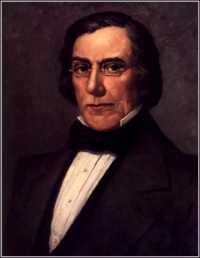
In an effort to avoid publishing the same stale pictures that everyone else posts when discussing the case, I have instead included a picture of Montgomery Blair, one of Dred Scott's attorneys before the United States Supreme Court.