Monday, May 28, 2012

James Madison and the Federal Veto; The Virginia Plan


On Tuesday May 29, 1787, Virginia governor Edmund Randolph "opened the main business" of the Philadelphia Convention by introducing a series of resolutions now known to us as the Virginia Plan.  Although there is no direct evidence as to who authored the resolutions, James Madison's fingerprints are all over it.  As Alison L. LaCroix summarizes in The Ideological Origins of American Federalism

Although the authorship of the plan cannot be determined, the provisions closely tracked Madison's proposals as outlined in his letters to Jefferson, Randolph, and Washington in March and April [1787].

(The letters are identified and linked in my first post on Madison's federal veto.)


Two of the Plan's fifteen resolutions contained provisions relating to a proposed central government veto on state legislation.  The sixth resolution asserted that the proposed "National Legislature" should have the power "to negative all laws passed by the several States, contravening in the opinion of the National Legislature the articles of Union":

6. Resolved that each branch ought to possess the right of originating Acts; that the National Legislature ought to be impowered to enjoy the Legislative Rights vested in Congress by the Confederation & moreover to legislate in all cases to which the separate States are incompetent, or in which the harmony of the United States may be interrupted by the exercise of individual Legislation; to negative all laws passed by the several States, contravening in the opinion of the National Legislature the articles of Union; and to call forth the force of the Union agst. any member of the Union failing to fulfill its duty under the articles thereo.
 The eighth resolution added more detail, calling for a national "council of Revision" that would review both legislative vetoes of state laws and all acts passed by the "National Legislature":

8. Resd. that the Executive and a convenient number of the National Judiciary, ought to compose a Council of revision with authority to examine every act of the National Legislature before it shall operate, & every act of a particular [i.e., State] Legislature before a Negative thereon shall be final; and that the dissent of the said Council shall amount to a rejection, unless the Act of the National Legislature be again passed, or that of a particular Legislature be again negatived by ----- of the members of each branch.

The veto provision of the sixth resolution was initially discussed on Monday June 1, 1787 and passed its first test:

The other clauses giving powers necessary to preserve harmony among the States to negative all State laws contravening in the opinion of the Nat. Leg. the articles of union, down to the last clause, (the words "or any treaties subsisting under the authority of the Union," being added after the words "contravening &c. the articles of the Union," on motion of Dr. FRANKLIN) were agreed to witht. debate or dissent. 
Careful readers will note that the version of the veto contained in the Virginia Plan differed somewhat from that urged by Madison in his pre-Convention letters.  In those letters, Madison had argued that the national legislature should have the power to veto state legislation "in all cases whatsoever"; the Plan limited the veto to those state laws "contravening in the opinion of the National Legislature the articles of the Union."

In fact, the arguments concerning the veto on Friday June 8, 1787 - the next time the veto came up for discussion - give us some reason to believe that the caucus of the Virginia delegation that had produced the Virginia Plan had not been entirely comfortable with Madison's broader version and had restricted it somewhat, against Madison's wishes.

At the outset of debate on June 8 Charles Pinckney of South Carolina moved to modify the provision by granting the legislature the power to veto all state laws "which they should judge to be improper":

Mr. PINKNEY moved "that the National Legislature shd. have authority to negative all laws which they shd. judge to be improper." He urged that such a universality of the power was indispensably necessary to render it effectual; that the States must be kept in due subordination to the nation; that if the States were left to act of themselves in any case, it wd. be impossible to defend the national prerogatives, however extensive they might be on paper; that the acts of Congress had been defeated by this means; nor had foreign treaties escaped repeated violations; that this universal negative was in fact the corner stone of an efficient national Govt.; that under the British Govt. the negative of the Crown had been found beneficial, and the States are more one nation now, than the Colonies were then.
According to Prof. LaCroix, "some scholars suspect" that Madison "collud[ed] with Pinckney (his fellow lodger at Mary House's rooms at the corner of  Fifth and Market streets)".  Not only did Pinckney support the change with the same startling allusion to British practice that Madison had cited in his letters; Madison immediately jumped up and passionately seconded Pinckney's motion.  "[A]n indefinited power to negative legislative actions of the States" was, in Madison's view, "absolutely necessary to a perfect system."  It was the "mildest expedient" that could "controul [sic] the centrifugal tendency of the States" to "continually fly out of their proper orbits and destroy the order and harmony of the political System":

Mr. MADISON seconded the motion. He could not but regard an indefinite power to negative legislative acts of the States as absolutely necessary to a perfect system. Experience had evinced a constant tendency in the States to encroach on the federal authority; to violate national Treaties; to infringe the rights & interests of each other; to oppress the weaker party within their respective jurisdictions. A negative was the mildest expedient that could be devised for preventing these mischiefs. The existence of such a check would prevent attempts to commit them. Should no such precaution be engrafted, the only remedy wd. lie in an appeal to coercion. Was such a remedy eligible? was it practicable? Could the national resources, if exerted to the utmost enforce a national decree agst. Massts. abetted perhaps by several of her neighbours? It wd. not be possible. A small proportion of the Community, in a compact situation, acting on the defensive, and at one of its extremities might at any time bid defiance to the National authority. Any Govt. for the U. States formed on the supposed practicability of using force agst. the unconstitutional proceedings of the States, wd. prove as visionary & fallacious as the Govt. of Congs. The negative wd. render the use of force unnecessary. The States cd. of themselves then pass no operative act, any more than one branch of a Legislature where there are two branches, can proceed without the other. But in order to give the negative this efficacy, it must extend to all cases. A discrimination wd. only be a fresh source of contention between the two authorities. In a word, to recur to the illustrations borrowed from the planetary system. This prerogative of the General Govt. is the great pervading principle that must controul the centrifugal tendency of the States; which, without it, will continually fly out of their proper orbits and destroy the order & harmony of the political System.
 In the next post I will continue to chart the course of the federal veto through the Constitutional Convention.

Sunday, May 27, 2012

James Madison and the Federal Veto: "In all cases whatsoever"


In her book The Ideological Origins of American Federalism lawprof Alison LaCroix explores a series of episodes from the Revolutionary and post-Revolutionary periods illustrating the development of lines of thought justifying the existence of multiple layers of government in order to counter the fundamental British argument that imperium in imperio was a “solecism.” While Prof. LaCroix spends a good deal of time linking the episodes and trying to establish a framework for evaluating the evolution of American arguments about government, I in my simplistic way most enjoyed the book for its descriptions and discussions of particular events and debates

Runner-up among these episodes, in my view, is Prof. LaCroix's chapter on the extrordinary 1773 debate over the nature of sovereignty between Massachusetts Governor Thomas Hutchinson and the colony's legislature (available online in Alden Bradford, et al., eds., Speeches of the Governors of Massachusetts, pp. 336 et seq.).

But the clear winner, I think, is the chapter on James Madison.  Much ink has been spilled over Madison's views concerning government immediately before and at the Philadelphia Convention, but Prof. LaCroix brings home, in a way I have not seen before, how central and essential the power of veto was to Madison's conception of the new federal government.

While I will get to the Virginia Plan itself in the next post, suffice it to say for present purposes that it contained provisions that would have granted the general government the power to veto state legislation.  This proposal, though often noted, is usually regarded as an embarrassment, an odd outlier that Madison stuck in perhaps as a placeholder until a better device to insure federal supremacy could be devised.  But Prof. LaCroix argues convincingly that Madison thought long and hard about the veto power, that it was central to his conception of the new government, and that he was convinced that it was utterly essential to keep the confederacy from flying apart.

I have neither the desire nor the will to parrot Prof. LaCroix's arguments.  However, I thought it would worthwhile to lay out, and provide links to, the key documents that she cites, so interested readers can consider them for themselves.

For convenience, the story begins over the winter of 1786-1787, when Madison, in anticipation of a convention, conducted a wide-ranging historical review of ancient and modern confederacies.  His studies resulted in thirty-nine pages of notes that have come down to us as Of Ancient and Modern Confederacies.  The notes indicate that a principal lesson that Madison drew was that confederacies typically flew apart because the central authority was not strong enough.

For example, Madison listed as the first ""Vice[] of the Constitution" of the Amphyctionic League the fact that "The defect of subjection in the members to the general authority [i.e., the failure of the members to be completely subjected to the general authority] ruined the whole Body."  Concerning the "Helvetic Confederacy," "weakness of the Union" was identified as a Vice.

So too with the "Belgic Confederacy": "The Union of Utrecht imports an authority in the States Genl seemingly sufficient to secure harmony; but the Jealousy in each province of its sovereignty renders the practice very different from the Theory."  And in the "Germanic Confederacy" "Jealousy of the Imperial authority seems to have been a great cement of the Confederacy."

At about the same time, Madison compiled his famous notes on the Vices of the Political System of the United States, which harped again and again on the failure of the states to follow central authority, both directly by ignoring federal commands and indirectly by legislating on matters on national concern and violating the rights of other states. For example:
1. Failure of the States to comply with the Constitutional requisitions.

This evil has been so fully experienced both during the war and since the peace, results so naturally from the number and independent authority of the States and has been so uniformly examplified in every similar Confederacy, that it may be considered as not less radically and permanently inherent in, than it is fatal to the object of, the present System.

2. Encroachments by the States on the federal authority.

Examples of this are numerous and repetitions may be foreseen in almost every case where any favorite object of a State shall present a temptation. Among these examples are the wars and Treaties of Georgia with the Indians--The unlicensed compacts between Virginia and Maryland, and between Pena. & N. Jersey--the troops raised and to be kept up by Massts.

3. Violations of the law of nations and of treaties.

From the number of Legislatures, the sphere of life from which most of their members are taken, and the circumstances under which their legislative business is carried on, irregularities of this kind must frequently happen. Accordingly not a year has passed without instances of them in some one or other of the States. The Treaty of peace--the treaty with France--the treaty with Holland have each been violated.[See the complaints to Congress on these subjects]. The causes of these irregularities must necessarily produce frequent violations of the law of nations in other respects. As yet foreign powers have not been rigorous in animadverting on us. This moderation however cannot be mistaken for a permanent partiality to our faults, or a permanent security agst. those disputes with other nations, which being among the greatest of public calamities, it ought to be least in the power of any part of the Community to bring on the whole.

4. Trespasses of the States on the rights of each other.

These are alarming symptoms, and may be daily apprehended as we are admonished by daily experience. See the law of Virginia restricting foreign vessels to certain ports--of Maryland in favor of vessels belonging to her own citizens--of N. York in favor of the same. Paper money, instalments of debts, occlusion of Courts, making property a legal tender, may likewise be deemed aggressions on the rights of other States. As the Citizens of every State aggregately taken stand more or less in the relation of Creditors or debtors, to the Citizens of every other States, Acts of the debtor State in favor of debtors, affect the Creditor State, in the same manner, as they do its own citizens who are relatively creditors towards other citizens. This remark may be extended to foreign nations. If the exclusive regulation of the value and alloy of coin was properly delegated to the federal authority, the policy of it equally requires a controul on the States in the cases above mentioned. It must have been meant 1. to preserve uniformity in the circulating medium throughout the nation. 2. to prevent those frauds on the citizens of other States, and the subjects of foreign powers, which might disturb the tranquility at home, or involve the Union in foreign contests. The practice of many States in restricting the commercial intercourse with other States, and putting their productions and manufactures on the same footing with those of foreign nations, though not contrary to the federal articles, is certainly adverse to the spirit of the Union, and tends to beget retaliating regulations, not less expensive & vexatious in themselves, than they are destructive of the general harmony.

5. want of concert in matters where common interest requires it.

This defect is strongly illustrated in the state of our commercial affairs. How much has the national dignity, interest, and revenue suffered from this cause? Instances of inferior moment are the want of uniformity in the laws concerning naturalization & literary property; of provision for national seminaries, for grants of incorporation for national purposes, for canals and other works of general utility, wch. may at present be defeated by the perverseness of particular States whose concurrence is necessary.


A principal problem, in short, was that the general government lacked sufficient authority.  And the remedy, Madison strongly implied, was a grant of power to coerce and restrain the states:
7. want of sanction to the laws, and of coercion in the Government of the Confederacy.

A sanction is essential to the idea of law, as coercion is to that of Government. The federal system being destitute of both, wants the great vital principles of a Political Constitution. Under the form of such a Constitution, it is in fact nothing more than a treaty of amity of commerce and of alliance, between so many independent and Sovereign States. From what cause could so fatal an omission have happened in the articles of Confederation? from a mistaken confidence that the justice, the good faith, the honor, the sound policy, of the several legislative assemblies would render superfluous any appeal to the ordinary motives by which the laws secure the obedience of individuals: a confidence which does honor to the enthusiastic virtue of the compilers, as much as the inexperience of the crisis apologizes for their errors. The time which has since elapsed has had the double effect, of increasing the light and tempering the warmth, with which the arduous work may be revised. It is no longer doubted that a unanimous and punctual obedience of 13 independent bodies, to the acts of the federal Government, ought not be calculated on. Even during the war, when external danger supplied in some degree the defect of legal & coercive sanctions, how imperfectly did the States fulfil their obligations to the Union? In time of peace, we see already what is to be expected. How indeed could it be otherwise? In the first place, Every general act of the Union must necessarily bear unequally hard on some particular member or members of it. Secondly the partiality of the members to their own interests and rights, a partiality which will be fostered by the Courtiers of popularity, will naturally exaggerate the inequality where it exists, and even suspect it where it has no existence. Thirdly a distrust of the voluntary compliance of each other may prevent the compliance of any, although it should be the latent disposition of all. Here are causes & pretexts which will never fail to render federal measures abortive. If the laws of the States, were merely recommendatory to their citizens, or if they were to be rejudged by County authorities, what security, what probability would exist, that they would be carried into execution? Is the security or probability greater in favor of the acts of Congs. which depending for their execution on the will of the state legislatures, wch. are tho’ nominally authoritative, in fact recommendatory only.
By late March 1787, Madison's studies had already led him to the tentative conclusion that "this political experiment" (the anticipated Philadelphia Convention) had to recommend a device by which the states were subjugated to "the federal head."  In a letter dated March 19, 1987 to Thomas Jefferson Madison identified this device as the power to veto local legislation "in all cases whatsoever" (emphasis in the original):
2dly. Over and above the positive power of regulating trade and sundry other matters in which uniformity is proper, to arm the federal head with a negative in all cases whatsoever on the local Legislatures. Without this defensive power, experience and reflection have satisfied me that, however ample the federal powers may be made, or however clearly their boundaries may be delineated on paper, they will be easily and continually baffled by the Legislative sovereignties of the States. The effects of this provision would be not only to guard the national rights and interests against invasion, but also to restrain the States from thwarting and molesting each other; and even from oppressing the minority within themselves by paper money and other unrighteous measures which favor the interest of the majority. In order to render the exercise of such a negative prerogative convenient, an emanation of it must be vested in some set of men within the several States, so far as to enable them to give a temporary sanction to laws of immediate necessity.
 By early April 1787, Madison was pressing the same line of thought on Virginia delegate and Governor Edmund Randolph, whose views would carry great weight within the delegation.  In a letter to Randolph dated April 8, 1787  Madison argued that it would be insufficient for "the national Government [to] be armed with a positive and complete authority in all cases where uniform measures are necessary, as in trade, &c., &c."  A power to veto state legislation "in all cases whatsoever" was also required:
Let it [the national Government] have a negative, in all cases whatsoever, on the Legislative acts of the States, as the King of Great Britain heretofore had. This I conceive to be essential and the least possible abridgement of the State sovereignties.  Without such a defensive power, every positive power that can be given on paper will be unavailing. It will also give internal stability to the States. There has been no moment since the peace at which the Federal assent would have been given to paper-money, &c., &c.
And in mid-April Madison turned his lobbying efforts to the single most important delegate, George Washington, whose attendance Madison now anticipated.  In a letter to Washington dated April 16, 1787 Madison took "the liberty of submitting . . . without apology to your eye" "some outlines of a new system" concerning "the subject which is to undergo the discussion of the Convention."

As in his letter to Gov. Randolph, Madison argued to Washington that it was necessary but not sufficient that "the national Government should be armed with positive and compleat authority in all cases which require uniformity; such as the regulation of trade, including the right of taxing both exports & imports, the fixing the terms and forms of naturalization, &c &c."  In addition, a veto over state laws "in all cases whatsoever" was required (emphasis in original):
Over and above this positive power, a negative in all cases whatsoever on the legislative acts of the States, as heretofore exercised by the Kingly prerogative, appears to me to be absolutely necessary, and to be the least possible encroachment on the State jurisdictions. Without this defensive power, every positive power that can be given on paper will be evaded & defeated. The States will continue to invade the National jurisdiction, to violate treaties and the law of nations & to harass each other with rival and spiteful measures dictated by mistaken views of interest. Another happy effect of this prerogative would be its controul on the internal vicissitudes of State policy, and the aggressions of interested majorities on the rights of minorities and of individuals. The great desideratum which has not yet been found for Republican Governments seems to be some disinterested & dispassionate umpire in disputes between different passions & interests in the State. The majority who alone have the right of decision, have frequently an interest, real or supposed in abusing it. In Monarchies the sovereign is more neutral to the interests and views of different parties; but, unfortunely he too often forms interests of his own repugnant to those of the whole. Might not the national prerogative here suggested be found sufficiently disinterested for the decision of local questions of policy, whilst it would itself be sufficiently restrained from the pursuit of interests adverse to those of the whole Society. There has not been any moment since the peace at which the representatives of the Union would have given an assent to paper money or any other measure of a kindred nature.
Madison's extraordinary directness in his letters to Randolph and Washington only emphasizes how critical he viewed the veto to be.  He had to have both men on his side to give his plan any hope of success, and he was utterly frank with them.  He explicitly admitted to both correspondents that the provision was based upon the example of the veto that the King of Great Britain had held over the acts of colonial legislatures, the source of which had been the 1696 Act for preventing Frauds and regulating Abuses in the Plantation Trade:
And itt is further enacted and declared by the Authority aforesaid That all Lawes By-lawes Usages or Customes att this tyme or which hereafter shall bee in practice or endeavoured or pretended to bee in force or practice in any of the said Plantations which are in any wise repugnant to the before mentioned Lawes or any of them soe far as they doe relate to the said Plantations or any of them or which are wayes repugnant to this present Act or to any other Law hereafter to bee made in this Kingdome soe farr as such Law shall relate to and mention the said Plantations are illegall null and void to all Intents and Purposes whatsoever.
It is hard to imagine a precedent more likely to arouse objection and suspicion among other colonists, except perhaps for the despised Declaratory Act of 1766, which Madison's language also recalled (emphasis added):
Whereas several of the houses of representatives in His Majesty's colonies and plantations in America have of late, against law, claimed to themselves, or to the general assemblies of the same, the sole and exclusive right of imposing duties and taxes upon His Majesty's subjects in the said colonies and plantations; and have, in pursuance of such claim, passed certain votes, resolutions, and orders derogatory to the legislative authority of Parliament, and inconsistent with the dependency of the said colonies and plantations upon the crown of Great Britain: may it therefore please Your Most Excellent Majesty that it may be declared, and be it declared by the king's Most Excellent Majesty, by and with the advice and consent of the Lords Spiritual and Temporal, and Commons, in this present Parliament assembled, and by the authority of the same, That the said colonies and plantations in America have been, are, and of right ought to be, subordinate unto, and dependent upon the imperial crown and Parliament of Great Britain; and that the king's Majesty, by and with the advice and consent of the Lords Spiritual and Temporal, and Commons, of Great Britain, in Parliament assembled, had, hath, and of right ought to have, full power and authority to make laws and statutes of sufficient force and validity to bind the colonies and people of America, subjects of the crown of Great Britain, in all cases whatsoever.

II. And be it further declared and enacted by the authority aforesaid, That all resolutions, votes, orders, and proceedings, in any of the said colonies or plantations, whereby the power and authority of the Parliament of Great Britain to make laws and statutes as aforesaid is denied, or drawn into question, are, and are hereby declared to be, utterly null and void to all intents and purposes whatsoever.
In succeeding installments I will look at the Virginia Plan and Madison's battles to retain and expand the veto power during the Convention.

Saturday, May 05, 2012

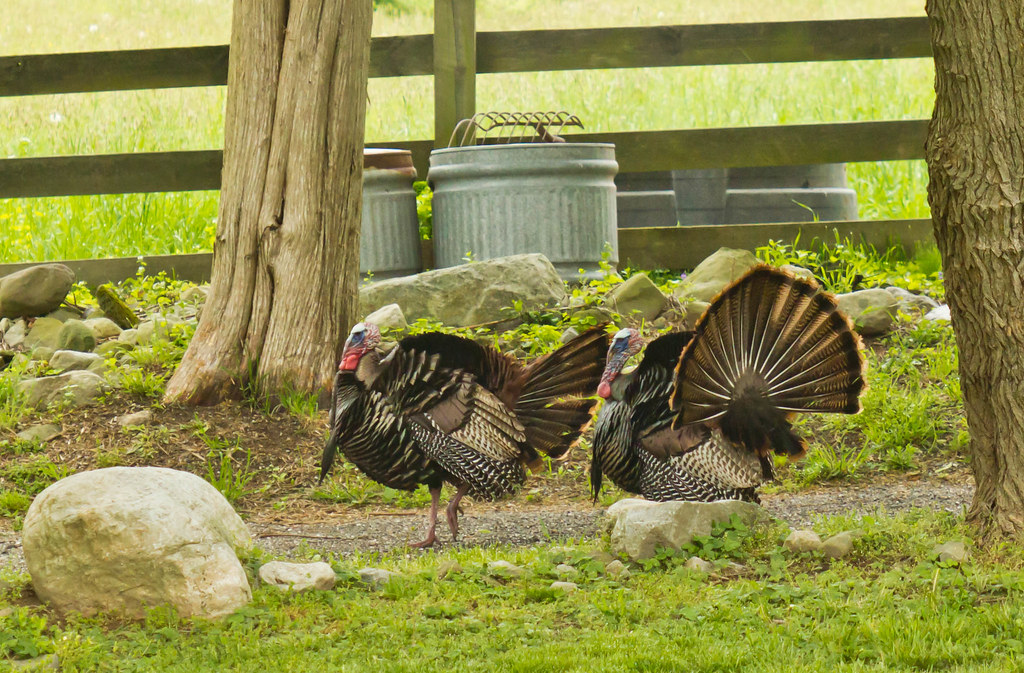
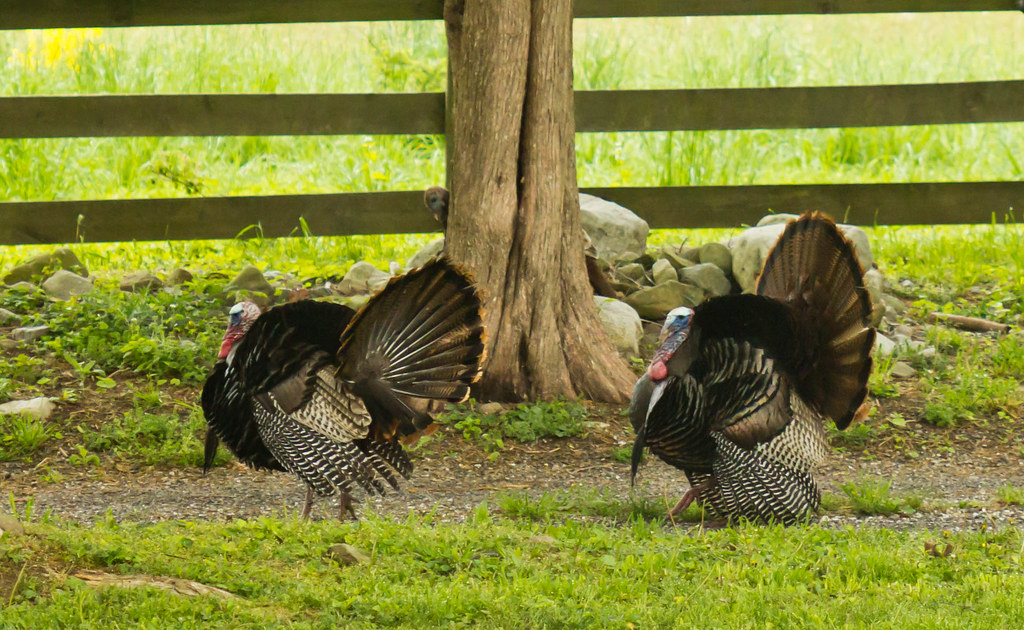
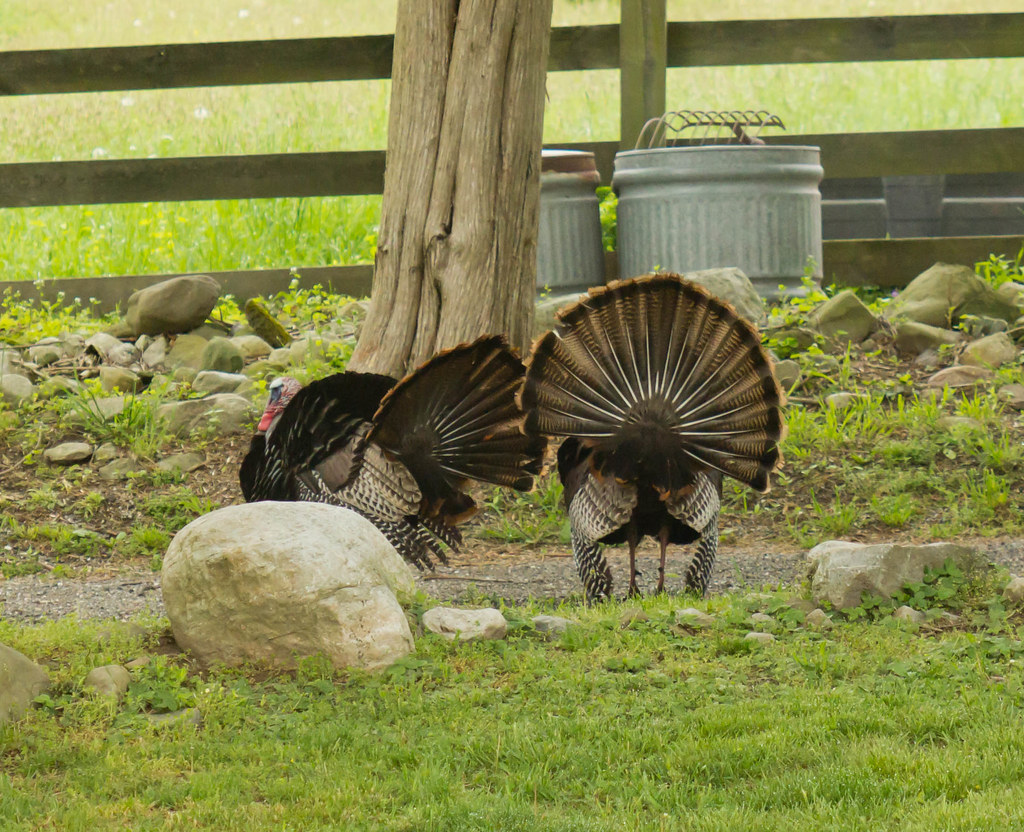
Turkeys Displaying


After several weeks of cool. damp weather, spring sprang yesterday afternoon, with temperatures shooting into the 70s.  This morning, the local wildlife responded by going crazy.  When I walked outside about 5:00 a.m., there were two large racoons, deer, turkeys, and songbirds making a racket.


A couple of hours later the turkeys were still hanging around - two males and three females (I think).  The males were showing off, and the females (not shown) were pretending to ignore them, although every once in a while they'd take a discreet peek.  I think the guy on the right is going to be the winner, since he has the biggest . . . tail.


Not great pictures - they were taken from some distance through a window that wasn't exactly clean, but what the heck.


It's Caturday!


And Ariadne says, "Let's roll!"

William Henry Chase Has His Habeas Suspended


You may know that in the beginning months of the Civil War President Lincoln issued a series of directives suspending the writ of habeas corpus.  Most of the suspensions were geographically defined (e.g., "at any point on or in the vicinity of the [any] military line, which is now [or which shall be] used between the City of Philadelphia and the City of Washington, via Perryville, Annapolis City, and Annapolis Junction").

But did you know that one suspension was directed toward a single individual?  On June 20, 1861 Lincoln sent a letter to Gen. Winfield Scott authorizing the suspension of habeas as to one "Major Chase, lately of the Engineer Corps":

To Winfield Scott

State Department, June 20, 1861.

The Lieutenant-General Commanding the Armies of the United States: You or any officer you may designate will, in your discretion, suspend the writ of habeas corpus so far as may relate to Major Chase, lately of the Engineer Corps of the Army of the United States, now alleged to be guilty of treasonable practices against this government.  ABRAHAM LINCOLN.

By the President:

WILLIAM H. SEWARD

So who was "Major Chase"?  The Lincoln Log identifies him as  "Major William Henry Chase [, who] resigned from the U.S. Army, October 31, 1856.  In 1861 he was commissioned colonel and major general of Florida state troops in the Confederate Army."

Wikipedia has an entry on Chase, although, strangely, it does not mention his unique recognition by the president.  Born in 1798, Chase was 63 years of age at the beginning of 1861.  Wikipedia describes his activities in Florida at the time of that state's secession that presumably resulted in Lincoln's order:

As the outset of Civil War became inevitable in January 1861, Chase sided with the Confederate partisans in Pensacola and was commissioned a colonel in the Florida militia. On January 8, two days before Florida officially seceded from the Union, Florida Governor Madison S. Perry authorized Chase to seize all federal forts in Pensacola. He was active in securing the surrender of the Navy Yard on January 12. On January 15, he and a small party rowed out to Fort Pickens, where Union forces had relocated, to demand surrender from Lieutenant Adam Slemmer. As recounted by J. H. Gilman, Chase said the following to Slemmer:


 "… It is a most distressing duty to me. I have come to ask of you young officers, officers of the same army in which I have spent the best and happiest years of my life, the surrender of this fort. I would not ask it if I did not believe it right and necessary to save bloodshed; and fearing that I might not be able to say it as I ought, and in order, also, that you may have it in proper form, I have put it in writing and will read it." He then took the manuscript from his pocket and began to read, but, after reading a few lines, his voice shook, and his eyes filled with tears. He stamped his foot, as if ashamed of exhibiting such weakness, and said, "I can't read it. Here, Farrand, you read it."

After the demand for surrender was read, Slemmer and Chase discussed what chance of success the 800 Confederate troops would have in seizing Pickens by force. Chase insisted that a defense would be futile:

"I could carry it by storm. I know every inch of this fort and its condition. … If you have made the best possible preparations, as I suppose you have, and should defend it, as I presume you would, I might lose one-half of my men. … You must know very well that, with your small force, you are not expected to, and cannot, hold this fort. Florida cannot permit it, and the troops here are determined to have it; and if not surrendered peaceably, an attack and the inauguration of civil war cannot be prevented. If it is a question of numbers, and eight hundred is not enough, I can easily bring thousands more."

Slemmer refused to surrender and held the fort until reinforcements could arrive. Pickens remained under Union control throughout the war.

Chase was promoted to brigadier general and later major general of the Florida forces, but due to his age and health, he had little active role in the war.

He died at his home at the southwest corner of Palafox and Wright Streets (now the site of Episcopal Day School) on February 8, 1870.
 In Justice in Blue and Gray: A Legal History of the Civil War, Stephen C. Neff observes that Chase "thereby obtained whatever degree of immortality a footnote is capable of conferring."

Monday, April 30, 2012

The Panic of 1837: Two Online Articles

 
As I've suggested before, the causes of the Panic of 1837 remain under debate.  For many years, the weight of historical thinking tended to embrace the Whig viewpoint and place the blame squarely on the shoulders of Andy Jackson and the locofocos.  Some combination of Jackson's war on the Second Bank of the United States, his transfer of United States deposits to the Pet Banks, and in particular the Specie Circular destabilized the money supply, resulting in a massive economic collapse.

Then the weight of historical opinion shifted more or less 180 degrees, absolving Jackson of all responsibility.  Foreign events entirely outside Jackson's control, and in particular a decision by the Bank of England to increase the discount rate on American paper in an attempt to reign in a perceived specie drain from the UK to the US, led to a catastrophic decrease in the availability of credit in the US.

Most recently, however, the pendulum has been swinging back: Jackson's actions were, in fact, at the heart of the crisis.  All of which leads me to the point of this post. I recently ran into a couple of articles, available online, which are well worth a read if you're interested in information about the Panic.

The first is Jessica Lepler's The Pressure of 1836: The International Origins of the Panic in 1837 (2007).  Prof. Lepler is reportedly preparing a book on the Panic, based upon her Ph.D. thesis on the subject.  The article in question, while perhaps less ambitious, nonetheless provides some fascinating details of the events occurring in London during 1836 and 1837.  In brief, the article does not purport to grapple exactly with the underlying domestic-or-foreign debate, but instead assumes that the Bank of England's actions were central.  But having said that, Prof. Lepler shows how the actions and rhetoric of Jackson and Jackson partisans (or is that partizans?) helped to create the perception in the UK that the US money supply was approaching a crisis.  To the extent that perception and confidence are reality in the economic world, Andy Jackson contributed.

More radical is Peter L. Rousseau's article entitled Jacksonian Monetary Policy, Specie Flows, and the Panic of 1837.  Prof. Rousseau rejects the thesis that the BOE was a principal cause of the Panic, citing among other things timing issues.  Instead he returns to a variant of the older thesis.  Jacksonian legislation and policies  resulted in a dramatic outflow of specie from New York Pet Banks, which held only $1.5MM of specie on May 1,  1837.  When bank runs on May 8 and 9 removed $1.3MM of specie, the banks suspended payments, and events cascaded from there.

About the illustration, entitled Capitol Fashions for 1837 (New York 1837):
A caricature of President Martin Van Buren issued during the Panic of 1837, strongly critical of his continuation of predecessor Andrew Jackson's hard-money policies. Particular reference is made to the Specie Circular, a highly unpopular order issued by the Jackson administration in December 1836, directing collectors of public revenues to accept only gold or silver (i.e., "specie") in payment for public lands. Designed to curb speculation, the measure was blamed by administration critics for draining the economy of hard money and precipitating the 1837 crisis. Hearkening back to the anti-Jackson "King Andrew the First" (no. 1833-4), the artist portrays Van Buren as a monarch in a princely cloak, treading on the Constitution. He is crowned "in the name of Belzebub . . . Ragamuffin king" by a demon. Van Buren's cloak is trimmed with "shinplasters," the colloquial term for the often worthless small-denomination bank notes which proliferated during the panic. Van Buren says, "I like this cloak amazingly, for now I shall be able to put into execution my Designs without being observed by every quizing, prying Whig. I'm obliged to keep close since my Safety Fund is blown . . ." Under the Safety Fund law, passed during Van Buren's term as governor of New York, banks were required to contribute to a fund used to liquidate the obligations of banks that failed. The fund was quickly exhausted during the panic. On the walls are pictures of "Bequests of the Late Incumbent" (Andrew Jackson), including "The Hickory Stick," worshipped by the masses like the brazen serpent in the Old Testament, Jackson's spectacles and clay pipe, his hat, the Safety Fund balloon in flames, and "the Last Gold Coin," minted in 1829 (the year Jackson first took office). On the wall at right is a headless statue of Jackson holding a "veto" in his right hand (an allusion to Jackson's 1832 veto of a bill to recharter the Bank of the United States). Visible through a window is a street scene where a crowd mobs a theater exhibiting "a Real Gold Coin." Beneath Van Buren's feet are several documents, including the Specie Circular and "petitions," the missives from New York bankers and merchants which deluged the White House calling for repeal of the Circular. A document labeled "Indian claims" refers to another unpopular Jackson legacy: the numerous grievances by tribes like the Cherokees and Seminoles regarding unfair and inhumane government treaties by which they were being displaced and deprived of their lands.

Saturday, April 28, 2012

It's Caturday!

IMG_1278.jpg

And Ariadne wants to sleep the day away.

Friday, April 27, 2012

"He sees to the salvation of your hen"


Having posted recently about sacred pagan chickens, I was delighted to run across a fowl reference in a post-pagan Christian setting.  It appears in Ramsay MacMullen's Christianity and Paganism in the Fourth to Eighth Centuries, in the midst of a discussion of the tendency of Christians in the period to address their prayers to saints and martyrs, rather than to God himself.  The good professor sees this as a continuation of the practice of common people in the pagan world to seek relief from deities less august than the major Olympians, who were too distant and unmindful of the smaller folk:
For, by their own act [conversion to Christianity], they [common folk] found themselves without gods.  A strange way to put it.  Surely they understood that the one Omnipotence was enough.  But no, the answer was overwhelmingly no.  This was because the concerns of little people were little, and they were therefore not accustomed to apply to Jupiter or Zeus for succor; nor to Jahweh, after conversion. Like the great Lex, they thought, great gods care nothing de minimis; great gods were lords and masters, not the fathers they hoped to appeal to . . ..  Conversion and the repudiation of their old patrons and rescuers among the divine ranks had left an emptiness, a loneliness in times of trouble, not comfortably to be filled by the Power preached from urban pulpits.
Fighting against this, Church fathers such as Augustine sought to reassure the members of their flock that God was both infinite and mindful of their most mundane cares (emphasis added):
We find Augustine again and again contesting his congregation's doubts whether God should be bothered about affairs of everyday life.  "There are those who say God is good, great, the top, beyond our perception, incorruptible, who will give us eternal life and that incorruptibility which he has promised in the resurrection, while temporal matters and matters of this world belong to daemones," to superhuman beings of a lower order . . ..  Yet, Augustine insists, God heals both man and beast, yes, even your flocks and herds..  "Let us reduce it to the very least things; he sees to the salvation of your hen."
We then meet Saint Germanus of Auxerre (c. 378 - c. 448), "who almost met Augustine's challenge, ministering not to a hen but to a rooster which had somehow lost its cock-a-doodle-doo."

The photo of the beautiful fresco of Saint Germanus healing the roosters is from this site.


Greek Mythology in the News!


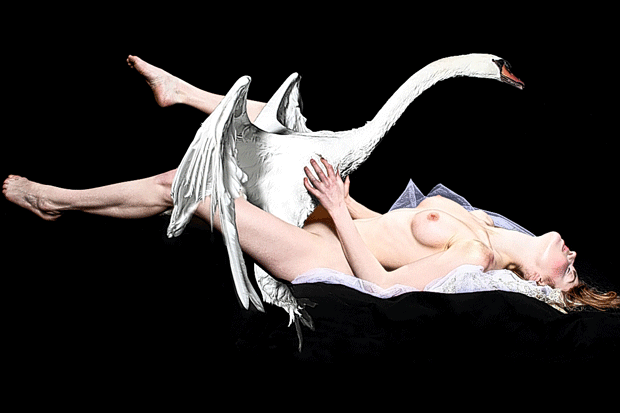
There were no complaints from the public when a Mayfair gallery exhibited a dramatic modern rendering of the ancient Greek myth of Leda and the swan in its window.

But the sensitive souls of the Metropolitan Police took a different view when they spotted Derrick Santini’s photograph of a naked woman being ravished by the bird.

An officer took exception as he passed the Scream gallery in Bruton Street on a bus. He alerted colleagues and two uniformed officers from Harrow arrived to demand the work be removed.

Jag Mehta, sales director at the gallery owned by Rolling Stone Ronnie Wood’s sons Tyrone and Jamie, said: “We asked them what the problem was and they said it suggested we condoned bestiality, which they said was an arrestable offence.
Thank God they didn't have any of these versions in the window. Or this. Or this.

Even the Romans Didn't Crucify Their Own Citizens


As I'm sure you know by now, a videotape recently caught an Obama EPA Administrator boasting that he modeled his enforcement philosophy on ancient Roman practice:
The Romans used to conquer little villages in the Mediterranean. They'd go into a little Turkish town somewhere, they'd find the first five guys they saw and they would crucify them. And then you know that town was really easy to manage for the next few years.
Putting aside the anachronistic reference to "Turkish" towns, there is a far more significant irony embedded in the comment: the Romans didn't crucify their own citizens.

Thursday, April 26, 2012

"Let them drink, since they won't eat"


Having recently discussed gluttony and hurling, I thought I'd turn briefly to their opposite - refraining from eating and hurling.  This story is pretty well known and you may be familiar with it already.  But it's one of my absolute favorites, so I just can't resist.

During the First Punic War the Romans, historically a nation of landlubbers, had managed to construct a navy from scratch and win a series of victories at sea against the Carthaginians, the preeminent naval power of the western Mediterranean.

Publius Claudius Pulcher, was the bluest of Roman bluebloods.  His patrician family, the Claudii, boasted of consular ancestors going back to Appius Claudius Sabinus Regillensis, who served as Consul in 495 BC.  Some 250 years later, in 249 BC, Appius' descendant Publius was also elected Consul.  Rome was then engaged in a vicious and longstanding (since 264 BC) grudge match with the Carthaginians, principally over the island of Sicily, known as the First Punic War.  Historically a nation of landlubbers, the Romans had somehow managed to construct a fleet from scratch and win a series of naval victories over the Carthaginians, the preeminent naval power in the western Mediterranean.


Along with his consulship in 249 BC our proud, pretty Publius ("Pulcher" meant "handsome" in Latin}was awarded command of a substantial Roman fleet, some 224 vessels strong  He proceeded to direct it to the Sicilian town of Lilybaeum, at the western point of the island, which a Roman army was then besieging.

Thirsty for glory, Publius had no intention of remaining in a supporting role.  At his insistence his fleet then set out for the harbor of Drepanum, about twenty five miles up the coast, where the Carthaginian fleet was based.  Preparing to engage, the Romans determined, in accordance with custom, to consult the sacred chickens carried in cages aboard Publius' flagship to insure that the omens were favorable.

Now the deal with the sacred chickens was pretty basic.  You let them out of their cages and threw some grain or feed on the ground (or, in this case, deck).  If they ate, the omens were good; if they didn't, watch out!  As the description suggests, the whole thing seems to have been fairly manipulable.  You want the sacred chickens to eat, well, just starve them a little beforehand.  And so it usually went.

Not today, however.  The chickens were let out from their cages, the grain was scattered - and the damned things wouldn't eat.  Maybe they were seasick.  But for whatever reason, the omens were bad, bad, bad.  The frickin' chickens' refusal to eat meant that the battle would be a disaster for the Romans.  Publius would have to break off contact and return to Lilybaeum.


The proud Publius, however, refused to take no for an answer.  No frickin' chickens (sorry, I can't resist) were going to humiliate him and deprive him of military glory.  Rather than withdraw with his tail between his leg, he promptly had the sacred chickens tossed overboard into the sea, uttering the immortal words, "Let them drink, since they won't eat" (Bibant, quoniam esse nolunt).

Two of our three sources for this wonderful story are Cicero and the biographer Suetonius,  Cicero describes the scene in his De Natura Deorum (On the Nature of the Gods):
Nihil nos P. Clodi bello Punico primo temeritas movebit, qui etiam per iocum deos inridens, cum cavea liberati pulli non pascerentur, mergi eos in aquam iussit, ut biberent, quoniam esse nollent? Qui risus classe devicta multas ipsi lacrimas, magnam populo Romano cladem attulit.

Will the presumptuousness of Publius Claudius during the First Punic War trouble us not at all?  He mocked the gods only in jest.  When the sacred chickens were taken from their cage and would not feed, he ordered them to be thrown into the water so they would drink, since they chose not to eat.  Followed as it was by the defeat of his fleet, his ridicule cost him many tears and brought great calamity to the Roman people.
Suetonius recounts his similar version in his Life of the emperor Tiberius (who was also a member of the Claudian gens):
Claudius Pulcher apud Siciliam non pascentibus in auspicando pullis ac per contemptum religionis mari demersis, quasi ut biberent quando esse nollent, proelium navale iniit; superatusque, cum dictatorem dicere a senatu iuberetur, velut iterum inludens discrimini publico Glycian viatorem suum dixit.

Claudius Pulcher began a sea-fight off Sicily, though the sacred chickens would not eat when he took the auspices, throwing them into the sea in defiance of the omen, and saying that they might drink, since they would not eat. He was defeated, and on being bidden by the senate to appoint a dictator, he appointed his messenger Glycias, as if again making a jest of his country's peril.


Our prnicipal source for the battle is the historian Polybius, who recounts it at some length in Book 1 of his Histories.  The fact that Polybius, who was writing only some 100 years after the event, fails to mention our Felicitous Fowl in his detailed account has led some to conclude that the story is apocryphal.  I would note, however, that Livy, too, apparently included the tale in his account. Book XIX (19) of Livy's History of Rome (Ab Urbe Condita Libri) has been lost, but a Fourth Century summary or epitome of the Book, known as the Periochae, includes a reference to the Sacred Squabs:
Consul Claudius Pulcher fought without success against the Carthaginian navy after evil omens (he had ordered the holy chickens to be drowned, which refused to eat). He was recalled by the Senate, ordered to appoint a dictator, and chose Claudius Glicia, a man of the lowest kind. Although he was forced to lay down his office, he afterwards attended the games in a purple-bordered toga.

Claudius Pulcher cos. contra auspicia profectus (iussit mergi pullos, qui cibari nolebant) infeliciter adversus Carthaginienses classe pugnavit, et revocatus a senatu iussusque dictatorem dicere Claudium Gliciam dixit, sortis ultimae hominem, qui coactus abdicare se magistratu postea ludos praetextatus spectavit.


The sources uniformly attest that the Holy Hens proved prescient.  The Romans suffered a catastrophic defeat.  Polybius records that in the ensuing Battle of Drepanum the Romans lost of 93 of 124 ships, with only about 31 escaping.

The defeat was also a disaster  for Publius personally.  Although his flag ship was one of the 31 that managed to slip away, Polybius records his subsequent public trial (perhaps for incompetence or impiety or both) and disgrace:
Publius . . . fell into ill repute among the Romans, and there was a great outcry against him for having acted rashly and inconsiderately and done all a single man could to bring a great disaster on Rome.  He was accordingly brought to trial afterwards, condemned to a heavy fine, and narrowly escaped with his life.

Tuesday, April 24, 2012

Did Muhammad Exist?


I'm guessing you find this review of Robert Spencer's Did Muhammad Exist? as surprising as I did.

The Early Middle Ages, 284-1000


When I drive- which is most days - I usually listen to lectures or podcasts downloaded from iTunes.  I recently finished an excellent Yale course that deserves a recommendation: Paul H. Freedman's The Early Middle Ages, 284-1000.  As the title indicates, the course covers the period from the accession of Diocletian (with a prequel on the Crisis of the Third Century) through the demise of the Carolingian Empire and the arrival of the Vikings.  Prof. Freedman clearly loves the age, and his well-constructed lectures guide his students through the difficult material with care and a dose of humor that had me laughing out loud more often than I care to admit.

Earlier recommendations are here.

Sunday, April 22, 2012

The Persistence of Paganism


Ramsay MacMullen has an encyclopedic knowledge of the Roman empire and early medieval world.  But what sets him apart is his ability to mine obscure texts for asides or offhand comments, and then use those fragments to illustrate fundamental point about the society.

A case in point.  In Christianity & Paganism in the Fourth to Eighth Centuries Prof. MacMullen uses a minor work of Gregory of Tours (c. 538-594) to demonstrate the stubborn persistence of paganism among the country folk in southern Gaul well into the Sixth Century. In a work called Vitae Patrum (Lives of the Fathers), a frustrated Gregory recounted a voyage in which he was the only Christian amidst a sea of pagans.  Prof. MacMullen sets the stage:
The depth of Christian belief had perhaps always been limited and the evidence of conversion . . . easy to exaggerate.  Even from the longest-evangelized, most completely church-ed area down to Provence, in the 580s, when a man took passage on a vessel bound for Italy, he might find "a great crowd of pagans getting aboard along with me, among all of whom, that crowd of country people, I was the only Christian."
Many would have skimmed over Gregory's observation without a second thought.  Prof. MacMullen spells out the implications:
The incident is very revealing, not least in the matter-of-fact tone of the narrative.  It fits easily with all the other evidence accumulated in the notes above, showing in still more advanced periods the persistence of this or that pagan custom, the survival of one or another ancient rite. 

The History of English in 10 Minutes


Fun!

H/T Anne Althouse.

Saturday, April 21, 2012

"The Compromise of 1850 must be judged a success"


I have also discussed in more than one post whether the Compromise of 1850 was a good thing or bad thing.  This breaks down, as I see it, into essentially two counterfactual questions.  Would war have erupted in 1850 or 1851 if the Compromise had failed?  And, if so, would the North have won?

In his new book on the Compromise, Fergus M. Bordewich answers the first question in the affirmative, the second in the negative.  He therefore concludes that "the Compromise must be judged a success."  (He qualifies this with the proviso, "albeit a temporary one," but that's another story. Millard and the other men who crafted the Compromise in 1850 had no way of predicting, for example, Bloody Kansas.)

As to the first issue, Bordewich has no doubt that "[f]ailure . . . meant war."  As I have argued before, he is convinced that the first shots would have been fired in Santa Fe.  But even a desultory border scrimmage between Texas and U.S. forces or New Mexican militia would have drawn in volunteers from other southern states and widened into a general war:

Failure would have meant war, with its first shots fired at Santa Fe instead of Fort Sumter.  Even if Texas had suffered an initial defeat, southerners were ready to rush to her aid. . . .  Large numbers of southerners had come to accept secession as politically reasonable, economically rational, and morally justified.

Intertwined with this issue is Bordewich's response to the second question.  The North would have lost, he maintains, primarily because it would not have put up a serious fight:

The North, if it had any stomach for war at all in 1850, would likely have lost. . . .  [F]ew northerners . . . were prepared to fight a war for the Union, much less to end slavery.  There was nothing in the North to compare with the flaming war fever that was epidemic in the newspapers of the South, and the fiery letters that war-hungry men from South Carolina to Mississippi sent to the leaders of Texas, begging for a chance to fight for slavery.

During the 1850s northern industrial resources grew by leaps and bounds.  Although this may also have contributed to the Union's victory a decade, but the crucial difference was "will":

During the decade that was purchased by the Compromise of 1850, the North's advantages in population, industrial production, and transportation steadily grew. . . .  But it took more to win the Civil War than factory output: it required will.  In the course of the 1850s, as slavery continued to gnaw at the nation's political vitals [other southern outrages omitted]. white Americans [in the North] increasingly understood that the erosion of their own rights was tied to the fate of enslaved blacks . . ..

Finally, Bordewich evocatively describes what might have happened if northerners like President Fillmore had taken the moral high road in 1850 and lost:

Had secession taken place peacefully in 1850, the South would have set a precedent that in time might well have splintered what remained of the United States still further.  The United States might then have evolved into a congeries of states - a Pacific Republic, a federation of New England, another of the upper Midwest - competitive with one another, vulnerable to foreign interference, and perhaps chronically at war.  A truncated United States would never have become a globe-striding power, or a beacon of liberty for the rest of the world, but more likely a second-tier state like Germany or France. . . .  That none of this happened, we owe to the compromisers of 1850.

Why Millard Blew It


While Erik worries about more important things, such as whether this phenomenon creates an incentive for modern-day presidents to start wars, I of course am fixated on Millard Fillmore.

Millard, as you know, gets hammered as a cross between a nebbish and the anti-Christ for facilitating and signing the bills that are collectively known as the Compromise of 1850. If only he'd sabotaged the Compromise and started a war that killed as many as died starting eleven years later.  Then maybe he'd be as revered as the Railsplitter!

"Anyone who thought that Fillmore lacked spine was now disabused"


I have explained in a number of previously published posts how Millard Fillmore's firm and decisive actions in early August 1850 formed the basis for resolution of the crisis that had been building for four years, ever since David Wilmot had introduced his fateful Proviso in August 1846.  In a nutshell (see the posts linked above for more detail), the newly-installed president made clear to the State of Texas that the federal government would fight if state forces attacked the New Mexico territory.

In his newly-published book America's Great Debate: Henry Clay, Stephen A. Douglas, and the Compromise That Preserved the Union, Fergus M. Bordewich points out the guts that this move took:
The following day, August 6 [1850], Fillmore sent his own message to Congress.  [Secretary of State Daniel] Webster may have contributed to it, but to give the president his due, anyone who thought that Fillmore lacked spine was now disabused.  A weak man might well have capitulated to the Texans: Fillmore dug in his well-polished boots.  The president declared unequivocally that New Mexico was federal territory, and that Texas enjoyed no rights or powers beyond her state limits.  "If Texas militia march into any of other States or into any Territory of the United States, there to execute or enforce any law of Texas, they become at that moment trespassers; they are no longer under the protection of any lawful authority, and are to be regarded merely as intruders," he declared.  Should the laws of the United States be opposed or obstructed in any way, it was his duty as commander-in-chief to employ the armed forces as they were needed.

The response to Fillmore's message, especially from northerners in Congress, was highly favorable; from Newport [Rhode Island], Henry Clay sent a telegram offering the president his full support.  The sleekly groomed Fillmore might not be the soldier that hard-edged [Zachary] Taylor had been, but his meaning was equally unmistakable: the United States was ready to go to war.


The president's message shifted the focus from the California issue to Texas-New Mexico.  And the combination of the president's "stick" and the "carrot" represented by the Texas bond bill did the trick:
The real question was: what would [the two Texas senators, Thomas Jefferson Rusk and Sam Houston] do?  Without their support, no compromise would work. . . .  Both . . . knew that federal troops were en route to New Mexico, that the president was firmly committed to resist an invasion, and that without the camouflage of the Omnibus Texas stood no chance of winning congressional recognition for its entire elephantine claim.  Some Texans were also having second thoughts.  "It is unpleasant to impoverish the state and tax our people with insupportable burthens to make war against the U.S. although it is as we all know on our soil," one uneasy constituent wrote to Rusk.
It was over within a matter of days.  On August 9 Rusk and Houston announced their support for the Texas-New Mexico measures.  That day, Stephen Douglas' motion for a third reading of the bill squeaked by, 27 to 24.  "[T]he Texans had tipped the balance."  The final vote on the bill, later that evening, "was decisive, if anticlimactic": 30 votes to 20.

About the illustration at the top, entitled Capability and Availability:
Sharply critical of both the Democratic and Whig choice of presidential candidates in 1852, the artist laments the nomination of two soldiers, Winfield Scott (center) and Franklin Pierce (far right), in preference to several more "capable" statesmen who appear at left. The latter are (left to right): Samuel Houston, John J. Crittenden, Thomas Hart Benton, Millard Fillmore, John Bell, Lewis Cass, Stephen A. Douglas, and Daniel Webster. Most prominent in the group are Fillmore, Cass, and Webster, who also sought the presidential nomination in 1852. Fillmore: "I have sought more anxiously to do what was right; than what would please, and feel no disappointment, at finding that my Conduct has, rendered me an unavailable candidate." Cass: "We have been partizans where we differed in opinions as to the best means of promoting the prosperity and happiness of our native land, but we cast aside, party when we stood Shoulder, to Shoulder, for the Constitution & the Union." Webster: "It is not our fortune to be, or to have been successful Millitary Chieftains. We are nothing but painstaking, hardworking, drudging Civilians, giving our life, and health, and strength, to the maintenance of the Constitution and upholding the liberties of our country." Columbia, draped in stars and stripes and grasping the hands of Scott and Pierce, responds: "I acknowledge your noble services, worth and Constant devotion most Illustrious sons, and that you have the long experience, Sound sense and practical wisdom which fit you to receive the highest honor in my power to bestow, but you are "not Available." " "Availability," in the contemporary lexicon, meant the quality of broad popular appeal. Scott and Pierce were both distinguished in the Mexican War. Scott, holding a liberty staff and Phrygian cap, proclaims: "You see Gentlemen it is "availability" that is required and that is "my" qualification." Pierce holds a shield adorned with stars and stripes, adding, "I am a "Great" man and have done the country "Great" Service! I never knew it before; but it "must be so;" for the Convention has declared it, and the Democracy affirm it." Before his nomination by the Democratic convention of 1852, Pierce was a relatively little known New Hampshire attorney--a fact which Whig publicists tended to exaggerate. Pierce had, after all, served as a two-term congressman and senator from New Hampshire.

Christian vs. Christian After The Edict of Milan


Ramsay MacMullen's Christianity & Paganism in the Fourth to Eighth Centuries has generated unhappiness in some quarters, for it focuses on how Christians turned from persecuted to persecutors just about as soon as they could after Constantine and Licinius issued the Edict of Milan in 313 AD.  Even after the reign and decrees of Theodosius, paganism, Prof. MacMullen maintains, did not just just fade gently away.  Not even imperial blessing and official preference were sufficient.  To complete the job, Christianity and Christians had to persecute, and many did so with gusto:
It used to be thought that, at the end, the eradication of paganism really required no effort.  The empire in its waning generations had suffered a decline not only material but spiritual.  Of itself, "paganism had by late antiquity become little more than a hollow husk."  To replace it, only a preferable alternative was needed which, when supplied and explained, over the course of time inevitably found acceptance.  But historians seem now to have abandoned this interpretation . . ..  The real vitality of paganism is instead recognized; and to explain its eventual fate what must also be recognized is an opposing force, an urgent one, determined on its extinction.  Such a force is easily felt in Christian obedience to the divine commands of both Testaments, calling for the annihilation of all error.  It was this that controlled the flow of religious history from the fourth century on.
But I digress.  The point of this post is to highlight a single phrase that I find so startling that I can scarcely believe it, notwithstanding that it comes from the pen of Prof. MacMullen.  After the Edict of Milan, while Christians began to focus on external enemies (pagans, Jews, Manichees), at the same time
sectarian rivalries within the church continued unabated and with freer use of force, now that it was safe (so in the century opened by the Peace of the Church, more Christians died for their faith at the hands of fellow Christians than had died before in all the persecutions).


Related Posts with Thumbnails