Wednesday, January 03, 2007

Ableman v. Booth X: "There Is No Middle Ground"

The second objection that Justice Smith addressed was an intensely practical one. If the federal government was not empowered to enforce the Fugitive Slave Clause, how and by whom would the clause be enforced?

Again, it seems to me that Justice Smith’s answer comes up short. “[R]epudiat[ing] the degrading insinuation that state officers are less faithful to the constitution, than federal officers,” he simply affirmed that “every state officer, executive, legislative and judicial, who takes an oath to support the constitution of the United States, is bound” to enforce it. But what if they do not?

“The simple answer is, that when the state and federal officers become so regardless of their oaths and obligations as either question implies, anarchy or revolution, or both, must supervene, for the government would be a willful departure from the fundamental law of its organization, and the people would be absolved from their allegiance to it.”

To counterbalance this surprising and alarming conclusion, Justice Smith sought to demonstrate that the consequences of the alternative – granting federal power over matters covered by Article IV -- would be even more catastrophic:

“What would be thought . . . should congress pass a law to carry into effect that clause of the fourth article in regard to citizenship [i.e., the Privileges and Immunities Clause]? and declare pains and penalties against any state functionary who should fail to comply? What would be thought if congress should declare it a penitentiary offense, for any executive of a state to refuse to surrender a fugitive from justice? What state would submit to see its chief magistrate dragged before the federal tribunals, on charge of infraction of such a law . . .? And yet the power to legislate at all upon the subject, is assuming supreme and unlimited power over the whole matter. There is no middle ground.”

Monday, January 01, 2007

Ableman v. Booth IX: The Fugitive Slave Act of 1793

One counter-argument that Justice Smith addressed was the fact that in 1793 the Second Congress had passed the Fugitive Slave Act of 1793. Although the 1793 Act imposed fewer burdens than the 1850 Act, it clearly assumed that the federal government had power to deal with fugitive slaves – and thus strongly suggested that the founding generation believed or assumed that the Fugitive Slave Clause granted that power to Congress. Again, I strongly suggest that you take a look at my earlier post discussing Prigg v. Pennsylvania and the 1793 Act.

Justice Smith clearly struggled with this issue. In the end, his explanation is not persuasive. In fairness to him, it may be that there is no convincing explanation. He stated:

“The law of 1793 was in fact but little, if any more than organizing the state authorities for the constitutional duties devolved upon them. For that very reason, it passed without scrutiny . . .. It was practically nothing more than the states themselves carrying out the constitutional compact. Not until it began to be required that the states should yield up all control over these subjects, and a prostration of their sovereignty was demanded, did attention become aroused. No importance, therefore, can justly be attached to the fact that this act was passed by an early congress and was signed by the father of his country, and was acquiesced in by the states and people. It is a remarkable fact that the most startling deviations from strict constitutional limits occurred in the very earliest years of the republic. So it must always be. But time, discussion, and experience have heretofore proved adequate correctives. Added to these, state sovereignty jeopardized, federal encroachment apprehended, and consolidation menacing, can hardly fail to accomplish the desired ends.”

Sunday, December 31, 2006

Ableman v. Booth VIII: The Fugitive Slave Clause As Compact Between the States

My earlier post on Prigg v. Pennsylvania will provide some background that may be useful to understanding why Associate Justice Smith believed that the Fugitive Slave Act of 1850 was unconstitutional.

Justice Smith began by reviewing the debates at the Constitutional Convention that resulted in the various provisions contained in Article IV of the Constitution, including but not limited to the Fugitive Slave Clause. He argued that the debates showed that, in Article IV, when the Convention delegated powers to Congress, it did so explicitly. For example, Section 1 of Article IV, the Full Faith and Credit Clause, specifically provided that “the Congress may by general laws prescribe the manner in which such acts, records, and proceedings shall be proved, and the effect thereof.”

Justice Smith argued that, except to the extent that it explicitly granted powers to the federal government, Article IV was simply a series of compacts among the states about how to handle certain matters among themselves. Those compacts did not authorize or contemplate any involvement by the federal government:

“The history [of the Constitution Convention debates relating to Article IV] is important, as it not only justifies and requires a distinction to be taken between grants of power and articles of compact, but it clearly demonstrates that the convention all along discriminated between grants of power to the government, and articles of compact between the states, and was extremely jealous and cautious in making such grants, and only did so when it was deemed absolutely necessary.”

One of those compacts was
the Fugitive Slave Clause contained in Section 2 of Article IV, which stated:

"No person held to service or labor in one state, under the laws thereof, escaping into another, shall, in consequence of any law or regulation therein, be discharged from such service or labor, but shall be delivered up on claim of the party to whom such service or labor may be due."

This clause, Justice Smith asserted, was the result of a quiet agreement “that the states would deliver up such fugitives from labor. No power was asked for the federal government to seize them; no such power was dreamed of; the proposition that the states should respectively deliver them up, was acquiesced in without any dissent."

Later, Justice Smith quoted all of Section 2 of Article IV – the Privileges and Immunities Clause, the Extradition Clause and the Fugitive Slave Clause. “Here is the whole of the section, without one word from which a grant may be inferred or implied.”

Although Justice Smith had made a strong case for the proposition that the Fugitive Slave Clause granted the federal government no power, he still had to deal with several counter-arguments. I will turn to those next.

Saturday, December 30, 2006

Ableman v. Booth VII: "I Want My Skirts to be Clear"

Associate Justice Smith had rebuked Booth and his lawyer for trying to force him to rule on the consitutional issue and then held that technical defects in the warrant entitled Booth to discharge. At this point, there was no need for Justice Smith to rule on the constitutionality of the Fugitive Slave Act of 1850.

But at this point, Justice Smith does something strange. Having escaped the need to resolve the constitutional issue, he does so anyway. I will not pause to review his reasoning for doing so, which is unpersuasive, except to the extent it implicates his understanding of the relationship between the federal and state governments.

In the course of explaining himself, Justice Smith turns back to the issue of his own jurisdiction. In effect, he suggests that he, as a state judge, rather than a federal judge, should decide the constitutional issue, because the sovereignty of the states is at issue and the federal government should not determine the extent of its own powers. I quote the following passage at some length because it is a truly remarkable summary of federalist theory given its source:

"The judicial department of the federal government is the creature by compact of the several states, as sovereignties, and their respective people. That department can exercise no power not delegated to it. All power not delegated and not prohibited to the states, the states have expressly reserved to themselves and the people. To admit that the federal judiciary is the sole and exlusive judge of its own powers, and the extent of the authority delegated, is virtually to admit that the same unlimted power may be exercised by every other department of the general government . . .. But I solemnly believe that the last hope of free representative and federative government rests with the states. Increase of influence and patronage on the part of the federal government naturally leads to consolidation, consolidation to despotism, and ultimate anarchy, dissolution and all its attendant evils.

"If the sovereignty of the states is destined to be swallowed up by the federal government; if consolidation is to supplant federation, and the general government to become the sole judge of its own powers . . ., as an humble officer of one of the states, bound to regard the just rights and powers both of the union and the states, I want my skirts to be clear, and that posterity may not lay the catastrophe to my charge. . .

"Without the states there can be no union; the abrogation of state sovereignty is not a dissolution of the union, but an absorbtion of its elements. He is the true man, the faithful officer, who is ready to guard every jot of power rightfully belonging to each, and to resist the slightest encroachment or assumption of power on the part of either."

Ableman v. Booth VI: "A Wicked and Cruel Enactment"

Having duly chastised Booth's tactics, Associate Justice Smith addressed the claimed technical defects in the warrant and proceeded to find the warrant lacking in respects that are, let us say, trivial at best. They are not worth lingering over, except to see a judge engage in hypertechnicality in order to reach a particular result. For example, the warrant stated that Booth had aided the escape of Glover, who was held in service to Garland, but it did not state that Garland had "claimed" Glover. The warrant also stated that Glover was in custody when Booth aided his escape, but it did not state that Glover "was in such custody as a fugitive from labor."

Justice Smith then explained why he was prepared to rely on such trivialities:

"No greater strictness is applied to this warrant than the law applies to all process of that class; though a much stricter rule might be justified; for this is a wicked and cruel enactment, and those who feel compelled to execute it, may well require of those who demand official service at their hands, that in taking their 'pound of flesh' they shall not 'shed one drop of christian blood.'"

(Emphasis added)

For these reasons, Justice Smith concluded that the warrant was "clearly, substantially and radically insufficient, and the petitioner is therefore entitled to a discharge."

Table Shot!


Better late than never: here's a picture of the Christmas table.

Ableman v. Booth V: Booth's Trial Strategy


As I have explained, Booth's initial habeas corpus petition alleged that his detention was illegal for two reasons: the Fugitive Slave Act of 1850 was unconstitutional, and the warrant contained technical defects.

At the hearing before Associate Justice Smith, however, Booth's attorney, Byron Paine (pictured), sought to withdraw the second objection, based on technical defects. He was presumably acting on the intructions of his client, Booth, who was trying to force Justice Smith to rule on the constitutional issue.

This drew an angry rebuke from Justice Smith:

". . . I do not admit the right of the citizen to complain to me of illegal imprisonment, and apply for a writ of habeas corpus for his discharge therefrom, and then waive or decline his discharge except upon such grounds only as he shall see fit to prescribe. While I am willing faithfully to discharge my duty in every instance when called upon, and to extend the protection of the law to every person entitled to its protection, I do not admit the right of any one to devise a fictitious imprisonment, merely to experiment upon my opinions or research in regard to particular questions of law which may chance to be deemed of more or less interest in the community. . ..

"I shall take this case, therefore, as the petition and the return too the writ present it for adjudication."

Ableman v. Booth IV: Smith on Jurisdiction


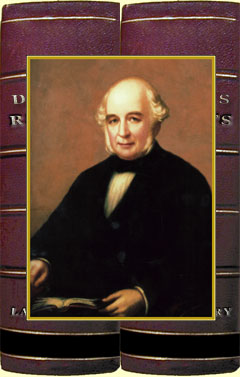
The proceedings in Wisconsin actually involved a number of cases and a number of decisions. The first of those decisions, In re Booth, 3 Wis. 1, 1854 WL 100 (1854), is by our friend, Associate Justice Abram D. Smith (pictured). It addresses a writ of habeas corpus that Sherman Booth filed after he was arrested but before he was indicted. To place the opinion in context, I must briefly describe what seems to have happened, in somewhat simplified form.

After Booth and others freed Glover on March 11, 1854, Booth was arrested on the basis of an order of Winfield Smith, "a commissioner duly appointed by the [federal] district court of the United States for said district [of Wisconsin]." In other words, Winfield Smith was not a state official or a federal judge, but rather an appointed federal "commissioner" under the
Fugitive Slave Act of 1850. As such, Section 1 of the Act gave him the powers of "arresting, imprisoning or bailing" "offenders for any crime or offense" under the Act.

To make a long story short, Booth was bailed, rearrested, rebailed and rearrested. Ultimately, on May 26, 1854, he was jailed to await indictment and trial.

Booth immediately petitioned the Wisconsin Supreme Court for a writ of habeas corpus. He argued that he should be freed for two reasons: first, the Fugitive Slave Act of 1850 was unconstitutional; and second, that the warrant that served as the basis for his arrest contained technical defects (such as the fact that it described Glover as "property" rather than using the statutory phrase "person held to service or labor").

Because the full court was not then in session, Associate Justice Smith heard the case alone on May 29 and 30, and issued his decision on June 7.

Before reaching the merits, Associate Justice Smith had to decide whether he even had jurisdiction to do so. Booth was in federal custody, but Smith was a state judge. Smith concluded that his exercise of jurisdiction would not impinge on the rights of the federal government because the warrant was issued by a commissioner and not by a federal judge. The commissioner was not independent and did not have true judicial powers:

"The warrant, by virtue of which the petitioner was held, was not issued by a federal judge or court, but by a commissioner of the United States. No exclusive or ultimate jurisdiction can be claimed for an officer of this kind. As one of the justices of the highest judicial tribunal of this state . . . I could not deny to any citizen or person entitled to the protection of the state, the proper process by which the validity of a warrant issued by such authority, could be examined. Nor can I admit, that a court commissioner, holding his appointment at the will of the court, responsible only to such court -- in fact, irresponsible and unimpeachable -- has the right or power to issue any process by which a citizen of the state may be imprisoned, that may not be examined, and its its validity tested, by the proper judicial authority of the state. . ..

" . . . [T]he States will never submit to the assumption, that United States commissioners have the power to hear and determine upon the rights and liberties of their citizens, and issue process to enforce their adjudications, which is beyond the examination or review of the state judiciary. . ..

"Every jot and tittle of power delegated to the federal government will be acquiesced in, but every jot and tittle of power reserved to the staes will be rigidly asserted, and as rigidly sustained."

Ableman v. Booth III: Abram D. Smith


Let's take a brief look at the first judge we're going to encounter. Abram D. Smith was born in 1811 in Lowville, New York. He became a lawyer and in 1842 moved to Milwaukee, Wisconsin, where he opened a practice.

When the Supreme Court of Wisconsin was reorganized in 1853, he was elected an Associate Justice. He served on the court until June 1859, when he was defeated. He was replaced, ironically enough, by Byron Paine, who had served as Sherman Booth's attorney in the various proceedings before the Wisconsin Supreme Court. He died in 1865.

A bit more about Associate Justice Smith may be found
here.

Ableman v. Booth II: Joshua Glover


Joshua Glover was the fugitive slave whom Sherman Booth and others freed on March 11, 1854. What do we know about him? The drawing to the right is supposedly of him, although I would guess it is entirely imaginative.

The little we know about Glover emerges from recitations in the opinions describing the affidavit made by his master seeking his return. The master, Benammi S. Garland, was "a farmer and carried on a farm about four miles from" St. Louis, Missouri. In March 1854, Glover was "forty-four or forty-five years of age," so he was born in about 1810. Garland purchased Glover "as a slave for life" in Missouri on January 1, 1849. Garland used Glover "as foreman on his said farm from the time of said purchase to the time of the escape" and "had seen the said Joshua daily" until then. Glover "ran away" "in the Spring of 1852" and had thus been at liberty for two years.

Physically, Glover was "about five feet, six or eight inches high, spare built, with rather long legs, very prominent knuckles, had large feet and hands, had a full head of wool, eyes small and inflamed, was of dissipated habits, was of rather an ashy black color, had one of his shoulders stiff from dislocation, and had stooping shoulders, and a slow gait."

Ableman v. Booth I


I haven't finished with Lemmon v. People yet, but I'm enjoying reading and writing about pre-War state court opinions that shed light on attitudes about slavery and the roles of the state and federal governments. I thought another interesting project would be to look into the state court decisions underlying the United States Supreme Court decision in Ableman v. Booth, 62 U.S. 506 (1859).

Very briefly (at this point), the Supreme Court case arose out of an incident in Wisconsin, in which Sherman M. Booth (pictured above), among others, freed a fugitive slave, Joshua Glover, who had been taken into custody by a Deputy United States Marshal pursuant to a warrant issued by a United States Federal District Judge. Booth was indicted and criminally convicted in federal court for aiding and abetting an escape in violation of the Fugitive Slave Act of 1850. A description of events is available
here.

Notwithstanding that the federal court was exercising jurisdiction, the Supreme Court of Wisconsin heard Booth's petition for habeas corpus, determined that the Fugitive Slave Act of 1850 was unconstitutional and Booth's incarceration therefore unlawful, and ordered him set free.

In the Supreme Court,
Chief Justice Taney wrote for a unanimous Court that the Supreme Court of Wisconsin lacked jurisdiction and reversed. In one of the many ironies of antebellum jurisprudence, Justice Taney endorsed in ringing language the principle of federal judicial supremacy:

"The Constitution was not formed merely to guard the States against danger from foreign nations, but mainly to secure union and harmony at home; for if this object could be attained, there would be but little danger from abroad; and to accomplish this purpose, it was felt by the statesmen who framed the Constitution, and by the people who adopted it, that it was necessary that many of the rights of sovereighty which the States then possessed should be ceded to the General Government; and that, in the sphere of action assigned to it, it should be supreme, and strong enough to execute its own laws by its own tribunals, without interruption from a State or from State authorities."

"The language of the Constitution, by which this power is granted, is too plain to admit of doubt or to need comment. It declares that 'this Constitution, and the laws of the United States which shall be passed in pursuance thereof, and all treaties made, or which shall be made, under the authority of the United States, shall be the supreme law of the land, and the judges in every State shall be bound thereby, anything in the Constitution or laws of any State to the contrary notwithstanding.'

"But the supremacy thus conferred on this Government could not peacefully be maintained, unless it was clothed with judicial power, equally paramount in authority to carry it into execution; for if left to the courts of justice of the several States, conflicting decisions would unavoidably take place, and the local tribunals could hardly be expected to be always free from the local influences of which we have spoken. And the Constitution and laws and treaties of the United States, and the powers granted to the Federal Government, would soon receive different interpretations in different States, and the Government of the United States would soon become one thing in one State and another thing in another. It was essential, therefore, to its very existence as a Government, that it should have the power of establishing courts of justice, altogether independent of State power, to carry into effect its own laws; and that a tribunal should be established in which all cases which might arise under the Constitution and laws and treaties of the United States, whether in a State court or a court of the United States, should be finally and conclusively decided. Without such a tribunal, it is obvious that there would be no uniformity of judicial decision; and that the supremacy, (which is but another name for independence,) so carefully provided in the clause of the Constitution above referred to, could not possibly be maintained peacefully, unless it was associated with this paramount judicial authority."

"[A]fter . . . the State judge or court [is] judicially apprized that the party is in custody under the authority of the United States, they can proceed no further. They then know that the prisoner is within the dominion and jurisdiction of another Government, and that neither the writ of habeas corpus, nor any other process issued under State authority, can pass over the line of division between the two sovereignties. He is then within the dominion and exclusive jurisdiction of the United States."

62 U.S. at 517-18, 523.

Although this language seems startling coming out of the mouth of Chief Justice Taney, it seems clearly correct. How, then, did the Supreme Court of Wisconsin justify its position and claim jurisdiction? On what grounds did that court determine that the Fugitive Slave Law of 1850 was unconsitutional? And was it correct? In future posts, I look at the decisions of the Wisconsin Supreme Court and discuss these and related issues.

Name That Court: A Clue

Here's a clue to help you answer the "name that court" quiz in the post immediately below. The man pictured was the Chief Justice of the state supreme court and the author of the opinion from which the quote was taken.


Don't cheat by right-clicking on the picture, which will reveal the source of the picture and the name of the state in question!

Guess the Antebellum Court

Here is a quote from a state supreme court, written in the early 1850s. You get to guess which court wrote it:

"[L]et it be constantly borne in mind, that notwithstanding we may have different governments, a nation within a nation, imperium in imperio, we have but one people; and that the same people which, divided into separate communities, constitute the respective State governments, comprise in the aggregate, the United States Government; and that it is in vain to shield them from a blow aimed by the Federal arm, if they are liable to be prostrated by one dealt with equal fatality by their own.

" . . . .

"From such State rights, good Lord deliver us! I utterly repudiate them from the creed of my political faith!"

(The italics are in the original.)

Thursday, December 28, 2006

Lemmon v. People XI

Having established his foundation, Judge Clerke began building on it by asking a rhetorical question:

"Is it consistent with this purpose of perfect union, and perfect and unrestricted intercourse, that property which the citizen of one State brings into another State, for the purpose of passing through it to a State where he intends to take up his residence, shall be confiscated in the State through which he is passing, or shall be declared to be no property, and liberated from his control?"

20 N.Y. at 636.

In order to answer the question, Judge Clerke first turned to the "the law of nations" for support. Under that law, he asserted, "the citizens of one government have a right of passage through the territory of another, peaceably, for business or pleasure; and the latter acquires no right over such person or his property." Moreover, foreign nations yield this privilege to each other "without any express compact. It is a principle of the unwritten law of nations." Id.

As you may guess, Judge Clerke then concluded that, if sovereign nations, unbound by compact, granted this privilege to one another, a fortiori "this principle is much more imperative on the several States." "For it can be clearly deduced, as we have seen, from the compact on which their union is based." Id.

Judge Clerke has one more hurdle to pass: are slaves "property," or is that term limited to "merchandise or things?" And who defines the term? We will deal with these issues in our next installment.

Wednesday, December 27, 2006

Lemmon v. People X

Judge Wright, ironically, voted in favor of freeing the eight slaves by insisting that the Constitution strictly limited the powers of the federal government to those specifically enumerated. Conversely, Judge Clerke voted to reverse by looking to the broad purposes of the Constitution as he perceived them rather than focusing on specific clauses or powers. In many ways, Judge Clerke's opinion is a remarkably "loose" and “liberal” one.

Judge Clerke agreed that the New York statute applied to the situation and, but for constitutional considerations, required freeing the slaves. “But it is a question of much greater difficulty, whether the Legislature had the constitutional power to do so.”

The Constitution, Judge Clerke asserted, “not only establishes a confederacy of States, but also, in regard to its most material functions, it gives this confederacy the character of a homogeneous national government.” The framers “evidently designed to incorporate this people into one nation, not only in its character as a member of the great family of nations, but also in the internal, moral, social and political effect of the Union upon the people themselves.”

From this, Judge Clerke in effect derived what we would today call the right to travel:

“It was essential to this grand design that there should be as free and as uninterrupted an intercommunication between the inhabitants and citizens of the different states, as between the inhabitants and citizens of the same State.”

20 N.Y. at 634.

In the remainder of the paragraph, Judge Clerke repeatedly invoked the “more perfect union” language of the Preamble and listed many of the provisions of the Constitution (including the Interstate Commerce Clause and the Privileges and Immunities Clause) that were designed “better to secure and perpetuate mutual friendship and intercourse among the people of the different States.” Based on this review, he concluded as follows:

“Most assuredly, the people who adopted the present Constitution did not intend that the intercourse between the people of the different States should be more limited or restricted than the States, in their corporate capacity, provided in the Articles of Confederation. On the contrary, they contemplated, as we have seen, a more perfect union, and a more perfect and unrestricted intercourse; and they amply secured it by the provisions to which I have referred.”

20 N.Y. at 635-36.

In the next post, we will see how Judge Clerke uses this foundation.

Tuesday, December 26, 2006

Lemmon v. People IX

I have reviewed, more or less completely as the case may be, the majority opinions of Judges Denio and Wright and the brief dissents of Chief Judge Comstock and Judge Selden.

The third dissenter, and the only judge who wrote a dissent of any length, was Thomas W. Clerke. Judge Clerke bears a very odd, double role in the case. He seems to have been a Justice of the Supreme Court who was sitting as a Judge of the New York Court of Appeals "ex officio." In all honesty, I'm not sure what this means in this context. Probably, he was a senior judge of the Supreme Court who sat on the Court of Appeals either by virtue of his seniority or by designation.

Judge Clerke's role was particularly unusual, first, because he a member of both the Supreme Court panel whose decision was appealed to the Court of Appeals, and of the Court of Appeals when it heard and decided that appeal. In other words, he sat in review of the decision of the panel of which he himself was a member.

Second, and even more oddly, he voted differently on the two panels. In the Supreme Court, he voted to affirm (and thus in favor of freeing the slaves). At the Court of Appeals, he voted to reverse the Supreme Court panel (including himself)!

In his Court of Appeals dissent, Judge Clerke even mentioned his change of view. He referred to "the judge who decided this case in the first instance (by whose reasoning, I may be permitted here to say, I was erroneously influenced in voting at the general term of the Supreme Court in the first district)."

20 N.Y. at 636.

Very, very strange.

Lemmon v. People VIII

I have previously noted that the opinion of Judge William B. Wright for affirmance contains several passionate denunciations of slavery. Apart from that rhetoric, the substance of the opinion is quite similar to that of Judge Denio, and I therefore will not discuss it at length.

One aspect of the opinion worth noting, however, is Judge Wright's emphasis on the limited powers of the federal government. Judge Wright almost certainly was savoring the irony as he used the doctrine of states' rights to strike a blow at the slave states in a passage such as this:

"Is there anything in the Federal Constitution to hinder the State from pursuing her own policy in regulating the social and civil condition of every description of persons that are or may come within her jurisdictional limits, or that enjoins on her the duty of maintaining the status of slavery in the case of slaves from another State of the Union voluntarily brought into her territory? It ought not to be necessary at this day to affirm the doctrine, that the Federal Constitution has no concern, nor was it designed to have, with the social basis and relations and civil conditions which obtain within the several States. The Federal Constitution is but the compact of the people of separate and independent sovereignties, yielding none of the rights pertaining to those sovereignties within their respective territorial limits, except in a few special cases."

20 N.Y. at 620-21.

Or this:

"It has never yet been doubted that the sovereign powers vested in the State governments remain intact and unimpaired, except so far as they are granted to the government of the United States; and that the latter government can claim no powers which are not granted to it by the Constitution, either expressly or by necessary implication. There is no grant of power to the Federal Government, and no provision of the Constitution from which any can be implied, over the subject of slavery in the States, except in the single case of a fugitive from service."

20 N.Y. at 628.

Finally, in the supreme irony, he invokes Dred Scott:

"Indeed, the exclusive right of the State of Missouri to determine and regulate the status of persons within her territory, was the only point in judgment in the Dred Scott case, and all beyond this was obiter [dictum, that is, extraneous discussion that was unnecessary to the decision and therefore not binding on other courts]. [Citations omitted.] Any other doctrine might prove more disasterous to the status of slavery than to that of liberty in the States, for, from the moment that it is conceded that, by the exercise of any powers granted in the Constitution to the Federal Government, it may rightly interfere in the regulation of the social and civil condition of any description of persons within the territorial limits of the respective States of the Union, it is not difficult to foresee the ultimate result."

20 N.Y. at 624-25.

This last passage seems to me to be a veiled threat to the Taney Court: if you hold that the Constitution requires a State to admit slaves, a Republican Court will in the future use your reasoning to compel southern States to abolish slavery.

Millard Fillmore Says "Ouch!"

Apparently in order to take a silly swipe at President Bush, Millard Fillmore's Bathtub gratuitously bashes its own eponym:

"Millard Fillmore is widely considered to be one of the worst, or most inactive, presidents in U.S. history. He was an accidental president, taking office on the death of Zachary Taylor. Trying to avoid controversy and confrontation he let fester many of the problems that would lead to the Civil War. He was a one-term president — his own party refused to nominate him for election on his own, in 1852. After the Whig Party crashed and burned, Fillmore accepted the nomination of the American Party, more commonly known as the Know-Nothing Party, in 1856. 'Millard Fillmore' is shorthand for 'failed presidency' in most lexicons."

I suppose one's view of President Fillmore may depend on what you think of the Compromise of 1850, but the claims that he was "inactive" or that he presided over a "failed presidency" are ludicrous. Shortly after becoming president, he vigorously endorsed the proposed Compromise, and his advocacy probably contributed to its successful passage. The Whigs failed to renominate him largely because he was unwilling to employ patronage to reward Whig bosses. No doubt, the Whigs later came to rue their foolish decision.

While his later acceptance of the American ("Know-Nothing") Party nomination in 1856 was not his finest hour, there were several mitigating factors. First, it's worth remembering that the Whig Party was dead and buried as a national party by 1856, and many former Whigs who found the Republicans unacceptable turned to the American Party as to the only other viable alternative to the Democrats. Second, the Americans nominated Fillmore in absentia and without his knowledge (he was in Europe, I believe). Bored and depressed from the deaths of his wife in 1853 and daughter in 1854, Fillmore accepted the nomination upon his return but did not, to the best of my knowledge, make any statements endorsing its nativist rhetoric.

I have previously posted a brief appreciation of Fillmore and his presidency
here.

Monday, December 25, 2006

Merry Christmas!

Hiram Denio


Since I'm in the middle of discussing Judge Hiram Denio's opinion in Lemmon v. People, I thought I'd provide a photo and brief bio. The following is from the New York State Courts site:

"Born in Rome, New York, on May 21, 1799, Hiram Denio commenced his legal studies at the age of 17 with Judge Joshua Hathaway of Rome and later studied in the office of Storrs & White in Whitesboro. After admission to the bar in 1821, Denio established a private practice with Wheeler Barnes in Rome. While in Rome, he was appointed County District Attorney, serving in this position from 1825 to 1834. In 1826, he relocated to Utica, forming another legal practice, this time with E.A. Wetmore. In 1834 he was appointed Circuit Judge and Vice-Chancellor for the 5th Circuit. However, four years later, he was forced to resign due to illness, returning to private practice once more. He served as Bank Commissioner from 1838 to 1840. In 1845 Judge Denio assumed the position of Reporter, publishing five volumes of the Reports before leaving the post in 1848. Appointed to fill a vacancy on the Court of Appeals in June 1853, he was reelected twice, serving as Chief Judge from 1856 through 1857. Considered one of the foremost judges in New York, he retired in 1866. Judge Denio served as trustee of Hamilton College from 1835 until his death. In 1859, Madison University (now Colgate University) awarded him the honorary degree of LLD. With William Tracy, he edited an edition of the revised statutes of New York published in 1852. Judge Denio died in Utica, New York, on November 5, 1871."
Related Posts with Thumbnails