Monday, March 19, 2012

Short Takes


A short post to highlight two interesting items I ran across this weekend, both of which are worth your investigation.

First on the list is a post at Volokh by Kenneth Anderson that announced the launching of ConText, a site that will "crowd source" James Madison's notes of the 1787 Constitutional Convention:
Organized like the Talmud, ConText surrounds the Notes with layers of commentary - commentary on the history (what was going on in the room), current events (how these events relate to current politics), theoretical and philosophical issues, and subsequent constitutional interpretation and dispute. Like Wikipedia, that commentary will be written by a scholarly community that develops around ConText: historians, constitutional scholars and practitioners, and interested students and lay people. Both the text and the commentary are fully searchable. And anyone can get an account and begin contributing.
For those of you who are unaware of them, Madison's notes are "the most important document in American history that nobody ever reads."  This looks like a tremendously exciting - and valuable - project.


Second is a wonderful article by Edward Luttwak entitled Homer Inc. Although the article purports to be a review of a new English translation of the Iliad, the review is simply a launching pad for a wide-ranging essay on the Iliad, touching on its historical roots, method of transmission and later codification by Aristarchus and others, and concluding with a deeply felt appreciation of the poem's terrible beauty, including the following:
Spears cut through temples, foreheads, navels, chests both below and above the nipple. Even despised bows kill, and heavy stones appear as weapons. Joyful victors strip their victims of their armour and gain extra delight from imagining their weeping mothers and wives. Yet the Iliad is a million miles away from the pornography of violence offered by many lesser war books, battle paintings, martial sculptures and most obviously films, in which the enemy bad guys are triumphantly trampled or gleefully mown down, because the humanity of the victims, their terror and their atrocious pain, are fully expressed. The powerful affirmation of the warrior’s creed – we are all mortal anyway so let us fight valiantly – coexists with the unfailingly negative depiction of war as horrible carnage.
 Read, as they say, the whole thing.

Saturday, March 17, 2012

Write Your Own Academic Sentence!


The University of Chicago Writing Program has a great website that will write your own academic sentence for you.  You pick the words, push the button, and voila! perfect academic nonsense appears.

I selected "linguistic transparency", "post-capitalist hegemony", "historicization" and "reification".  I got:
The reification of post-capitalist hegemony functions as the conceptual frame for the historicization of linguistic transparency.
Perfect!

Thursday, March 15, 2012

I Threw a Pear Into the Air . . .


It's been years (decades?) since I've seen the I, Claudius miniseries and even longer since I've read Robert Graves' books.  It's therefore entirely possible that this scene was in one or the other or both, but if so I had forgotten it.

In his biography of the emperor Caligula, Robert A. Barrett relates the untimely death of Claudius' son, Claudius Drusus. In about AD 20, the boy (who could have been no more than about 11 at the time, his mother having married Claudius in about AD 9) became engaged to Junilla, the daughter of the then-rising praetorian prefect Sejanus (she was about four years of age).
It was a short-lived union. A few days later the boy, perhaps anxious to prove that he had not inherited his father's clumsiness, threw a pear into the air, deftly caught it in his mouth, then choked to death.
The ancient source of the story is Suetonius, who tells it in his biography of Claudius:
[Claudius] had children by three of his wives: by Urgulanilla, Drusus and Claudia; by Paetina, Antonia; by Messalina, Octavia and a son, at first called Germanicus and later Britannicus. He lost Drusus just before he came to manhood, for he was strangled by a pear which he had thrown into the air in play and caught in his open mouth. A few days before this he had betrothed him to the daughter of Sejanus, which makes me wonder all the more that some say that Drusus was treacherously slain by Sejanus.

The Great Cameo: Germanicus Departs for the East, AD 17


Wikipedia reports that the Great Cameo of France, a five-layered sardonyx cameo measuring 31 cm by 26.5 cm, was created about AD 23.

But what scene does it portray?  You can read Wikipedia's somewhat different take, but Anthony A. Barrett, in his biography of the emperor Caligula, argues that it may commemorate the departure of Caligula's father, Germanicus, in the autumn of AD 17 on an important diplomatic mission to the Roman East at the direction of the emperor Tiberius. "According to this view the central figure is the enthroned Tiberius, who bestows the task on Germanicus, who faces him, accoutred in battle armor.  Behind Germanicus [on the left] stand [his wife] Agrippina and [his son] the young Caligula."

Germanicus never returned to Italy.  He died in Antioch on October 10, AD 19, at the age of 33 years.

Wednesday, March 14, 2012

Lucius Annaeus Seneca


Seneca is popularly known as a Stoic philosopher, statesman and turgid dramatist who selflessly tried to gently but firmly steer the emperor Nero away from his naturally vicious tendencies and was rewarded for his troubles by an order to commit suicide.

I was therefore amused to see that Anthony A. Barrett has a refreshingly different take on the revered rhetor in his biography of Little Boots, Caligula: The Corruption of Power.  Dismissing Seneca's writings mentioning Caligula as "generally of little positive value, as he was clearly obsessed by personal antipathy," Barrett observes:
Seneca made a career from obsequious flattery of the living emperors and unfettered vilification of their dead predecessors.

Tuesday, March 13, 2012

Define "Smart"


I ran across this article about feral pigs in upstate New York via Ann Althouse.  But what struck me was this paragraph:
Last year, the state set a similar corral trap too soon, catching only three pigs. After that, none of the others returned to the area, even after the trap was dismantled. “I’ve never worked with an animal this smart,” Mr. Reed said.
So, if they're so smart, why didn't they return when the trap was removed?

Measuring the Pulse of the Western World Based On A Single Headline


I understand why some complain about Ramsay MacMullen’s writing style, which can be dense and convoluted. But at his finest he’s something like a great impressionist painter, or even a pointillist, daubing multiple points of color on his canvas, out of which a vivid yet maddeningly indistinct atmosphere emerges.

More importantly, his style also reflects, I think, his perception of the historian’s craft, which is not to simplify or create grand patterns, but rather just the opposite: to try to recreate the myriad complexities and contradictions of long-dead societies that are now hidden from us by bland marble statues, scattered facts and unsupported assumptions.

Two examples may suffice, both from Prof. MacMullen’s fine Paganism in the Roman Empire, to illustrate his insistence that an honest attempt to capture the past must avoid the impulse to generalize.  The first follows a review of specific examples testing "the vitality of paganism":
This is the kind of mixed bag of facts that renders general statements about religious life so hard to frame or so easily criticized if they are framed too narrowly. What, for instance, can one make of the assertion that oracles, “it is true, enjoyed a recovery in popularity in the second century” [quoting from a 1929 work by Belgian archaeologist and historian Franz Cumont] – for which a single inscription is cited, recording help sought by a city in Sardinia from Apollo in Claros? Such characterizing of the feelings and thoughts of fifty million people on any day out of thirty-six thousand has something ludicrous about it, as if one were to measure the pulse of the western world on the basis of a single headline in the St. Albans Sentinel. Worse than that, perhaps: since religious feelings are not something to talk about in public, in some of their aspects, they must prove all the harder to assess from the outside. The more need for care.
Another quote of poor M. Cumont – “In the third century, the misery of the times was the cause of such great suffering . . . that people sought asylum in the expectation of a better life” – draws a second outburst. After questioning the evidence supporting the assertion, Prof. MacMullen expresses broader misgivings about whether it is ever possible, or desirable, to make such broad characterizations:
[W]hat sense does it make to assign a single character to so long an era? – as if one were to say, “in Italy, Switzerland, the Low Countries, Britain, France, and Spain between about 1400 and 1600, people were tense and worried.” The statement denies the very change and complexity which it is the job of historians to discover . . .. As if a century, let alone two or three, could be “an age” – that is, a stretch of time in which just about everybody acted in significantly different ways from other human beings before and after, but with something close to a characteristic uniformity among themselves!
The human tendency to arrange facts into patterns and the paucity of facts available concerning the Classical world – certainly in comparison to those available to a historian of, say, the Twentieth Century – suggest that the ancient historian must be particularly wary:
It can only be the observer’s ignorance that would make all the life of a vast area for so long a span, in the mind’s eye, blur, shrink, stop. Such ignorance is the natural condition of the ancient historian, paradoxically inviting him to arrange his few scattered facts into grand patters – the fewer, the grander. Where the temptations and the hazards are so pressing, perhaps it should be a rule that no one may generalize about ancient history until he has served an old-fashioned, seven-year apprenticeship in the teaching, or at least the formal study, of modern history!

Tuesday, March 06, 2012

The Funeral of Hiram Cronk


Here's something startling.  Did you know that the last surviving veteran of the War of 1812 was Hiram Cronk?  And did you know that there's a YouTube video of his May 1905 funeral in New York City?  Well, there is:


According to Wikipedia:
Hiram Cronk (April 29, 1800 – May 13, 1905) was the last surviving veteran of the War of 1812 at the time of his death.
Born in Frankfort, New York, Cronk enlisted with his father and two brothers on August 4, 1814. He served with the New York Volunteers in the defense of Sackett's Harbor, and was discharged November 16, 1814. For his service, he received a pension of $12 per month. In 1903, the United States Congress increased it to $25 per month. He also received a special pension of $72 per month from the State of New York.
Cronk spent most of his life working as a shoemaker. He married Mary Thornton in 1825, with whom he had seven children. At the time of his death he had 14 grandchildren and eight great-grandchildren (one of whom, Jane, lived to over 100 years of age herself, making the two "serial centenarians").
He died in Ava, New York in May 1905 at the age of 105. After his death, his body was displayed in the main lobby of New York City Hall. An estimated 25,000 people paid their respects. He is buried in Cypress Hills Cemetery, Brooklyn, New York.


The pictures, above and below, from this site:
Hiram Cronk was the oldest surviving veteran of the War of 1812. When he passed in 1905, it was a major event. 10,000 observers paid their respects as he lay in state in City Hall, and these pictures appeared in the May 19, 1905 edition of the Brooklyn Daily Eagle as he was laid to rest in Cypress Hills.


What If Adams and Jefferson Did Attack Ads?


I can't resist pointing out this great project described at Real Clear History: What If Jefferson and Adams Did Attack Ads?
This spring, a small cadre of Williams College students is participating in an experimental history course on the American Presidents. Instead of producing papers, as is the norm in most history classes, the students will create video campaign ads for the presidential elections from Washington to Lincoln.

There’s a catch, though. The students can only use images, quotes, documents, and music from the era. They cannot use anything that came afterwards. An image of the White House burning in 1812 would not work for the election of 1808. They cannot use images of Leutze’s famous Washington Crossing the Delaware, a product more reflective of the 1840s than the 1770s. Their assignment is to capture the spirit of the age – not the spirit of our historical memory.
Real Clear History is partnering with the class and promises to display the best videos every week or so, as the students progress through the elections from 1796 through 1860.  In the first installment, linked at the top, RCP has four videos that might have been used in the 1796 contest between John (the Monarchist) Adams and Thomas (Indecisive Atheist and Jacobin) Jefferson.  I've posted a different anti-Jefferson piece here.

The videos are also posted at YouTube, and it appears there's a YouTube Channel at which all the videos will be displayed.  I'm eagerly anticipating future installments.

Saturday, March 03, 2012

"I will avenge myself"


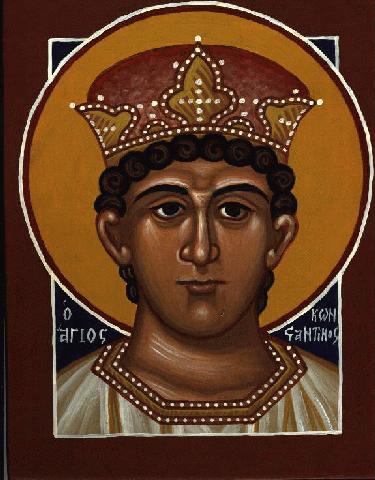
The immensity of the autocrat's power only insures his isolation. Particularly was this so for Constantine the Great, shrouded by "elaborate remoteness" to guard against plots and to "bestow[] him with some of the mystery and holiness of a god in a temple." And yet, as Ramsay MacMullen notes, Constantine raged against the layers of bureaucracy that enshrouded him:
To all provincials:
If anyone anywhere in any rank or office believes he can truly and clearly establish anything, against any of my governors, counts, retinue, or court, that seems not to have been properly and justly handled, let him come forward with courage and in safety, let him address himself to me. I myself will hear everything, I myself will judge, and if the matter is substantiated, I will avenge myself. Let him speak! If the matter is proven, as I said, I will avenge myself.

Friday, March 02, 2012

King Kong


Haven't had a Frank Zappa Friday in a while.

Thursday, March 01, 2012

Why Did Constantine Convert? Ramsay MacMullen Eliminates Possibilities


What was it that drew Constantine the Great, so momentously for Western civilization, toward monotheism and ultimately to Christianity?  In his biography of the emperor, Ramsay MacDonald eliminates possibilities.  It wasn't, for example, a personal relationship with Christ.  Constantine hardly knew him:
Writing  about the Donatists in 314, Constantine mentions Christ, but several considerations, and several modern scholars, suggest that the letter was drafted or edited by churchmen in the court . . .; otherwise he makes no reference to Christ until 321.  That peculiarity deserves emphasis.  It does much to explain the route that his spirit traveled in conversion, passing not instantaneously from paganism to Christianity but more subtly and insensibly from the blurred edges of one, not truly itself, to the edges of the other.
Nor was it the moral vision of the religion:
A decade after his conversion [Constantine] was still personally decreeing crucifixion as a punishment.  The right of parents to expose unwanted children he never attacked, despite opposite views which he might have read in the Divine Institutes; and there, too, Lactantius had harshly condemned gladiatorial spectacles as "public murders," which, notwithstanding, the emperor left untouched until 325. . . . [T]he contrast is clear between his attention to the outward parts and appearances of the Church, and on the other hand his inattention to its spiritual meaning.

Wednesday, February 29, 2012

Enchanters, Murderers and Adulterers


You are the sole and absolute ruler of the known world.  Your eldest son has come of age, married, and fathered a son.  To celebrate this momentous event, you decide to declare an amnesty for all criminals, except for those convicted of specific, particularly heinous offenses.  Which crimes do you choose to exempt?

Well, if you're Constantine the Great in AD 322, your choices might be considered a bit odd by contemporary standards.  According to Ramsay MacMullen's biography of the emperor,
Constantine expressed his pride and happiness through a general amnesty to all criminals "except enchanters, murderers, and adulterers," those being beyond the pale.
"The list," Prof. MacMullen dryly observes, "throws an interesting light on morals and mores of the time."

Sunday, February 26, 2012

Two Versions of Constantine's Vision


Lactantius was the first to tell the story of Constantine's dream that caused him to have his soldiers to place the Chi-Rho symbol on their shields.  The description appears toward the beginning of Book XLIV of Lactantius' work De Mortibus Persecutorum ("On the Deaths of the Persecutors", written about 318).  According to Lactantius,  the Chi-Rho originated in a dream that Constantine had shortly before "the sixth day before the kalends of November" (i.e., October 27) in the year 312, while he and his army were camped near Rome. The Battle of the Milvian Bridge took place the next day, October 28, 312.
And now a civil war broke out between Constantine and Maxentius. Although Maxentius kept himself within Rome, because the soothsayers had foretold that if he went out of it he should perish, yet he conducted the military operations by able generals.

In forces he exceeded his adversary; for he had not only his father's army, which deserted from Severus, but also his own, which he had lately drawn together out of Mauritania and Italy.

They fought, and the troops of Maxentius prevailed. At length Constantine, with steady courage and a mind prepared for every event, led his whole forces to the neighbourhood of Rome, and encamped them opposite to the Milvian bridge.

The anniversary of the reign of Maxentius approached, that is, the sixth of the kalends of November, and the fifth year of his reign was drawing to an end.

Constantine was directed in a dream to cause the heavenly sign to be delineated on the shields of his soldiers, and so to proceed to battle. He did as he had been commanded, and he marked on their shields the letter X, with a perpendicular line drawn through it and turned round thus at the top, being the cipher of CHRIST. Having this sign, his troops stood to arms.

Iam mota inter eos fuerant arma civilia. Et quamvis se Maxentius Romae contineret, quod responsum acceperat periturum esse, si extra portas urbis exisset, tamen bellum per idoneos duces gerebatur.

Plus virium Maxentio erat, quod et patris sui exercitum receperat a Severo et suum proprium de Mauris atque Gaetulis nuper extraxerat.

Dimicatum, et Maxentiani milites praevalebant, donec postea confirmato animo Constantinus et ad utrumque paratus copias omnes ad urbem propius admovit et a regione pontis Mulvii consedit.

Imminebat dies quo Maxentius imperium ceperat, qui est a.d. sextum Kalendas Novembres, et quinquennalia terminabantur.

Commonitus est in quiete Constantinus, ut caeleste signum dei notaret in scutis atque ita proelium committeret. Facit ut iussus est et transversa X littera, summo capite circumflexo, Christum in scutis notat. Quo signo armatus exercitus capit ferrum.


In his Life of Constantine, written many years after Lactantius' account (after Constantine's death in 337 and before Eusebius' own death c. 340), Eusebius tells a very different story.  Chapter XXVIII of Book I describes an event that differs in time, place and manner.  Eusebius places the event at an unspecified location - presumably in Gaul - at some point before Constantine reached the decision to invade Italy and try to oust Maxentius.  (See Chapter XXXVII, in which Constantine begins to arm himself for the invasion of Italy only after these events.)  Since Constantine entered northern Italy in the spring of 312, the vision must have taken place before that.

Here we find, for the first time, the famous story of the cross in the sky, seen by the whole army:
Accordingly [Constantine] called on God with earnest prayer and supplications that he would reveal to him who he was, and stretch forth his right hand to help him in his present difficulties. And while he was thus praying with fervent entreaty, a most marvelous sign appeared to him from heaven, the account of which it might have been hard to believe had it been related by any other person. But since the victorious emperor himself long afterwards declared it to the writer of this history, when he was honored with his acquaintance and society, and confirmed his statement by an oath, who could hesitate to accredit the relation, especially since the testimony of after- time has established its truth? He said that about noon, when the day was already beginning to decline, he saw with his own eyes the trophy of a cross of light in the heavens, above the sun, and bearing the inscription, CONQUER BY THIS. At this sight he himself was struck with amazement, and his whole army also, which followed him on this expedition, and witnessed the miracle.

Then in Chapters XXIX through XXI we learn that that night - again, months before the Battle of the Milvian Bridge - Constantine had a dream in which Christ appeared to him:
[Constantine] said, moreover, that he doubted within himself what the import of this apparition could be. And while he continued to ponder and reason on its meaning, night suddenly came on; then in his sleep the Christ of God appeared to him with the same sign which he had seen in the heavens, and commanded him to make a likeness of that sign which he had seen in the heavens, and to use it as a safeguard in all engagements with his enemies.

At dawn of day he arose, and communicated the marvel to his friends: and then, calling together the workers in gold and precious stones, he sat in the midst of them, and described to them the figure of the sign he had seen, bidding them represent it in gold and precious stones. And this representation I myself have had an opportunity of seeing.

Now it was made in the following manner. A long spear, overlaid with gold, formed the figure of the cross by means of a transverse bar laid over it. On the top of the whole was fixed a wreath of gold and precious stones; and within this, the symbol of the Saviour's name, two letters indicating the name of Christ by means of its initial characters, the letter P being intersected by X in its centre: and these letters the emperor was in the habit of wearing on his helmet at a later period. From the cross-bar of the spear was suspended a cloth, a royal piece, covered with a profuse embroidery of most brilliant precious stones; and which, being also richly interlaced with gold, presented an indescribable degree of beauty to the beholder. This banner was of a square form, and the upright staff, whose lower section was of great length, bore a golden half-length portrait of the pious emperor and his children on its upper part, beneath the trophy of the cross, and immediately above the embroidered banner.


On Eusebius' story, Ramsay MacMullen comments as follows in his biography of the emperor:
Incontestably, the account errs in introducing the princes into the picture [Constantine's eldest son, Crispus, was probably born between 299 and 305; his second son, Constantine II, was not born until 316]; it is almost certain that the labarum as a whole postdates 312; so also, the chrisma, and if the sky-writing was witnessed by forty thousand men, the true miracle lies in their unbroken silence about it. 

"Bullneck"?


Well here's one I hadn't heard before.  In his biography of the emperor Constantine the Great, Ramsay MacMullen tells us that as a young man Constantine's nickname was "bullneck":
It is said that [Constantine's] being sent to Diocletian's court was partly for the purpose of educating him, but there is more evidence of his physical growth than of his mental.  He attained an average height but a very robust build and great strength.  His fellows treated him with respect and nicknamed him Bullneck.
 The coin portrait at the top dates to AD 313, when Constantine (born c. AD 280) was about 33 years of age.


ADDENDUM.  I've added immediately above a second image of a coin portraying Constantine in 306-307, when he would have been 26 or 27 years of age.  He looks pretty bull-necked to me.

Tuesday, February 21, 2012

Can Someone Explain the Fruit Thing to Me?


The Roman emperor Constantius II, son of Constantine the Great, died of illness in October or November 361 AD.  After relating the circumstances of his death, in Book XXI of his great history of the later Roman empire the Roman historian Ammianus Marcellinus sums up Constantius' "good and bad qualities."

The description of the good qualities ends with the following (emphasis added):
In riding, in hurling the javelin, and especially in the skilful use of the bow, and in all the exercises of the foot-soldiers, he was an adept. That no one ever saw him wipe his mouth or nose in public, or spit, or turn his face in either direction, or that so long as he lived he never tasted fruit, I leave unmentioned, since it has often been related.

Equitandi et iaculandi, maximeque perite dirigendi sagittas, artiumque armaturae pedestris perquam scientissimus. Quod autem nec tersisse umquam nares in publico nec spuisse nec transtulisse in partem alterutram vultum aliquando est visus, nec pomorum quoad vixerat gustaverit, ut dicta saepius praetermitto.
OK, I get that it's admirable for an emperor not to wipe his nose in public or spit.  But what's with the fruit thing?

UPDATE.  It turns out that there's a learned academic article on this precise issue:  Why Didn't Constantius II Eat Fruit? Unfortunately, it's on JSTOR, so I can't read it!

Monday, February 20, 2012

Roman Dacia: A Tale of Two Salients


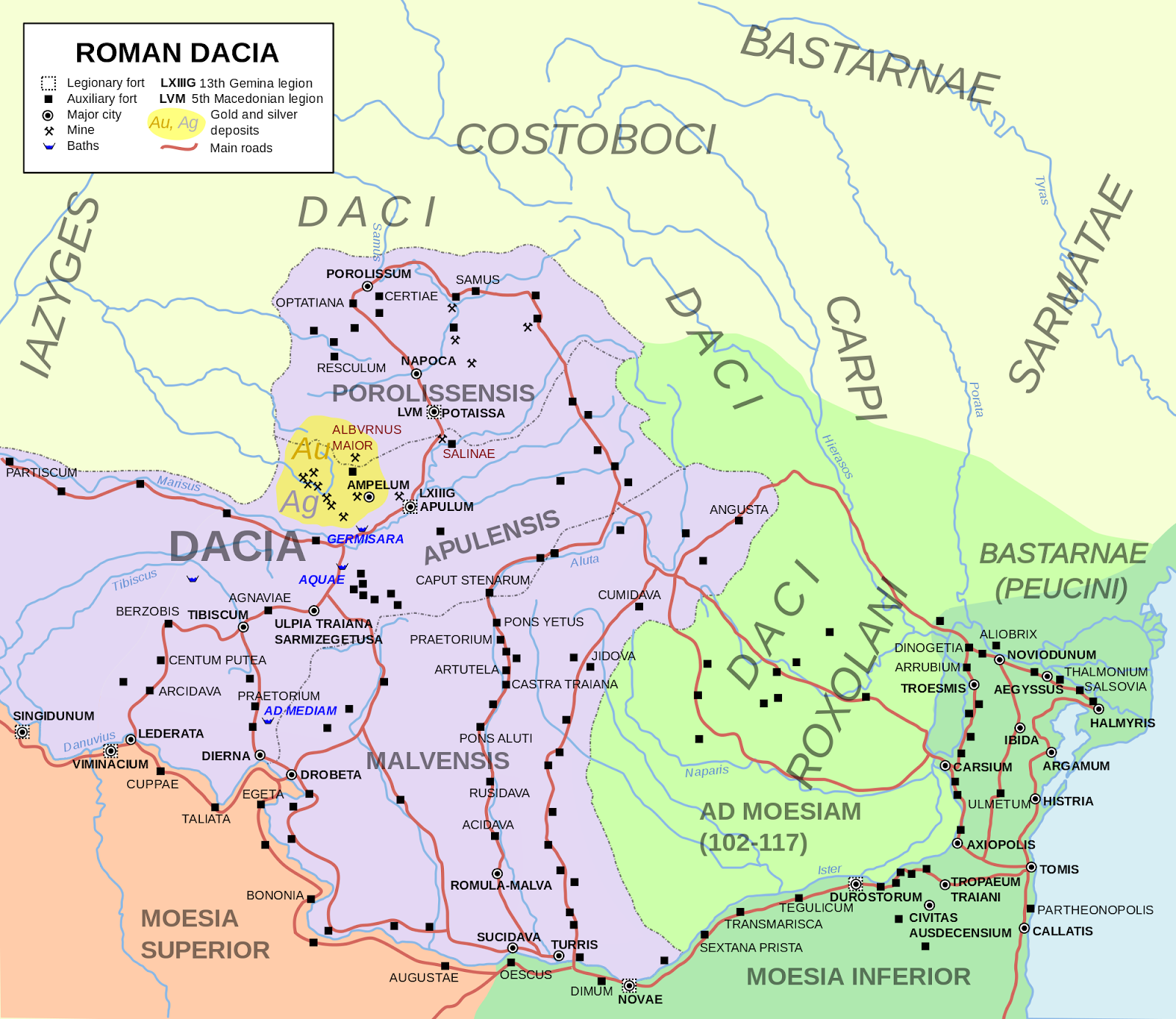
When you read any book on military history, you quickly learn that salients are BAD.  What on earth, then, was the Roman emperor Trajan thinking when he annexed the province of Dacia in AD 106?  Two books I read recently touch on this issue and come to very different conclusions.


Seen on a modern map (shown at the top, in purple), the Roman province of Dacia looks like a textbook example of an exposed salient.  The boundary of the Roman empire had until then extended east-west across the Balkan Peninsula with the Danube as the northern border.  The new province jutted awkwardly north of the river, inviting trouble.  As Edward N. Luttwak explains in his wonderful book The Grand Strategy of the Roman Empire From the First Century A.D. to the Third:
[T]he frontiers of the new province of Dacia formed a deep wedge . . . adding more than 370 miles to the length of the imperial perimeter.  In fact, on the map the new province presents a classic profile of vulnerability.
And yet, Luttwak argues that Dacia made sense, at least so long as the Romans had sufficient military strength.  This is because the salient effectively separated two groups of tribes, one situated on the western side of the salient, the other on the eastern, impeding their ability to coordinate attacks:
On either side of the Dacian salient were the plains occupied by the subsidized Sarmatians: Iazyges to the west and Roxolani to the east.  Had Rome been weak and the Sarmatians strong, the Dacian province would have been vulnerable to encirclement . . .; but with Rome as strong as it then was, the Dacian frontier effectively separated the Sarmatians on either side and weakened their combined power.


I know it's a far-fetched analogy, but on a far smaller scale Robert E. Lee's troop disposition at the North Anna River during the Overland Campaign immediately came to mind.  By establishing a position with a salient, Lee effectively impeded the ability of the Union forces to coordinate their attacks on the two sides of the salient.

In her equally fine book Rome and the Enemy: Imperial Strategy in the Principate, on the other hand, Susan P. Mattern wonders whether Trajan even understood that he was creating a salient.  As I discussed in this recent post, the ability of the Romans to visualize geography was poor to nonexistent.  Citing maps such as these reconstructions of Strabo's and Ptolemy's maps of Europe , together with evidence that the Romans thought that the entire distance from the Danube to the North Ocean was fewer than 400 miles, Prof. Mattern suggests that Trajan may well have imagined the territory as having a shape far different than the one we see on a modern map:


But it is not clear that Trajan and his advisers thought of strategy in terms of two-dimensional geography at all; or if they did, the vulnerable salient evident to modern cartography was not necessarily what they imagined.  For example, Ptolemy's work . . . shows the Carpathian Mountains running east to west in a straight line . . ..  Dacia, on Ptolemy's map, looks very different and more "rational" than on a modern one.


Indeed, Trajan may have expected that the northern boundary of the territory would be the Northern Ocean itself, eliminating any salient altogether:
But the most likely frontier imagined by Trajan  when he invaded this territory was the ocean itself.  It is likely that he shared the prevalent view of a flattened northern Europe; Agrippa had, after all, placed the ocean only 396 miles from the Danube River.   The total conquest of eastern Europe must have seemed an attainable goal. . . .  [B]ecause of the mainly mythological nature of Roman conceptions about the area, it seems probable that the emperor was motivated by notions of reaching the northern ocean and the exciting prospect of exploring and conquering exotic, unknown territory, which was also supposed to be rich in gold.

Romans, Geese and Eagles


It never ceases to amaze me how even the most sophisticated Romans, such hardheaded realists in so many respects, were at the same time given to believing the craziest of old wives' tales.

Here is one I particularly like, from Ammianus Marcellinus' History of the Later Roman Empire.  I have included an entire paragraph for context and bolded the key portion:
Now the aforesaid Barbatio was a somewhat boorish fellow, of arrogant intentions, who was hated by many for the reason that, while he commanded the household troops under Gallus Caesar, he was a perfidious traitor; and after Gallus' death, puffed up with pride in his higher military rank, he made like plots against Julian, when he became Caesar; and to the disgust of all good men he chattered into the open ears of the Augustus many cruel accusations. He surely was unaware of the wise saying of Aristotle of old, who, on sending his disciple and relative Callisthenes to King Alexander, charged him repeatedly to speak as seldom and as pleasantly as possible in the presence of a man who had at the tip of his tongue the power of life and death. And it should not cause surprise that men, whose minds we regard as akin to the gods, sometimes distinguish what is advantageous from what is harmful; for even unreasoning animals are at times wont to protect their lives by deep silence, as appears from this well-known fact. The geese, when leaving the east because of heat and flying westward, no sooner begin to traverse Mount Taurus, which abounds in eagles, than in fear of those mighty birds they close their beaks with little stones, so that even extreme necessity may not call forth a clamour from them; and after they have passed over those same hills in speedier flight, they cast out the pebbles and so go on with greater peace of mind.
The photo, by the way, is from a very amusing article entitled Canada Geese Put One Over on American Eagle.

Roman Geography


Imagine a military commander setting out to launch an invasion of a territory the size of a country. He has no maps, and feels the need for none.

Imagine a mighty state that has through conquest established an empire encompassing some two and a half million square miles and held it for centuries. Its rulers have no accurate maps and have only a hazy idea where the empire's borders lie.

As Susan P. Mattern argues in her fine Rome and the Enemy: Imperial Strategy in the Principate, this was ancient Rome. In a nutshell, the Romans had virtually no maps, and none that were accurate:
Maps in the sense of two-dimensional, scaled representations of the world . . . were . . . not the familiar objects in antiquity that they are today. There was no Greek word that meant, specifically, “map,” and there appears to have been none in Latin either . . ..

The practical tools available to generals were mainly the itineraries compiled by the army; travelers could use the periploi composed by merchants, where these existed. Scaled maps were probably not used or perceived as useful for military or strategic purposes. While the argument from silence is always suspect for antiquity, it is striking that no author of any tactical treatise and no historian of antiquity including Caesar mentions maps in a military context or even, virtually at all.
As the quote indicates, the principal geographic tool that the Romans used was not a two-dimensional map but an “itinerary.” This was a list of distances between specified stops on a route. The Antonine Itinerary is the most famous example.

Itineraries could be expressed in visual form, but they lacked direction and were not “maps” as we think of them:
The most spectacular example is the Tabula Peutingeriana . . . [which] is not just a list, but a road map of the world that displays stops and distances in graphic form. . . . Roads are represented by lines, stops by jags in the lines, and distances between stops are inscribed as on modern road maps. Spas and villages are represented as symbols; the Mediterranean is a snaky green line through the middle. The length of the Peutinger Table is more than twenty times its width, probably because it was originally drawn on a papyrus roll. Thus it illustrates the limitations of “odological” information very well: it is not possible to tell the direction of a route on this map or to gain a two-dimensional sense of the shape of any region . . ..


I encourage you to double-click on Peutinger Table, which appears just above, and try to imagine that it is your sole guide on a trip from, say, Rome to Trier, or London to Antioch.  Then, go to Omnes Viae, a wonderful site where you can plot the same trip and get results both in itinerary form and plotted out on a map.  My only regret is that the site doesn't also plot out the trip on a copy of the Peutinger Table itself.

Although there appear to have been a handful of two-dimensional maps available to the Romans, they were neither scaled nor accurate and, as noted above, it does not seem that they were consulted for military purposes. Even a quick glance at a reconstruction of the map probably best known to Romans during the Empire, the so-called Map of Agrippa (shown at the top of this post), explains why.  Assuming it existed (one scholar has argued that it was not a map, but text only), Agrippa's orbis terrarum urbi spectandus (the “world to be looked at by the city”) is known primarily from a description in Book III Pliny the Elder's Natural History:


Baeticae longitudo nunc a Castulonis oppidi fine Gadix CCL et a Murgi maritima ora XXV p. amplior, latitudo a Carteia Anam ora CCXXXIIII p. Agrippam quidem in tanta viri diligentia praeterque in hoc opere cura, cum orbem terrarum orbi spectandum propositurus esset, errasse quis credat et cum eo Divum Augustum? is namque conplexam eum porticum ex destinatione et commentariis M. Agrippae a sorore eius inchoatam peregit.

At the present day the length [i.e., east-west distance] of Bætica, from the town of Castulo, on its frontier, to Gades is 250 miles, and from Murci, which lies on the sea-coast, twenty-five miles more.  The breadth [i.e., north-south distance], measured from the coast of Carteia, is 234 miles.  Who is there that can entertain the belief that Agrippa, a man of such extraordinary diligence, and one who bestowed so much care on his subject, when he proposed to place before the eyes of the world a survey of that world, could be guilty of such a mistake as this, and that too when seconded by the late emperor the divine Augustus?  For it was that emperor who completed the Portico which had been begun by his sister, and in which the survey was to be kept, in conformity with the plan and descriptions of M. Agrippa.

(As as aside, I note that there seems to be disagreement whether the word in the Latin text is urbi or orbi - "[to be seen] by the city [of Rome]" or " by the world".  Prof. Mattern apparently believes it is urbi, the authors of the University of Chicago website the latter.)


At all events, Prof. Mattern elaborates on the Map of Agrippa as follows:
Apparently this was an image of the world painted on the Porticus Vipsania, a building funded by Augustus' close friend [Marcus Vipsanius] Agrippa in the Campus Martius, and completed after his death by Augustus. It divided the world into twenty-four regions, and may have been accompanied by a commentary, which was also published separately, [which] offered length and breadth measurements for each of the twenty-four sections.


There is substantial reason to believe the understanding of the Roman ruling class concerning world geography was generally consistent with Agrippa's Map.  "It is doubtful whether any [of the ancient geographers] . . . actually drew maps to illustrate their texts."  But reconstructions of the world based on the descriptions of the Greek geographer Strabo, who was "part of that world", show a generally similar picture:


Focusing in particular on Europe, we find the continent oddly narrowed north to south, with a flattened northern cost that leaves the Pyrenees running north-south rather than east-west, and Britain lying on its side, almost as close to Spain as it is to Gaul and extending on the east all the way to Germany.  This may explain, for example, the rather odd description of Britain that Tacitus provides in the Agricola:
Britannia, insularum quas Romana notitia complectitur maxima, spatio ac caelo in orientem Germaniae, in occidentem Hispaniae obtenditur, Gallis in meridiem etiam inspicitur; septentrionalia eius, nullis contra terris, vasto atque aperto mari pulsantur. Formam totius Britanniae Livius veterum, Fabius Rusticus recentium eloquentissimi auctores oblongae scutulae vel bipenni adsimulavere.
Britain, the largest of the islands which Roman geography includes, is so situated that it faces Germany on the east, Spain on the west; on the south it is even within sight of Gaul; its northern extremities, which have no shores opposite to them, are beaten by the waves of a vast open sea. The form of the entire country has been compared by Livy and Fabius Rusticus, the most graphic among ancient and modern historians, to an oblong shield or battle-axe.
A general on campaign would have used such a map at his peril:


It is true that later in the Principate, a somewhat more accurate description of the world became available to the Romans, in the form of Ptolemy's work:


But "antiquity did not share today's pronounced tendency to value the new over the old in scholarship."  As a result, "Ptolemy's work, which was so fundamental to Renaissance cartography had only a slight impact on later Roman geography and remained obscure until the fourteenth century."

Friday, February 10, 2012

Cicero and Crassus


I was never a big fan of Cicero in school.  But over the years I've mellowed toward the old pedant.  After all, at least he wasn't utterly amoral like Crassus - I assume you've heard the story about how Crassus would show up at burning apartment buildings with his private fire brigade (there was no public fire department in Rome) and offer to put out the fire, but only after the owners of the burning building and those adjacent to it sold him the properties for a pittance.

Then the other week Ramsey MacMullen pointed out, in his Roman Social Relations, this correspondence from Cicero to his friend Atticus, which the good professor archly characterizes as "one of [Cicero's] most unlovable letters."  It certainly sheds a whole new light on old Chick-Pea:
As to your question about the reason for my having sent for Chrysippus - two of my shops have fallen down and the rest are cracking.  So not only the tenants but the very mice have migrated.  Other people call this a misfortune, I don't call it even a nuisance.  Oh Socrates and Socratic philosophers, I shall never be able to thank you enough! Good heavens, how paltry such things are in my eyes!  But after all I am adopting a plan of building on the suggestion and advice of Vestorius, which will convert this loss into a gain.

Thursday, February 09, 2012

Name That Emperor


When this Roman emperor was unexpectedly elevated to the throne, he whispered to himself a line from Homer: "Purple death and powerful fate closed his eyes."  While on campaign as emperor, he adopted a common soldier's diet, forbidding "such delicacies as pheasant and sow's womb and udders to be ordered and served for him."  He was:

a.  Domitian
b.  Marcus Aurelius
c.  Septimius Severus
d.  Constantine the Great
e.  Julian the Apostate

The line, by the way, is from Book 20 of the Iliad:

. . . τὸν δὲ κατ᾽ ὄσσε
ἔλλαβε πορφύρεος θάνατος καὶ μοῖρα κραταιή

It is part of a passage relating the murderous rampage of the grief-stricken Achilles among the Trojans when he takes the field following the death of Patroclos.  In Alexander Pope's translation:

Thy life, Echeclus! next the sword bereaves,
Deep though the front the ponderous falchion cleaves;
Warm'd in the brain the smoking weapon lies,
The purple death comes floating o'er his eyes.

"Tacitus, in certain respects an utter fool"


It's not every day that you run across one of the leading modern historians of the Roman Empire calling the man generally regarded as the finest ancient Roman historian "an utter fool", but that is what Ramsay MacMullen has to say about Publius Cornelius Tacitus in his Roman Social Relations 50 B.C. to A.D. 284.

Here, for the record, is the passage, which illustrates the "almost incredible snobbery" of Rome's minute upper crust:
Citizens of the capital felt themselves vastly superior to men of any other origin.  Tacitus lists "among so many sorrows that saddened the city" in the year 33 the marriage of a woman of the royal family to someone "whose grandfather many remembered as a gentleman outside the Senate, from Tivoli" - the horror of the mesalliance lying no more in equestrian rank than in the stain of small-town birth a bare two generations ago.  If we ask who "the city" is that felt such grief, and who "the many" are who reckoned up the inadequate years since immigration to Rome, we lay bare an almost incredible snobbery.  For Tacitus, in certain respects an utter fool, only the few thousands of his own circle really existed.
Prof. MacMullen's reference is to Annals 6.27.  The woman in question was Julia, the daughter of Drusus the Younger. The marriage that so saddened the city was to Gaius Rubellius Blandus.

Wednesday, February 01, 2012

Could the Civil War Have Been Avoided?


A poster at Civil War Talk pointed out this videotaped conference entitled Could the Civil War Have Been Avoided?, and I thought I'd pass along the recommendation. It's got a fine panel of participants, including William Freehling, Harold Holtzer and Craig Symonds.

As I commented on the CWT thread, I think the most important lesson to be drawn from the discussion is that the question "Was the Civil War Inevitable?" is in fact overbroad and subsumes a number of different questions, such as:

Was the Civil War - that is, the war that broke out in the Spring of 1861 - inevitable?
Was a civil war - that is, some of sort war between northern and southern states, either before (e.g., 1833 or 1850-51) or after 1861 - inevitable?
Was secession inevitable?
Was the northern reaction to secession inevitable?
Was the war in the form it took - with Virginia, Tennessee, North Carolina and Arkansas joining the Confederacy - inevitable?

The failure to identify which sub-question one is addressing - a mistake that the most of the participants in the conference avoid - is what makes, I think, most discussions of the topic unproductive, and why they often descend into name-calling.

I like people who agree with me as the next guy, so I'll also point out that the participants at least touched on a number of issues that I've discussed from time to time, such as:

Michael Lind emphasizes (at about 14:40) the complexity of causation.  See, for example my post Causation and the Civil War

Prof. Symonds (roughly 27:00) points out that causation is not the same as motivation.  I'm sure I've made that point, but I can't find the frickin' post.

Prof. Symonds also notes (about 27:45), in response to some hand-wringing over whether the war should have come sooner than it did, that the north might well not have prevailed in a war fought earlier.  Pointing to the north's industrialization during the 1850s, he opines that "the south could easily have won" a war that started in 1850.  This is a point I have argued several times.  See, for example, my posts Was the Compromise of 1850 a Good Thing or a Bad Thing? and Millard Loses a War He Didn't Fight.

Prof. Symonds merits censure on one point, however.  When discussing the Compromise of 1850 he gives credit to Henry Clay and Stephen Douglas; no mention of Millard's crucial - and fortuitous - role.  Sigh.

About the image, entitled The Telegraphic Candidates (1848):
In a race between the railroad and the telegraph the "telegraphic candidates," Lewis Cass and William O. Butler, are first to the White House. The artist ridicules Zachary Taylor for his hazy stance on major campaign issues and manages a jibe at the "dead letter" affair as well. (See "The Candidate of Many Parties," no. 1848-24.) Other presidential candidates Henry Clay, Martin Van Buren, and a third (possibly John P. Hale) are also in the race, traveling in a small boat, on a horse, and in a wheelbarrow respectively. Taylor and his running mate Millard Fillmore ride a locomotive "Non-Comittal. No Principles." along a track toward the White House (left). Taylor (seated on the engine): "Why Fill, my boy, we must be on the wrong track!" Fillmore (in the cab): "Yes, but if you hadn't dealt so much in the Mail line, it would have been all right!" The "Mail line" is a reference to the dead letter affair. Above them, Cass and Butler walk across telegraphic wires to enter a window of the White House. Cass, holding a sword (a memento of his 1812 military service), declares "I seek the people's eternal happiness!" Butler, holding onto Cass's coattail and thumbing his nose, yells back to Taylor "Zack, for old acquaintance sake I should like you to have been on the right side." Butler, like Taylor, served as a general in the Mexican War. Butler also taunts Van Buren, who ambles along on a scrawny horse at the far right, "O, Marty how are greens?" Van Buren (in a mock-Dutchman's accent): "O, mine got! Shonny! we pe a great deal mush pehind our time!" To the right of the train is a wheelbarrow from which protrude the legs and arms of another contestant, probably Liberty party candidate John P. Hale. A black man, representing abolitionism, lies on the ground beside the cart. Hale: "You d--d lazy niger get up and push along or we shall never get there!" Abolition: "De lor bless us all, me satisfy I go sleepey!" Henry Clay, in a sinking boat on the left, laments, "A pretty pass affairs have come to!" Samuel F. B. Morse had installed the first telegraphic line, linking Baltimore and Washington, in 1844. While still a novelty in 1848, the line may have a metaphorical significance in "The Telegraphic Candidates--&1as the symbolic path between Baltimore, where Cass and Butler were nominated, and Washington. The print must have appeared in the summer of 1848, between the May convention, which nominated Cass and Butler, and Hale's withdrawal from the race in August. Weitenkampf cites a version of the print in the New York Historical Society with the title "Popular Conveyances, or Telegraphic Dispatches for the White House."

Saturday, January 21, 2012

Defiling Gore About the Altars


On the other hand, Prof. MacMullen points out that visitors to temple precincts in the Roman empire were apt to encounter less pleasing sights and smells:
[Christians] pointed with elaborate repugnance to "the pollution around the idols, the disgusting smell and smoke of sacrifices, the defiling gore about the altars and the taint of blood from the offerings.  Did they overstate the case?  It was a pagan who described "the priest himself [who] stands there all bloody and like an ogre carves and pulls out entrails and extracts the heart and pours the blood about the altar."  It is clear that the great bulk of meat . . . eaten in the ancient world had been butchered in temple precincts, most of which, ill-supplied with water, could not be swashed down easily, accumulated ugly piles of offal in corners, and supported not only flies but stray mongrels as well.
The Christian criticism quoted by Prof. MacMullen is from the Life of Gregory Thaumaturgos (the Wonderworker) by Gregory of Nyssa.  The "pagan" quoted is the satirist Lucian's De sacrificiis.

Wednesday, January 11, 2012

The Storm of War


I have read a number of one-volume histories of World War II, and I had sworn them off, but this video interview of the author sorely tempts me to add Andrew Roberts's The Storm of War: A New History of the Second World War to the list.  Thirty-eight minutes, but well worth your time.

Sunday, January 08, 2012

Published!


Last May I ventured down to Longview, Texas for a wedding.  After some excellent barbecue at Carter's Bar-B-Que, I drove over to the Gregg County Courthouse and took some photos of the monument to the Confederate soldier standing on the front lawn.

Flash forward to later last year, when I received an email requesting permission to use one of the photos on the cover of the December 2011 issue of the United Daughters of the Confederacy Magazine.  The issue is now out, and the result is shown above.
Related Posts with Thumbnails