Showing posts with label Christopher Hitchens. Show all posts

Thursday, May 24, 2007

Jimmy Carter Says "Ouch!" Again

Christopher Hitchens on Jimmy Carter: now there's a match made in heaven (whoops: sorry, Chris)!
In the Carter years, the United States was an international laughingstock. This was not just because of the prevalence of his ghastly kin: the beer-sodden brother Billy, doing deals with Libyan President Muammar Qaddafi, and the grisly matriarch, Miz Lillian. It was not just because of the president's dire lectures on morality and salvation and his weird encounters with lethal rabbits and UFOs. It was not just because of the risible White House "Bible study" sessions run by Bert Lance and his other open-palmed Elmer Gantry pals from Georgia. It was because, whether in Afghanistan, Iran, or Iraq—still the source of so many of our woes—the Carter administration could not tell a friend from an enemy. His combination of naivete and cynicism—from open-mouthed shock at Leonid Brezhnev's occupation of Afghanistan to underhanded support for Saddam in his unsleeping campaign of megalomania—had terrible consequences that are with us still. It's hardly an exaggeration to say that every administration since has had to deal with the chaotic legacy of Carter's mind-boggling cowardice and incompetence.

Monday, April 30, 2007

George Tenet Says "Ouch!"

Since I've been on a mini Christopher Hitchens kick, try his brutal trashing of George Tenet: "A Loser's History: George Tenet's Sniveling, Self-Justifying Book Is a Disgrace".

Sunday, April 22, 2007

More Hitchens

Since I just mentioned Christopher Hitchens's Jefferson biography, here are some thoughts I set down about the book while reading it:

It's certainly not the first biography of Jefferson you'd want to read -- it assumes a general knowledge of the man and events. If you don't know of him, Hitchens is a highly opinionated and highly controversial -- and highly amusing -- commentator (among other things, he wrote books savaging Mother Teresa and Bill Clinton), and it's fascinating to see what he chooses to emphasize and how he chooses to characterize people and events. He admires Jefferson a bit too much to blaze away with both barrels, although he doesn't pull punches where appropriate, but he's most fun when attacking other targets he really despises:
Dumas Malone, Jefferson's most revered biographer, continued in this tone as late as 1985, writing that for Madison Hemings to claim descent from his master was no better than "the pedigree printed on the numerous stud-horse bills that can be seen posted around during the Spring season. No matter how scrubby the stock or whether the horse has any known pedigree, owners invented an exalted stock for their property." In other words, for many decades historians felt themselves able to discount [James] Callender's story because it had originated with a contemptible bigot who had a political agenda. But one cannot survey the steady denial, by a phalanx of historians, of the self-evident facts without appreciating that racism, sexism, and political partisanship have also been manifested in equally gross ways, and by more apparently 'objective' means, and at the very heart of our respectable academic culture.

"The Christian King of Great Britain"

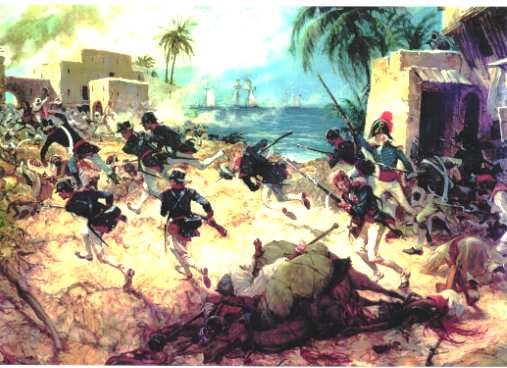
The ever-refreshing Christopher Hitchens (whose brief biograph of Jefferson I enjoyed, although I wish it had been more acerbic) has an interesting article up at City Journal: "Jefferson Versus the Muslim Pirates". Here's a snippet:
How many know that perhaps 1.5 million Europeans and Americans were enslaved in Islamic North Africa between 1530 and 1780? . . .

Some of this activity was hostage trading and ransom farming rather than the more labor-intensive horror of the Atlantic trade and the Middle Passage, but it exerted a huge effect on the imagination of the time—and probably on no one more than on Thomas Jefferson. Peering at the paragraph denouncing the American slave trade in his original draft of the Declaration of Independence, later excised, I noticed for the first time that it sarcastically condemned “the Christian King of Great Britain” for engaging in “this piratical warfare, the opprobrium of infidel powers.” The allusion to Barbary practice seemed inescapable.
Related Posts with Thumbnails