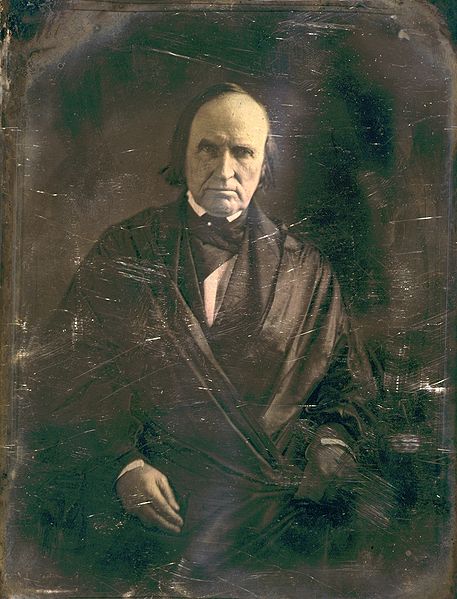
There are, I suppose, two ways of viewing John McLean. On the positive side, one can see him as a self-made man who rose from humble beginnings to attain positions of substantial responsibility, including member of Congress, member of the Ohio Supreme Court, Postmaster General and, for over thirty years, Associate Justice of the United States Supreme Court.
Also to his credit, he dissented from the Court's Dred Scott decision, and, as Earl M. Maltz notes, “he was a committed opponent of slavery” throughout his career.
I, however, tend to take a less charitable view of McLean. He was a quintessential political opportunist who repeatedly leaned whichever way the wind blew – and did not hesitate to stab his friends in the back if it suited his purpose. Most damningly, as John Quincy Adams's Postmaster General, in charge of a large patronage network, he did not hesitate to inflict harm on his boss in an attempt to curry favor with Andrew Jackson in anticipation of the 1828 election – a gambit that worked when Jackson appointed him to the Supremes in 1829.
Later, McLean did not hesitate to jump ship from the Democrats in favor of the Whigs, Free Soilers, Know Nothings, Republicans or any other party that might advance his interests. And without casting doubt on the sincerity of his Dred Scott dissent, the effort was amateurish and reads more like a campaign brochure than a legal opinion.
Because that it exactly what it was. For this man of modest talents (which is not to say he had none – he had been an able administrator of the Post Office, which is why Adams did not feel justified in firing him despite his disloyalty) and unrealistic sense of self-importance seems to have spent most of his career trying to position himself as a credible presidential candidate.
Dryly observing that “little in [McLean's] background made him an obvious candidate for the presidency,” William G. Ross, in an article entitled Presidential Ambitions of U.S. Supreme Court Justices: A History and a Cautionary Warning, catalogs McLean's almost comical attempts to obtain the nomination of almost any party that would have him:
All of which apparently left little time for the Supreme Court. “After reviewing McLean's papers in the Library of Congress, John Frank wryly reported that he had 'found there substantially nothing on the business of being a judge,' but that he had uncovered 'an endless stream of observations' concerning his perennial candidacy for the presidency.”
About the illustration (emphasis added):
Also to his credit, he dissented from the Court's Dred Scott decision, and, as Earl M. Maltz notes, “he was a committed opponent of slavery” throughout his career.
For example, while sitting on the Ohio Supreme Court in 1817, he declared in dictum that “viewing the question abstractly I could not hesitate to declare that a slave in any state or country, according to the immunitable principles of natural justice, is entitled to his freedom; that, that which had its origin in usurpation and fraud can never be sanctified into a right.” Pronouncements such as these led Senator Thomas Hart Benton of Missouri to declare that McLean was “abolitionist enough for anybody outside of a mad house - & his wife is abolitionist enough for all those who ought to be in one.”
I, however, tend to take a less charitable view of McLean. He was a quintessential political opportunist who repeatedly leaned whichever way the wind blew – and did not hesitate to stab his friends in the back if it suited his purpose. Most damningly, as John Quincy Adams's Postmaster General, in charge of a large patronage network, he did not hesitate to inflict harm on his boss in an attempt to curry favor with Andrew Jackson in anticipation of the 1828 election – a gambit that worked when Jackson appointed him to the Supremes in 1829.
Later, McLean did not hesitate to jump ship from the Democrats in favor of the Whigs, Free Soilers, Know Nothings, Republicans or any other party that might advance his interests. And without casting doubt on the sincerity of his Dred Scott dissent, the effort was amateurish and reads more like a campaign brochure than a legal opinion.
Because that it exactly what it was. For this man of modest talents (which is not to say he had none – he had been an able administrator of the Post Office, which is why Adams did not feel justified in firing him despite his disloyalty) and unrealistic sense of self-importance seems to have spent most of his career trying to position himself as a credible presidential candidate.
Dryly observing that “little in [McLean's] background made him an obvious candidate for the presidency,” William G. Ross, in an article entitled Presidential Ambitions of U.S. Supreme Court Justices: A History and a Cautionary Warning, catalogs McLean's almost comical attempts to obtain the nomination of almost any party that would have him:
In 1832, he hoped at various times to become the standard bearer of the National Republicans, the Democrats, or the Anti-Masons. In advance of the 1836, 1844, and 1848 elections, he pinned his hopes on the Whigs, and in 1848 and 1852 he was mentioned as a possible candidate of the Free Soil party. In advance of the 1856 election, McLean angled for the presidential nomination of the nativistic American (“Know Nothing”) Party while focusing his attention on the newly formed Republican Party. . . . McLean quietly sought the Republican nomination again in 1860, a year in which he received 22 votes at the convention of the Constitutional Union Party.
All of which apparently left little time for the Supreme Court. “After reviewing McLean's papers in the Library of Congress, John Frank wryly reported that he had 'found there substantially nothing on the business of being a judge,' but that he had uncovered 'an endless stream of observations' concerning his perennial candidacy for the presidency.”
About the illustration (emphasis added):
An imaginative and elaborate parody on the upcoming 1844 presidential campaign. The artist favors Whig nominee-apparent Henry Clay and is highly critical of incumbent John Tyler. The "chase" for the presidency leads to the White House (upper left) where Robert Tyler arouses his sleeping father saying, "Come wake up old Sampson, the Philistines are upon you!" President Tyler replies with a yawn: "Why Bobby my Pippin! I do believe I've been asleep! no matter I'm the People's favorite and belong to no Party. They will reelect me! If they don't I'll veto the whole concern d--n me!" His statement and the presence of a "Veto" paper on his desk allude to his liberal use of the presidential refusal to stymie Whig congressional efforts to establish a National Bank. In Robert Tyler's pocket is a scroll "Irish Repeal," referring to his support of that international movement. Approaching the steps of the White House, riding a beast which is half-horse and half-alligator (a mythical animal associated in popular lore with Clay's Kentucky), is Henry Clay. He exclaims triumphantly, "Hurrah! Old Kentuck will distance them all yet, and then the views of the lamented Harrisson will be carried out in full, and treachery will meet its reward." The sun rises behind him and an eagle with a streamer reading "E pluribus unum" flies ahead. Clay is followed by South Carolina Democrat John Calhoun, who remarks, "My old nullification Coota Turtle is rather a slow Coach! I am afraid he won't get out of this Clay Bank!" Taking the lower road (in keeping with his reputation for intrigue) is Martin Van Buren, riding a fox and exclaiming, "Confound Calhoun! He is right in my way! I'll take a short cut and though the path is crooked and rather dirty, I don't care so that I get in." Van Buren was derisively nicknamed "the Kinderhook fox." On the same path are two more presidential aspirants, James K. Polk(?) and Richard M. Johnson. The first, sitting on a donkey and waving a club, yells, "I'am an Old Soldier, but I shall never get in unless I can turn this Donkeys head the right way." Johnson, who has fallen off his horse, exclaims, "My old amalgamation Nag has got the blind staggers! and I can stump it no longer!" "Amalgamation" was common parlance for the melding of races, more specifically referring here to Johnson's common-law marriage and offspring with a mulatto woman, Julia Chinn. Off to the right, Massachusetts senator Daniel Webster sits by an open fire, cooking a cauldron of "Chowder" (a staple of his native New England), vowing, "I shant leave my Chowder! unless my country calls me." Behind him on horseback is Gen. Winfield Scott who calls over to War of 1812 Commodore Charles Stewart, seated in a boat on a lake, "Odds bullets and bayonets! I don't care about being President but if my friends insist upon it I'll serve! I say Commodore, cant you or I get in by a Coup-de-main!" Stewart replies, "I think not General! so I'll haul my wind! I am better fitted to govern the helm of old Ironsides than the helm of State." In the lower right corner, a man (possibly Supreme Court Justice John McLean) falls head first down an incline, saying, "If I thought I had a drop of Democratic blood in my veins I would let it out."