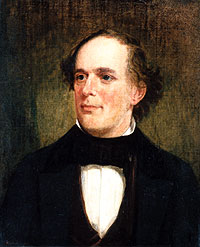
Showing posts with label Sherman M. Booth. Show all posts

Thursday, January 25, 2007

Ableman v. Booth XIX: Justice Crawford on Federal Supremacy

After explaining what his views of federal and state authority concerning enforcement of the Fugitive Slave Clause would be "[i]f this were a new question," Justice Crawford then conceded that he was constrained

"because the question has been authoritatively decided by the supreme court of the United States, the last and final constitutional exponent. Upon this, as upon all other questions arising out of the constitution of the United States, or the laws of congress, I am bound to yield obedience to the decisions of that tribunal, for upon such questions we are subordinate."

Justice Crawford was thus the only member of the Supreme Court of Wisconsin who explicitly admitted that the United States Supreme Court's decisions on federal constitutional matters were binding on state courts. Chief Justice Whiton did not expressly admit as much, but Justice Crawford correctly (in my view) took the position that the Chief Justice had tacitly conceded the issue:

"From these decisions [Prigg and others], I am led to view the subject as definitely settled, and the maxim stare decisis, as entirely applicable. I understand the chief justice to feel himself concluded by these decisions, so far as they declare the act of 1793 to have been the exercise of a constitutional power by congress to legislate, but that because they do not settle the question, whether the fugitive slave is entitled to a trial by jury, of the state where he is seized, and, because the act of 1850 confers certain powers on commissioners appointed by the federal courts, which are claimed to be judicial, the constitutionality whereof has not been determined by the supreme court of the United States, he is at liberty to inquire upon these points, whether the act of 1850 is obnoxious to the consitution."

As to the open issues identified by the Chief Justice, Associate Justice Crawford confessed that the arguments had "raised doubts in my mind," but in the end they "failed to produce that conviction which should justify a court, or judge, to pronounce a legal enactment void, because unconsitutional, and I am therefore unable to concur in the opinion that this law is unconsitutional."

Friday, January 19, 2007

Ableman v. Booth XIII: Edward Vernon Whiton

It's time to return to Sherman Booth. To get you back into the swing, let me introduce the next actor we'll encounter: Edward Vernon Whiton, the Chief Justice of the Supreme Court of Wisconsin.

Chief Justice Whiton was born in Massachusetts in 1805. He earned his law degree there and moved to Wisconsin in 1837. A Whig and later a Republican, Whiton served in the territorial legislature and at the state constitutional convention. When Wisconsin achieved statehood in 1848, he was elected a state circuit court judge and served ex officio as a justice of the State Supreme Court. When the Supreme Court was reorganized as a separate body in 1853, he became its first Chief Justice. He served in that position until his death in 1859. Brief biographies are available here and here

Time permitting, tomorrow I will discuss Chief Justice Whiton's opinion.

Saturday, January 13, 2007

Salmon Chase and The Fugitive Slave Clause

I don't know whether Abram Smith, Sherman Booth or Byron Paine ever met Salmon Portland Chase, but they had clearly absorbed Chase's arguments about the constitutionality of the Fugitive Slave Acts. You will recall that one of Associate Justice Smith's principal arguments was that the Fugitive Slave Clause did not delegate any power to Congress. The Clause was simply a compact between the States, unenforceable by Congress.

Well, this was exactly the argument that Chase had been making and popularizing since the late 1830s, as part of his thesis that the founders loathed slavery and provided in the Constitution that the federal government should have nothing to do with it:

"Chase . . . tried to interpret the [fugitive slave] clause almost out of existence. The section . . ., Chase pointed out, differed from other clauses in neglecting to delegate to Congress power to enforce it by appropriate legislation. Since all powers not delegated to the federal government were reserved to the states, Chase insisted that the clause was really a compact between the northern and southern states, and that 'each State must judge for itself as to the character of the compact, and the extent of the obligation created by it.' The laws of 1793 and 1850 involving the federal government in the capture of fugitives were unconstitutional, since Congress had no power on the subject."

Eric Foner, Free Soil, Free Labor, Free Men: The Ideology of the Republican Party Before the Civil War (Oxford Univ. Press 2d Ed. 1995) at 77.

Sound familiar?

This helps us understand, by the way, why many members of the Reconstruction Congress believed that it had the power to enforce the Thirteenth Amendment via civil rights legislation, even though that amendment contained no provision specifically delegating power to Congress to do so. It also helps explain why many members of the Reconstruction Congress believed that Section 1 of the Fourteenth Amendment was unnecessary. In Prigg v. Pennsylvania (1842), the Supremes had held -- contrary to Chase's arguments, that the Fugitive Slave Act of 1793 was constitutional: the Fugitive Slave Clause necessarily gave Congress, by implication, the power to enforce it. Members of the Reconstruction Congress reasoned or assumed that the Thirteenth Amendment similarly carried the necessary implication that Congress had the power it enforce it.

It was John Bingham of Ohio who drove his colleagues to include Section 1 in the Fourteenth Amendment because he was one of the few who understood that the implication of Barron v. Baltimore was that Congress did not have the power to enforce the provisions of the Bill of Rights against the States.

Friday, January 05, 2007

Ableman v. Booth XII: "A More Dread Calamity"


Associate Justice Abram D. Smith closed his opinion with a paragraph that presumably summarizes the hopes and fears of many northerners. As you read it, remember that it was released on June 7, 1854, just one week after Congress passed the Kansas-Nebraska Act on May 30:

“What, then, is to be done? Let the free states return to their duty, if they have departed from it, and be faithful to the compact, in the true spirit in which it was conceived and adopted. Let the slave states be content with such an execution of the compact as the framers of it contemplated. Let the federal government return to the exercise of the just powers conferred by the constitution, and few, very few, will be found to disturb the tranquility of the nation, or to oppose, by word or deed, the due execution of the laws. But until this is done, I solemnly believe that there will be no peace for the state or the nation, but that agitation, acrimony and hostility will mark our progress, even if we escape a more dread calamity, which I will not even mention.”

Earlier Posts:

Ableman v. Booth I
Ableman v. Booth II
Ableman v. Booth III
Ableman v. Booth IV
Ableman v. Booth V
Ableman v. Booth VI
Ableman v. Booth VII
Ableman v. Booth VIII
Ableman v. Booth IX
Ableman v. Booth X
Ableman v. Booth XI

"He Came Here With Black Perjury Upon His Soul"

I mentioned in an earlier post that the attorney who represented Sherman Booth in the legal proceedings arising out of the liberation of fugitive slave Joshua Glover was Byron Paine (pictured left, I'd guess in the early 1860s). According to the Wisconsin Court System site, Paine was an abolitionist and friend of Booth who represented him without pay.

But this post is dedicated to more mundane matters. Paine also represented John A. Messenger, who with Booth apparently formed part of the crowd that freed Glover. Like Booth, Messenger was criminally charged in federal court in Wisconsin with aiding and assisting the rescue of a fugitive slave, in violation of the Fugitive Slave Act of 1850. A related decision captures a bit of Paine's courtroom style.

A certain Mr. Jennings was, it seems, a chief prosecution witness against Messenger. His testimony against Messenger was apparently damning, and Paine does not seem to have dented Jennings' credibility, for in his closing Paine was none too subtle. Speaking of Jennings' testimony, Paine's defense was: "He came here [as a witness] with black perjury upon his soul . . . He stood there with black perjury upon his soul . . . He is perjured."

The source is a decision by the Wisconsin Supreme Court in a slander action that Jennings brought against Paine, Jennings v. Paine, 4 Wis. 358, 1855 WL 1921 (1855). The holding, by the way, was that Paine's speech in the courtroom was absolutely privileged.

Wednesday, January 03, 2007

Ableman v. Booth XI: Prigg v. Pennsylvania

The third and final hurdle that Justice Smith had to clear was Prigg v. Pennsylvania, in which the Supreme Court had ruled that the Fugitive Slave Act of 1793 was constitutional. Before he addressed that decision, he argued at length that the Fugitive Slave Act of 1850 also violated the Due Process Clause. Prigg did not address that issue. For that reason, among many others, the decision was not binding:

“In view of the dissentient opinions of the members of the supreme bench; in view of the discrepancy of opinion which has characterized all other decisions [on the issue]; in view of the fugitive character of the power here claimed by congress, leaping from article to article, from section to section, and from clause to clause, hovering now over a grant, then over a compact, fluttering now around an implication, then around an incident, to find whereon it may rest its foot; in view of the alarm which has seized upon many of the states in consequence of the enormous power which it has called upon congress to assume in its behalf, and the deep wounds which it seeks to inflict upon the rights and sovereignty of the states, and upon the great principles of human freedom; in view of all this, are we not justified in asking of the supreme court of the United States to review their decision . . .?”

Ableman v. Booth X: "There Is No Middle Ground"

The second objection that Justice Smith addressed was an intensely practical one. If the federal government was not empowered to enforce the Fugitive Slave Clause, how and by whom would the clause be enforced?

Again, it seems to me that Justice Smith’s answer comes up short. “[R]epudiat[ing] the degrading insinuation that state officers are less faithful to the constitution, than federal officers,” he simply affirmed that “every state officer, executive, legislative and judicial, who takes an oath to support the constitution of the United States, is bound” to enforce it. But what if they do not?

“The simple answer is, that when the state and federal officers become so regardless of their oaths and obligations as either question implies, anarchy or revolution, or both, must supervene, for the government would be a willful departure from the fundamental law of its organization, and the people would be absolved from their allegiance to it.”

To counterbalance this surprising and alarming conclusion, Justice Smith sought to demonstrate that the consequences of the alternative – granting federal power over matters covered by Article IV -- would be even more catastrophic:

“What would be thought . . . should congress pass a law to carry into effect that clause of the fourth article in regard to citizenship [i.e., the Privileges and Immunities Clause]? and declare pains and penalties against any state functionary who should fail to comply? What would be thought if congress should declare it a penitentiary offense, for any executive of a state to refuse to surrender a fugitive from justice? What state would submit to see its chief magistrate dragged before the federal tribunals, on charge of infraction of such a law . . .? And yet the power to legislate at all upon the subject, is assuming supreme and unlimited power over the whole matter. There is no middle ground.”

Sunday, December 31, 2006

Ableman v. Booth VIII: The Fugitive Slave Clause As Compact Between the States

My earlier post on Prigg v. Pennsylvania will provide some background that may be useful to understanding why Associate Justice Smith believed that the Fugitive Slave Act of 1850 was unconstitutional.

Justice Smith began by reviewing the debates at the Constitutional Convention that resulted in the various provisions contained in Article IV of the Constitution, including but not limited to the Fugitive Slave Clause. He argued that the debates showed that, in Article IV, when the Convention delegated powers to Congress, it did so explicitly. For example, Section 1 of Article IV, the Full Faith and Credit Clause, specifically provided that “the Congress may by general laws prescribe the manner in which such acts, records, and proceedings shall be proved, and the effect thereof.”

Justice Smith argued that, except to the extent that it explicitly granted powers to the federal government, Article IV was simply a series of compacts among the states about how to handle certain matters among themselves. Those compacts did not authorize or contemplate any involvement by the federal government:

“The history [of the Constitution Convention debates relating to Article IV] is important, as it not only justifies and requires a distinction to be taken between grants of power and articles of compact, but it clearly demonstrates that the convention all along discriminated between grants of power to the government, and articles of compact between the states, and was extremely jealous and cautious in making such grants, and only did so when it was deemed absolutely necessary.”

One of those compacts was
the Fugitive Slave Clause contained in Section 2 of Article IV, which stated:

"No person held to service or labor in one state, under the laws thereof, escaping into another, shall, in consequence of any law or regulation therein, be discharged from such service or labor, but shall be delivered up on claim of the party to whom such service or labor may be due."

This clause, Justice Smith asserted, was the result of a quiet agreement “that the states would deliver up such fugitives from labor. No power was asked for the federal government to seize them; no such power was dreamed of; the proposition that the states should respectively deliver them up, was acquiesced in without any dissent."

Later, Justice Smith quoted all of Section 2 of Article IV – the Privileges and Immunities Clause, the Extradition Clause and the Fugitive Slave Clause. “Here is the whole of the section, without one word from which a grant may be inferred or implied.”

Although Justice Smith had made a strong case for the proposition that the Fugitive Slave Clause granted the federal government no power, he still had to deal with several counter-arguments. I will turn to those next.

Saturday, December 30, 2006

Ableman v. Booth VII: "I Want My Skirts to be Clear"

Associate Justice Smith had rebuked Booth and his lawyer for trying to force him to rule on the consitutional issue and then held that technical defects in the warrant entitled Booth to discharge. At this point, there was no need for Justice Smith to rule on the constitutionality of the Fugitive Slave Act of 1850.

But at this point, Justice Smith does something strange. Having escaped the need to resolve the constitutional issue, he does so anyway. I will not pause to review his reasoning for doing so, which is unpersuasive, except to the extent it implicates his understanding of the relationship between the federal and state governments.

In the course of explaining himself, Justice Smith turns back to the issue of his own jurisdiction. In effect, he suggests that he, as a state judge, rather than a federal judge, should decide the constitutional issue, because the sovereignty of the states is at issue and the federal government should not determine the extent of its own powers. I quote the following passage at some length because it is a truly remarkable summary of federalist theory given its source:

"The judicial department of the federal government is the creature by compact of the several states, as sovereignties, and their respective people. That department can exercise no power not delegated to it. All power not delegated and not prohibited to the states, the states have expressly reserved to themselves and the people. To admit that the federal judiciary is the sole and exlusive judge of its own powers, and the extent of the authority delegated, is virtually to admit that the same unlimted power may be exercised by every other department of the general government . . .. But I solemnly believe that the last hope of free representative and federative government rests with the states. Increase of influence and patronage on the part of the federal government naturally leads to consolidation, consolidation to despotism, and ultimate anarchy, dissolution and all its attendant evils.

"If the sovereignty of the states is destined to be swallowed up by the federal government; if consolidation is to supplant federation, and the general government to become the sole judge of its own powers . . ., as an humble officer of one of the states, bound to regard the just rights and powers both of the union and the states, I want my skirts to be clear, and that posterity may not lay the catastrophe to my charge. . .

"Without the states there can be no union; the abrogation of state sovereignty is not a dissolution of the union, but an absorbtion of its elements. He is the true man, the faithful officer, who is ready to guard every jot of power rightfully belonging to each, and to resist the slightest encroachment or assumption of power on the part of either."

Ableman v. Booth VI: "A Wicked and Cruel Enactment"

Having duly chastised Booth's tactics, Associate Justice Smith addressed the claimed technical defects in the warrant and proceeded to find the warrant lacking in respects that are, let us say, trivial at best. They are not worth lingering over, except to see a judge engage in hypertechnicality in order to reach a particular result. For example, the warrant stated that Booth had aided the escape of Glover, who was held in service to Garland, but it did not state that Garland had "claimed" Glover. The warrant also stated that Glover was in custody when Booth aided his escape, but it did not state that Glover "was in such custody as a fugitive from labor."

Justice Smith then explained why he was prepared to rely on such trivialities:

"No greater strictness is applied to this warrant than the law applies to all process of that class; though a much stricter rule might be justified; for this is a wicked and cruel enactment, and those who feel compelled to execute it, may well require of those who demand official service at their hands, that in taking their 'pound of flesh' they shall not 'shed one drop of christian blood.'"

(Emphasis added)

For these reasons, Justice Smith concluded that the warrant was "clearly, substantially and radically insufficient, and the petitioner is therefore entitled to a discharge."

Ableman v. Booth IV: Smith on Jurisdiction


The proceedings in Wisconsin actually involved a number of cases and a number of decisions. The first of those decisions, In re Booth, 3 Wis. 1, 1854 WL 100 (1854), is by our friend, Associate Justice Abram D. Smith (pictured). It addresses a writ of habeas corpus that Sherman Booth filed after he was arrested but before he was indicted. To place the opinion in context, I must briefly describe what seems to have happened, in somewhat simplified form.

After Booth and others freed Glover on March 11, 1854, Booth was arrested on the basis of an order of Winfield Smith, "a commissioner duly appointed by the [federal] district court of the United States for said district [of Wisconsin]." In other words, Winfield Smith was not a state official or a federal judge, but rather an appointed federal "commissioner" under the
Fugitive Slave Act of 1850. As such, Section 1 of the Act gave him the powers of "arresting, imprisoning or bailing" "offenders for any crime or offense" under the Act.

To make a long story short, Booth was bailed, rearrested, rebailed and rearrested. Ultimately, on May 26, 1854, he was jailed to await indictment and trial.

Booth immediately petitioned the Wisconsin Supreme Court for a writ of habeas corpus. He argued that he should be freed for two reasons: first, the Fugitive Slave Act of 1850 was unconstitutional; and second, that the warrant that served as the basis for his arrest contained technical defects (such as the fact that it described Glover as "property" rather than using the statutory phrase "person held to service or labor").

Because the full court was not then in session, Associate Justice Smith heard the case alone on May 29 and 30, and issued his decision on June 7.

Before reaching the merits, Associate Justice Smith had to decide whether he even had jurisdiction to do so. Booth was in federal custody, but Smith was a state judge. Smith concluded that his exercise of jurisdiction would not impinge on the rights of the federal government because the warrant was issued by a commissioner and not by a federal judge. The commissioner was not independent and did not have true judicial powers:

"The warrant, by virtue of which the petitioner was held, was not issued by a federal judge or court, but by a commissioner of the United States. No exclusive or ultimate jurisdiction can be claimed for an officer of this kind. As one of the justices of the highest judicial tribunal of this state . . . I could not deny to any citizen or person entitled to the protection of the state, the proper process by which the validity of a warrant issued by such authority, could be examined. Nor can I admit, that a court commissioner, holding his appointment at the will of the court, responsible only to such court -- in fact, irresponsible and unimpeachable -- has the right or power to issue any process by which a citizen of the state may be imprisoned, that may not be examined, and its its validity tested, by the proper judicial authority of the state. . ..

" . . . [T]he States will never submit to the assumption, that United States commissioners have the power to hear and determine upon the rights and liberties of their citizens, and issue process to enforce their adjudications, which is beyond the examination or review of the state judiciary. . ..

"Every jot and tittle of power delegated to the federal government will be acquiesced in, but every jot and tittle of power reserved to the staes will be rigidly asserted, and as rigidly sustained."

Ableman v. Booth III: Abram D. Smith


Let's take a brief look at the first judge we're going to encounter. Abram D. Smith was born in 1811 in Lowville, New York. He became a lawyer and in 1842 moved to Milwaukee, Wisconsin, where he opened a practice.

When the Supreme Court of Wisconsin was reorganized in 1853, he was elected an Associate Justice. He served on the court until June 1859, when he was defeated. He was replaced, ironically enough, by Byron Paine, who had served as Sherman Booth's attorney in the various proceedings before the Wisconsin Supreme Court. He died in 1865.

A bit more about Associate Justice Smith may be found
here.

Ableman v. Booth II: Joshua Glover


Joshua Glover was the fugitive slave whom Sherman Booth and others freed on March 11, 1854. What do we know about him? The drawing to the right is supposedly of him, although I would guess it is entirely imaginative.

The little we know about Glover emerges from recitations in the opinions describing the affidavit made by his master seeking his return. The master, Benammi S. Garland, was "a farmer and carried on a farm about four miles from" St. Louis, Missouri. In March 1854, Glover was "forty-four or forty-five years of age," so he was born in about 1810. Garland purchased Glover "as a slave for life" in Missouri on January 1, 1849. Garland used Glover "as foreman on his said farm from the time of said purchase to the time of the escape" and "had seen the said Joshua daily" until then. Glover "ran away" "in the Spring of 1852" and had thus been at liberty for two years.

Physically, Glover was "about five feet, six or eight inches high, spare built, with rather long legs, very prominent knuckles, had large feet and hands, had a full head of wool, eyes small and inflamed, was of dissipated habits, was of rather an ashy black color, had one of his shoulders stiff from dislocation, and had stooping shoulders, and a slow gait."

Ableman v. Booth I


I haven't finished with Lemmon v. People yet, but I'm enjoying reading and writing about pre-War state court opinions that shed light on attitudes about slavery and the roles of the state and federal governments. I thought another interesting project would be to look into the state court decisions underlying the United States Supreme Court decision in Ableman v. Booth, 62 U.S. 506 (1859).

Very briefly (at this point), the Supreme Court case arose out of an incident in Wisconsin, in which Sherman M. Booth (pictured above), among others, freed a fugitive slave, Joshua Glover, who had been taken into custody by a Deputy United States Marshal pursuant to a warrant issued by a United States Federal District Judge. Booth was indicted and criminally convicted in federal court for aiding and abetting an escape in violation of the Fugitive Slave Act of 1850. A description of events is available
here.

Notwithstanding that the federal court was exercising jurisdiction, the Supreme Court of Wisconsin heard Booth's petition for habeas corpus, determined that the Fugitive Slave Act of 1850 was unconstitutional and Booth's incarceration therefore unlawful, and ordered him set free.

In the Supreme Court,
Chief Justice Taney wrote for a unanimous Court that the Supreme Court of Wisconsin lacked jurisdiction and reversed. In one of the many ironies of antebellum jurisprudence, Justice Taney endorsed in ringing language the principle of federal judicial supremacy:

"The Constitution was not formed merely to guard the States against danger from foreign nations, but mainly to secure union and harmony at home; for if this object could be attained, there would be but little danger from abroad; and to accomplish this purpose, it was felt by the statesmen who framed the Constitution, and by the people who adopted it, that it was necessary that many of the rights of sovereighty which the States then possessed should be ceded to the General Government; and that, in the sphere of action assigned to it, it should be supreme, and strong enough to execute its own laws by its own tribunals, without interruption from a State or from State authorities."

"The language of the Constitution, by which this power is granted, is too plain to admit of doubt or to need comment. It declares that 'this Constitution, and the laws of the United States which shall be passed in pursuance thereof, and all treaties made, or which shall be made, under the authority of the United States, shall be the supreme law of the land, and the judges in every State shall be bound thereby, anything in the Constitution or laws of any State to the contrary notwithstanding.'

"But the supremacy thus conferred on this Government could not peacefully be maintained, unless it was clothed with judicial power, equally paramount in authority to carry it into execution; for if left to the courts of justice of the several States, conflicting decisions would unavoidably take place, and the local tribunals could hardly be expected to be always free from the local influences of which we have spoken. And the Constitution and laws and treaties of the United States, and the powers granted to the Federal Government, would soon receive different interpretations in different States, and the Government of the United States would soon become one thing in one State and another thing in another. It was essential, therefore, to its very existence as a Government, that it should have the power of establishing courts of justice, altogether independent of State power, to carry into effect its own laws; and that a tribunal should be established in which all cases which might arise under the Constitution and laws and treaties of the United States, whether in a State court or a court of the United States, should be finally and conclusively decided. Without such a tribunal, it is obvious that there would be no uniformity of judicial decision; and that the supremacy, (which is but another name for independence,) so carefully provided in the clause of the Constitution above referred to, could not possibly be maintained peacefully, unless it was associated with this paramount judicial authority."

"[A]fter . . . the State judge or court [is] judicially apprized that the party is in custody under the authority of the United States, they can proceed no further. They then know that the prisoner is within the dominion and jurisdiction of another Government, and that neither the writ of habeas corpus, nor any other process issued under State authority, can pass over the line of division between the two sovereignties. He is then within the dominion and exclusive jurisdiction of the United States."

62 U.S. at 517-18, 523.

Although this language seems startling coming out of the mouth of Chief Justice Taney, it seems clearly correct. How, then, did the Supreme Court of Wisconsin justify its position and claim jurisdiction? On what grounds did that court determine that the Fugitive Slave Law of 1850 was unconsitutional? And was it correct? In future posts, I look at the decisions of the Wisconsin Supreme Court and discuss these and related issues.
Related Posts with Thumbnails