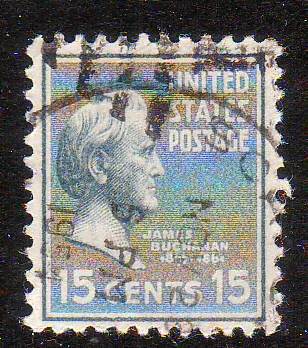
Showing posts with label James Buchanan. Show all posts

Thursday, January 07, 2010

Happy Birthday, Mr. President!


Our thirteenth president, Millard Fillmore, was born January 7, 1800, two hundred ten years ago today. I have written a number of posts over the course of this blog trying to illustrate and explain why he was a fine man and an outstanding president. I urge you to click on the Millard Fillmore tag and take a look at a post or two to get a taste.

Meanwhile, here is something to think about. What if Fillmore, against all odds, had been reelected president in 1856 on the American Party ticket, and occupied the White House in 1860?

Fillmore demonstrated in the Crisis of 1850 that he was no milquetoast. While he fervently sought compromise (and took effective action to achieve it), he also made clear that he would resolutely oppose, by military action if necessary, any attempt to disrupt the Union, ordering federal troops to New Mexico to defend against possible attack by Texas.

In 1860, retired from politics, he displayed the same instincts. Although he was critical of the Republicans for their unwillingness, in his view, to compromise, he was aghast at President James' Buchanan's failure to take military steps to defend the Union. Fillmore's biographer, Robert J. Rayback, describes the former president's position:
On the eve of war Fillmore's criticism was not confined to Republicans. When President Buchanan did not take quick military action to stop South Carolina's secession, Fillmore labeled it a "mistake." "That the general government is sovereign . . . admits of no doubt in my mind," he asserted. From that precept, he argued that no state could "set up its will against" the national government. "Secession and all such acts are absolutely void." Buchanan made his "mistake," Fillmore thought, when he said that the national government has "no authority to 'coerce a state.'" In reality, those who passed the ordinance of secession, Fillmore thought, should have been "regarded as an unauthorized assembly of men conspiring to commit treason, and as such liable to be punished like any other unlawful assembly engaged in the same business."

In all probability, considering his actions in 1850, had Fillmore been in Buchanan's place he would have strengthened the federal garrisons in the Deep South and would have been prepared, if conciliation failed, to use force against the secessionists.

Happy Birthday, Mr. President.

Saturday, January 02, 2010

James Buchanan Declines the Supreme Court: Was Polk Suprised?


In my recent post discussing President James K. Polk's offer to nominate James Buchanan to the Supreme Court in 1846, I inferred that Polk was not surprised when Buchanan declined the offer on Saturday August 1, 1846. I have located Polk's diary entry describing his meeting with Buchanan that day, and he certainly does not sound surprised. Apparently confirming this, Polk had already done his homework on an alternate nominee, and was prepared to nominate Robert C. Grier:
Mr. Buchanan called about 6 O'Clock P. M. [on August 1, 1846] and informed me that he had decided to remain in the Cabinet and not to accept the offer which I had made him to appoint him Judge of the Supreme Court. He said that he did this cheerfully, although he had long desired a seat on the bench, and that now he would stick to me & go through my administration with me. I then told him that I would nominate Judge Greer [sic] of Pittsburg to the vacant seat on the bench on monday next [i.e., Monday August 3, 1846]. He replied that he would be entirely satisfied with Judge Greer's [sic] appointment.

I can almost hear Polk groaning when he listens to Buchanan announcing "that now he would stick to me & go through my administration with me."

The illustration is courtesy of Pop Art Machine.

Friday, January 01, 2010

Associate Justice James Buchanan?


Did you know that James Buchanan almost became an Associate Justice of the United States Supreme Court in 1846? I didn’t either. Robert W. Merry tells the unlikely tale in his interesting and enjoyable biography of James K. Polk, A Country of Vast Designs.


The story begins two years earlier, with the death of Associate Justice Henry Baldwin in April 1844. Wikipedia reports that President John Tyler made two nominations before he left office in March 1845, both of whom were rejected.


In December 1845, president James K. Polk nominated George Washington Woodward to the vacant seat. Polk considered Woodward, a Pennsylvanian then serving as a Pennsylvania state court judge, as a “sound, original, & consistent democrat, of the strict construction school.” Baldwin had been from Pennsylvania, and I assume the Polk selected Woodward to preserve the seat for the politically important Keystone State. (Both of President Tyler’s rejected nominees had also been from Pennsylvania, making pretty clear that both parties regarded the position as reserved for that state.) Perhaps finding a worthy member of the Pennsylvania bar also accounts for Polk's delay.

James Buchanan – another Pennsylvanian – was serving at the time as Secretary of State. Polk’s leading cabinet officer was also the most annoying. Buchanan, with his eye constantly on future advancement, provided advice that shifted constantly with the political winds. On Oregon, for example, he was initially dovish, urging the president not to risk war with Great Britain. When he perceived, however, that Lewis Cass of Michigan was riding a groundswell of popularity by urging an aggressive stance, Buchanan performed a dramatic about-face and attempted to erase evidence of his earlier position.

The politically sensitive Buchanan vehemently objected to Woodward’s nomination, and late on Christmas evening, 1845, Buchanan went to the White House to complain to the president. In faction-riven Pennsylvania, the Democratic faction led by Buchanan and Simon Cameron considered Woodward an enemy. “The secretary complained bitterly that Polk had not alerted him in advance and accused Polk of undermining his political standing in Pennsylvania with numerous adverse patronage decisions,” a charge Polk vehemently denied.


Supreme Court nominations were acted on far more quickly in those days. Within a month, on January 22, 1846, the Senate voted on Woodward’s nomination – and rejected him by a tally of 20-29. Circumstantial evidence suggested that Buchanan and his crony Simon Cameron were largely responsible for the administration’s embarrassment:


The entire Whig caucus had voted against [Woodward], along with six Democrats – Cameron, [Thomas Hart] Benton [of Missouri], Ambrose Sevier and Chester Ashley of Arkansas, and David Yulee and James Westcott of Florida. Polk knew Cameron, Sevier, and Westcott were intimate friends of Buchanan, presumably susceptible to entreaties from the secretary to support the president. Clearly, Buchanan had not supported the administration in its hour of need.


In fact, it was worse than that. It appeared that Buchanan had been angling for the Supreme Court position himself and had engineered Woodward’s defeat in order to position himself as the next nominee:


Worse, Polk heard that Buchanan had expressed hopes of getting the job even before the Woodward vote. “The information given me . . .,” wrote Polk to his diary, “left the painful impression that Mr. Buchanan has been willing to see . . . Mr. Woodward rejected by the Senate in order to obtain the office himself.” Later that evening the president received visits from Vice President [George M.] Dallas, Senator Daniel Dickinson of New York, and [William] Allen of Ohio. They were indignant. The six errant Democrats had ignored all arguments in favor of the highly qualified Woodward, they reported, and voted simply for political effect. Cameron was the apparent ringleader, they said, and immediately after the vote rumors began floating across the Senate floor that Buchanan would be the next nominee. Sure enough, Polk shortly received a letter from Benton recommending Buchanan for the job.


Privately, Polk was irate, but he did not confront or take action against Buchanan – part of a strange pattern in which the president seemed reluctant to take on his disloyal cabinet member.

Things took a strange turn five months later. Although Polk had vowed that Buchanan would never get the judicial position he apparently wanted, on June 10, 1846, Polk offered his secretary of state the vacancy. Polk never explained why, and his motives must therefore remain a mystery. Perhaps he viewed it as a graceful way of booting the every-annoying Buchanan out of the cabinet. Even if Old Buck declined the offer, perhaps he would display a little more loyalty to his chief. Placating the irascible and unpredictable Benton was crucial to Polk, and perhaps that also played a role.

At all events, Buchanan appeared delighted by Polk's offer, and on June 28 he reported that he would accept the nomination.

After that, strange became bizarre. First, Polk and Buchanan disagreed as to the timing of the announcement of the nomination. On July 1, Polk told Buchanan that he would send the nomination to the Senate shortly before Congress was scheduled to adjourn (roughly the beginning of August, one month hence). Polk apparently wanted the Senate first to focus on and deal with pressing policy matters. He may also have felt that an early nomination would only give Buchanan’s enemies time to rally their forces.

Buchanan, in turn, pushed for an immediate nomination, suggesting that intervening international events might preclude his departure from State.


Apparently sensing that Buchanan’s mind was not entirely made up, on July 12 Polk tried to force the issue by seeking Buchanan’s approval to send a letter to U.S. ambassador Louis McLane in London with an offer to become Buchanan’s successor. Buchanan suggested that Polk refrain from sending the letter, since he (Buchanan) might change his mind.

Finally, on or about August 1, Buchanan “stunned Polk with the news” that he would decline the Supreme Court offer and remain in the cabinet. Since timing was no longer an issue (Congress was scheduled to adjourn in a week), Buchanan’s motivation is unclear. Merry suggests that Buchanan may have been concerned that he might face considerable opposition that might damage his political reputation. It may also be that he simply concluded that remaining at State provided the most likely path to the presidency.


Although Merry characterizes Polk as “stunned” by Buchanan’s decision, I suspect he fully expected it, because he seems to have been prepared with another candidate. It appears that Polk immediately nominated yet another Pennsylvanian – a relatively obscure state trial court judge by the name of Robert C. Grier. Grier was unanimously approved by the Senate on August 4, 1846 – only three days after Buchanan had turned down the job.


Both the unanimous vote and subsequent events suggest that Grier was acceptable to Buchanan, and at least that Buchanan did not regard him as a political enemy, as he had Woodward. Alert readers may note that, in the run-up to the Supreme Court’s issuance of its decision in the Dred Scott case in March 1857, Buchanan did not hesitate to write to Grier to urge him to join the southern majority on the Missouri Compromise issue. Grier, in turn, promptly responded to Buchanan that he was prepared to rule in a manner that would accommodate the wishes of the president-elect.

As long-time readers know, I like a good what-if, and this suggests a really good one. Buchanan may have imagined that a Supreme Court justiceship might have served as a stepping-stone to the presidency, but that was unprecedented. If Buchanan had been on the Court in 1856 and unavailable, for all practical purposes, as a potential nominee, who might the Democrats have nominated in his stead? As I recall, the Democrats selected Buchanan that year because he was about the only person of any stature they could find who had not taken a stand on Stephen A. Douglas’s Kansas-Nebraska Act. (The fact that he was from the crucial state of Pennsylvania was also a big plus.) Who else would have satisfied that criterion? And if the Democrats had selected a more divisive candidate (Douglas, for example), might Republican John C. Fremont have been elected? And then what? Civil War in 1857?

Thursday, August 27, 2009

"I regret beyond expression that you believed me to be an emissary of Mr. Clay"


Sorry, but I have an irresistible urge to dump on James Buchanan a little. I did say something nice about Old Buck once or twice, but the truth is that it's a whole lot easier and more fun to abuse him. Can you say, "Low hanging fruit"?

This installment dates to fairly early in Buchanan's career, 1827, when Buck was a member of the House of Representatives. But before I get to Buck, I need to give you some background.

The background is the famous “corrupt bargain” of 1825. In the run-up to the presidential election of 1824 there were four or five contenders. John C. Calhoun dropped out early in 1824, swamped by enthusiasm for Andrew Jackson in Pennsylvania. In the fall elections, none of the remaining four candidates obtained a majority of electoral votes. This meant that, under the Twelfth Amendment, the trailing candidate, Speaker of the House Henry Clay, dropped from contention. The remaining three – John Quincy Adams, William H. Crawford of Georgia and Andrew Jackson – advanced to the final round. The winner would be selected by the House of Representatives, with each state's delegation voting as a unit and getting one vote. A majority of state delegations (13 of 24) was required to declare a winner.

This isn't the place to go into gory detail about the alleged “corrupt bargain”. Suffice it to say that Clay used his influence as Speaker of the House to help convince the delegations of three states that he had won and in which Jackson had finished second (Kentucky, Missouri and Ohio) to vote for “Quinzy”. Adams prevailed with a bare majority of 13 state delegations (Jackson had 7, Crawford 4). Thereafter Adams nominated Clay as his Secretary of State, a position then regarded as the principal stepping-stone to the presidency. Jackson and his supporters cried foul, maintaining that Adams had gained office only by entering into a “corrupt bargain” with Clay.

Over two years later, on March 27, 1827, the Jacksonian storyline took an odd twist that appeared both to enhance the credibility of an explicit “bargain” and to emphasize the incorruptibility of Old Hickory. On that date, the Fayetteville Carolina Observer published a letter by Virginia planter Carter Beverley asserting that Clay's friends had approached Jackson with a deal before Clay sealed his corrupt bargain with Adams. In a nutshell, Clay had offered to make the Old Hero president if he agreed not to make Adams his Secretary of State. Old Hickory had virtuously and indignantly rejected the offer.

The wonderful James Parton quotes extensively from Beverly's letter in the third volume of his Life of Jackson (paragraph breaks added):
I have just returned from General Jackson's. I found a crowd of company with him. Seven Virginians were of the number. He gave me a most friendly reception, and urged me to stay some days longer with him.

He told me this morning, before all his company, in reply to a question that I put to him concerning the election of J. Q. Adams to the presidency, that Mr. Clay's friends made a proposition to his friends, that, if they would promise, for him [General Jackson] not to put Mr. Adams into the seat of Secretary of State, Mr. Clay and his friends would, in one hour, make him [Jackson] the President.

He [General Jackson] most indignantly rejected the proposition, and declared he would not compromise himself; and unless most openly and fairly made the President by Congress, he would never receive it. He declared, that he said to them, he would see the whole earth sink under them, before he would 'bargain or intrigue for it.'"

Jacksonian newspaper editors knew a good thing when they saw it. Duff Green, a cohort of John Calhoun and Jackson (who were at this point allied), promptly republished the story and charge in his United States Telegraph.

Clay denied the story but otherwise bided his time. Soon enough, Jackson fell into the trap by writing a letter, made public on June 5, 1827, endorsing and elaborating on Beverley's story. Among other things, Jackson revealed that he had been informed of Clay's offer by “a member of Congress of high respectability.” James Parton again quotes from letter (paragraph breaks added):
Early in January, 1825, a member of Congress, of high respectability, visited me one morning, and observed that he had a communication he was desirous to make to me; that he was informed there was a great intrigue going on, and that it was right I should be informed of it; that he came as a friend, and let me receive the communication as I might, the friendly motives through which it was made he hoped would prevent any change of friendship or feeling in regard to him. To which I replied, from his high standing as a gentleman and member of Congress, and from his uniform friendly and gentlemanly conduct toward myself, I could not suppose he would make any communication to me which he supposed was improper. Therefore, his motives being pure, let me think as I might of the communication, my feelings toward him would remain unaltered.

The gentleman proceeded: He said he had been informed by the friends of Mr. Clay, that the friends of Mr. Adams had made overtures to them, saying, if Mr. Clay and his friends would unite in aid of Mr. Adams' election, Mr. Clay should be Secretary of State; that the friends of Mr. Adams were urging, as a reason to induce the friends of Mr. Clay to accede to their proposition, that if I were elected President, Mr. Adams would be continued Secretary of State (innuendo, there would be no room for Kentucky); that the friends of Mr. Clay stated, the West did not wish to separate from the West, and if I would say, or permit any of my confidential friends to say, that in case I were elected President, Mr. Adams should not be continued Secretary of State, by a complete union of Mr. Clay and his friends, they would put an end to the presidential contest in one hour. And he was of opinion it was right to fight such intriguers with their own, weapons.

To which, in substance, I replied – that in politics, as in every thing else, my guide was principle; and contrary to the expressed and unbiased will of the people, I never would step into the presidential chair; and requested him to say to Mr. Clay and his friends (for I did suppose he had come from Mr. Clay, although he used the term of' Mr. Clay's friends) that before I would reach the presidential chair by such means of bargain and corruption, I would see the earth open and swallow both Mr. Clay and his friends, and myself with them. If they had not confidence in me to believe, if I were elected, that I would call to my aid in the cabinet men of the first virtue, talent, and integrity, not to vote for me.

The second day after this communication and reply, it was announced in the newspapers that Mr. Clay had come out openly and avowedly in favor of Mr. Adams. It may be proper to observe, that, on the supposition that Mr. Clay was not privy to the proposition stated, I may have done injustice to him. If so, the gentleman informing me can explain.

Clay then pounced. He again publicly denied the report and this time also demanded that Jackson reveal the identity of the “member of Congress of high respectability” who had served as the source. “'I demand the witness,' he thundered [according to Robert Remini], 'and await the event with fearless confidence.'”

You can probably see where this is going. It soon came out that the source was none other than Jacksonian Congressman James Buchanan of Pennsylvania. The only problem was that Buchanan's story was untrue.

Caught between a rock and a hard place, Buchanan issued a public letter, printed in the Lancaster Journal on August 6, 1827, in which he asserted that the whole thing had been a misunderstanding. Jackson, he suggested, had misinterpreted statements that Buchanan had made to him in a conversation held at the very end of 1824. Parton quotes from Buchanan's letter (paragraph breaks added):

The duty which I owe to the public, and to myself, now compels me to publish to the world the only conversation which I ever held with General Jackson, upon the subject of the last presidential election, prior to its termination. . . .

On the 30th of December, 1824, (I am able to fix the time, not only from my own recollection, but from letters which I wrote on that day, on the day following, and on the 2d of January, 1825,) I called upon General Jackson. After the company had left him, by which I found him surrounded, he asked me to take a walk with him; and, while we were walking together upon the street, I introduced the subject. I told him I wished to ask him a question in relation to the presidential election; that I knew he was unwilling to converse upon the subject; that, therefore, if he deemed the question improper, he might refuse to give it an answer: that my only motive in asking it, was friendship for him, and I trusted he would excuse me for thus introducing a subject about which I knew he wished to be silent. His reply was complimentary to myself, and accompanied with a request that I would proceed.

I then stated to him there was a report in circulation, that he had determined he would appoint Mr. Adams Secretary of State, in case he were elected President, and that I wished to ascertain from him whether he had ever intimated such an intention; that he must at once perceive how injurious to his election such a report might be; that no doubt there were several able and ambitious men in the country, among whom I thought Mr. Clay might be included, who were aspiring to that office; and, if it were believed he had already determined to appoint his chief competitor, it might have a most unhappy effect upon their exertions, and those of their friends; that, unless he had so determined, I thought this report should be promptly contradicted under his own authority. I mentioned it had already probably done him some injury. . . .

After I had finished, the General declared he had not the least objection to answer my question; that he thought well of Mr. Adams, but he never said or intimated that he would, or would not, appoint him Secretary of State; that these were secrets he would keep to himself – he would conceal them from the very hairs of his head; that if he believed his right hand then knew what his left would do on the subject of appointments to office, he would cut it off and cast it into the fire; that if he ever should be elected President, it would be without solicitation, and without intrigue, on his part; that he would then go into office perfectly free and untrammeled, and would be left at perfect liberty to fill the offices of the government with the men whom, at the time, he believed to be the ablest and the best in the country.

I told him that this answer to my question was such a one as I had expected to receive, if he answered it at all; and that I had not sought to obtain it for my own satisfaction. I then asked him if I were at liberty to repeat bis answer? He said that I was at perfect liberty to do so, to any person I thought proper. I need scarcely remark that I afterward availed myself of the privilege.

The conversation on this topic here ended, and in all our intercourse since, whether personally, or in the course of our correspondence, General Jackson never once adverted to the subject, prior to the date of his letter to Mr. Beverly. I called upon General Jackson, upon the occasion which I have mentioned, solely as his friend, upon my individual responsibility, and not as the agent of Mr. Clay or any other person.

“Mortified by the testimony of his Pennsylvania friend [says Merrill Peterson], Jackson retired from the controversy without another word.” Privately, however, he was, in the words of Robert Remini, “livid over the Buchanan letter. 'The outrageous statements of Mr. Buchanan will require my attention,' he rumbled to his friend and neighbor William B. Lewis.”

James Parton quotes extensively from Jackson's letter to Lewis (or perhaps a second letter to him). Jackson seems to have believed both that Buchanan's 1825 (or 1824) inquiry to him was “corrupt[]” and that his 1827 letter describing the conversation was a lie (once again, paragraph breaks added):
Your observations with regard to Mr. Buchanan are correct. He showed a want of moral courage in the affair of the intrigue of Adams and Clay – did not do me justice in the expose he then made, and I am sure about that time did believe there was a perfect understanding between Adams and Clay about the presidency and the Secretary of State. This I am sure of. But whether he viewed that there was any corruption in the case or not, I know not; but one thing I do know, that he wished me to combat them, with their own weapons – that was, let my friends say if I was elected I would make Mr. Clay Secretary of State. This, to me, appeared deep corruption, and I repelled it with that honest indignation as I thought it deserved.

Buchanan, for his part, could only grovel. Remini again: “Meanwhile, the hapless meddler apologized for misleading the general. 'I regret beyond expression,' he wrote, 'that you believed me to be an emissary of Mr. Clay.'”

The illustration is taken from The Wasp's Stuff. Excellent!

Saturday, June 20, 2009

Two Short Takes on Historical Inevitability


Having posted recently on the inevitability of the Civil War (or lack thereof), I can't miss the opportunity to flag Dimitri's recent post sardonically noting an attempt by the Director of James Buchanan's Wheatland estate to revive Old Buck's reputation by asserting that nobody elected in 1856 could have averted the war. As I have suggested here and here, quite possibly the opposite is true.

All of which brings to mind one of my favorite quotes, by Merrill D. Peterson, concerning the February 28, 1844 explosion on board the USS Princeton, which killed (among others) John Tyler's Secretary of State Abel P. Upshur and resulted in the installation of John Caldwell Calhoun as his successor. The explosion, Peterson observed, was "one of those random events which in its consequences makes a mockery of every attempt to impose some grand law on the history of nations." I suppose the same characterization might apply to the fact that "His Accidency" became president in the first place.

Tuesday, March 17, 2009

"A few striking examples"


When he left him this morning, James Buchanan was asserting that, if Section 25 of the Judiciary Act of 1789 were repealed, federal laws “would thus be entirely annulled.” He proceeded to give “a few striking examples” – hypotheticals that illustrated the point.

His first example took aim directly at South Carolina, the tariff and nullification:
Suppose the Legislature of one of the States, believing the tariff laws to be unconstitutional, should determine that they ought not to be executed within its limits. They accordingly pass a law, imposing the severest penalties upon the collector and other custom-house officers of the United States within their territory, if they should collect the duties on the importation of foreign merchandise. The collector proceeds to discharge the duties of his office under the laws of the United States, and he is condemned and punished before a State court for violating this State law.

Repeal of Section 25, Buchanan asserted, would allow the unnamed state to “nullify” the tariff:
Repeal this section, and the decision of the State court [convicting the collector] would be final and conclusive; and any State could thus nullify any act of Congress which she deemed to be unconstitutional.

Such a result would be disastrous, for the choices would be dissolution or war:
If no such appeal [to the Supreme Court] existed, then, upon the occurrence of cases of this character, the General Government would be compelled to determine whether the Union should be dissolved, or whether there should be a recurrence to force – an awful alternative, which we trust may never be presented. We will not attempt further to portray the evils which might result from the abandonment of the present judicial system. They will strike every reflecting mind.

Thirty years later, then President Buchanan confronted a similar choice between dissolution or war. As I have discussed in the past, he regrettably took the position that, although secession was unauthorized, the federal government lacked the power under the Constitution to employ (in his earlier words) “a recurrence to force” to prevent it.

"These laws would be entirely annulled"


Over the weekend, I referred to a report issued by the House Judiciary Committee on January 24, 1831 endorsing a bill that would have repealed Section 25 of the Judiciary Act of 1789. Section 25 then authorized the United States Supreme Court to review, among other things, final judgments of state supreme courts holding federal statutes to be “invalid”. The proposal had obvious application to the then-simmering Nullification dispute.

The minority “Counter Report” was written by none other than Rep. James Buchanan of Pennsylvania. Since most people (including me) have little good to say about him, I thought I’d take a look at what seems to have been Mr. Buchanan’s finest hour.

The most interesting thing about Buchanan’s report is that it takes on nullification fairly directly. If Section 25 were repealed,
[t]he judiciary of the States might refuse to carry into effect the laws of the United States; and without that appeal to the Supreme Court which the 25th section authorizes, these laws would be entirely annulled, and could not be executed without resort to force.

In the next installment, I’ll look at “a few striking examples” that Buchanan uses to illustrate his point.

Saturday, March 14, 2009

James Buchanan, Savior?


Lawrence Solum recommends an article by Mark A. Graber, James Buchanan as Savior? Judicial Power, Political Fragmentation, and the Failed 1831 Repeal of Section 25. Here's a portion of the abstract:
James Buchanan is often credited with being the unlikely savior of judicial review in early Jacksonian America. In 1831, Buchanan, then a representative from Pennsylvania, issued a minority report criticizing the proposed repeal of Section 25 of the Judiciary Act of 1789 that is generally credited with convincing a skeptical Congress that fundamental constitutional norms required federal judicial oversight of state courts and state legislatures. This paper claims that federalism and political fragmentation were more responsible than James Buchanan for the failed repeal of Section 25 . . ..

Unfortunately, the full abstract suggests that Prof. Graber (the author of a book on Dred Scott that I haven't read) is somewhat longwinded and given to jargon ("Judicial power, the evidence from 1831 and other times suggests, thrives in a political environment more characterized by intercurrence than realignment.").

Nonetheless, the underlying subject matter looks interesting. For you non-lawyers, the "Section 25" of the title is Section 25 of the Judiciary Act of 1789, passed by the First Congress to set up the federal court system. The text is here. Section 25, in Prof. Graber's words,
authorized the Supreme Court to review state court decisions upholding state laws against federal constitutional attack, declaring federal laws unconstitutional, or rejecting claims of federal constitutional right. Repeal for all practical purposes would have abolished federal judicial review of state laws and severely curtailed federal judicial review of national laws.

Apparently, in 1831, the House Judiciary Committee issued a report recommending the repeal of Section 25. "[James] Buchanan, then a representative from Pennsylvania, issued a minority report criticizing the repeal," and his analysis carried the day.

The topic looks particularly interesting because of the date: 1831 was fewer than two years before the Nullification Crisis. The proposed repeal of Section 25 would have facilitated Nullification tremendously. Or, rather, perhaps it would have made political Nullification unnecessary, because the same end could have been accomplished through the state judiciary. Assume, for example, that the South Carolina Supreme Court held in 1832 that the tariff was unconstitutional and ordered imported goods released without payment of the tariff. No Section 25, no appeal to the U.S. Supreme Court, no remedy.

I haven't looked at the Judiciary Committee Report yet. Who wants to bet there was a South Carolinian or two sitting on the Committee?

Note to self: check David Currie.

Sunday, February 22, 2009

"Jacksonian Antislavery and the Politics of Free Soil"


Having posted several quibbles concerning minor inaccuracies and inconsistencies in Jonathan H. Earle’s Jacksonian Antislavery and the Politics of Free Soil, 1824-1854, I thought I should make sure that the record is clear: this is an eye-opening book.

The growth of the anti-slavery (or more properly anti-slavery extension) movement in the north in the decades before the Civil War is generally thought of as a Whiggish phenomenon. Whiggish types, absorbing via the Second Great Awakening the evangelical morality that also gave rise to the temperance campaign, increasingly came to regard slavery as a sin and moral blot on the body of the Republic. Yes, there may have been a few oddball Democrats who saw the light and ultimately tagged along, but for the most part northern Democrats seemed to be amoral at best: Lewis Cass inventing popular sovereignty, Franklin Pierce, Stephen Douglas and James Buchanan generally toadying to the south and the southern wing of their party.

Professor Earle sets out to correct this misimpression. In fact, a number of Democrats led the way in identifying slavery and the slave power as enemies. One of the delights of the book lies in meeting and getting to know previously unknown or indistinct political figures: Thomas Morris of Ohio and Preston King of New York (both of whom I have discussed before); John P. Hale, who unexpectedly precipitated a dramatic political realignment in New Hampshire, previously the “South Carolina of the North”; Marcus Morton of Massachusetts; and even David Wilmot, otherwise a vague figure who in most narratives mysteriously appears out of nowhere, only to disappear again into the mist.

More importantly, Professor Earle explores why there seems to have been a correlation between radical, hard-money, anti-Bank Democrats and opposition to the expansion of slavery. One key, he argues, was the tendency of radical democrats to perceive conspiratorial coalitions of interests that threatened to dominate yeoman farmers and urban proletariat: manufacturers who clamored for high tariffs, monopolistic corporations that shielded capitalists from ordinary rules of individual liability, and most famously the Monster Bank.

With a little squinting, Professor Earle suggests, slaveholders could look a lot like an aristocratic special interest. In an earlier post, I quoted from an 1839 speech by Senator Thomas Morris (Dem – Ohio), in which he not only drew the parallel but argued that the Bank Power and the Slave Power had joined forces:
But all will not do; these two powers must now be united; an amalgamation of the black power of the South with the white power of the North must take place, as either, separately, cannot succeed in the destruction of the liberty of speech and the press and the right of petition. Let me tell gentlemen that both united will never succeed. As I said on a former day, God forbid that they should ever rule this country. I have seen this billing and cooing between these different interests for some time past; I informed my private friends . . . that these powers were forming a union to overthrow the present [Van Buren] Administration . . ..

* * *

[T]he assertion has gone forth that we have twelve hundred millions of slave property at the South; and can any man so close his understanding here as not plainly to perceive tht the power of this vast amount of property at the South is now uniting itself to the banking power of the North, in order to govern the destinies of this country? Six hundred millions of banking capital is to be brought into this coalition, and the slave power and the bank power are thus to unite in order to break down the present Administration. There can be no mistake, as I believe, in this matter. The aristocracy of the North, who, by the power of a corrupt banking system, and the aristocracy of the South, by the power of the slave system, both fattening upon the labor of others, are now about to unite in order to make the reign of each perpetual. Is there an independent American to be found who will become the recreant slave to such an unholy combination? Is this another compromise to barter the liberties of the country for personal aggrandizement? “Resistance to tyrants is obedience to God.”

Almost ten years later, Pennsylvania Democrat David Wilmot spoke in similar terms:
“The gallant and true men who fought the battle of popular rights against privilege and monopoly – who aided in crushing the monster bank, and wresting from the grasp of eastern capital the hard earnings of labor, will never fight the battles of slavery propagandism” [Wilmot declared]. Again investing the rhetoric of antislavery with an older brand derived from the pen of William Leggett, Wilmot insisted that since southern capital had “a thousand millions of dollars invested in slaves,” the current struggle, like the bank war in the 1830s, was best viewed as one between “capital and labor.”

But what seems to given urgency to the threat presented by the Slave Power was the concept of Free Soil, which Professor Earle asserts is the crucial and overlooked component of the “free soil, free labor, free men” trilogy. Free Soil was not, Professor Earle argues, simply a “synonym for [the] more developed concept of free labor, an ideology . . . closely linked with the rise of capitalism in the North. . . . [M]any Free Soilers . . . came from remote rural areas or radical labor backgrounds and felt nothing but contempt for Whiggish free-labor views.”

The term originally referred to land reform: “the free distribution of the public lands to poor settlers, in the form of inalienable homesteads.” Although containing slavery was an incidental benefit, the scheme also enhanced democracy (more of those Jeffersonian yeoman farmers), reduced unemployment and raised wages, and attacked privileged land monopolists and speculators.

In time, however, “the Free Soil ideology [evolved] from a program for land reform to a bulwark against slavery expansion.” It was precisely the elusiveness of the phrase that made Free Soil so politically potent:
During the 1840s and 1850s, homesteads became unalterably fused with the issue of slavery expansion . . .. This link underscored Free Soil’s rhetorical elusiveness and ambiguity. The potent term was appropriated by a host of other groups, movements, and political parties, including the Free Soil Party and, later, the Republicans. No matter who appropriated it, however, Free Soil always potentially implied the double meaning . . .: land free of charge and at the same time free of slavery. Free Soil managed to speak directly to the anxieties of poor or vulnerable northern whites, creating a new source of support for limiting slavery’s expansion.

The radical Democratic critique of slavery was thus very different from the moral and religious foundations of abolitionism and abolition-based political organizations such as the Liberty Party. The emphasis on Free Soil and the Slave Power also focused the political debate squarely on the territories.

The genius of the Free Soil and Republican parties was to incorporate the double meaning of Free Soil – and its radical Democratic message – into their platforms. By doing so they were able to broaden their base to include large numbers of Democrats who became convinced that their former party had become “a tool of the slaveholding oligarchy.” These Democrats, moreover, often came from hardscrabble rural districts that had consistently resisted the lure of the Whigs -- areas such as New York's "Passed-Over District" and the Wilmot District of Pennsylvania. It is no accident that in 1862 the Republican Party produced the Homestead Act as well as the Emancipation Proclamation.

Quibbles and all, Professor Earle's book is excellent. Highly recommended.

About the illustration:
An election-year satire favoring Free Soil candidate Martin Van Buren in the 1848 presidential contest. A long-legged John Van Buren carries his father piggyback through Salt River, heading toward the White House on the far shore. "Matty" says, "Thanks to your long legs, John, I believe that I shall pass over this Jordan dry shod." The younger Van Buren assures his father, "Hold on Dad & I'll put you through." Meanwhile, abolitionist editor Horace Greeley and candidates Taylor and Clay are having a more difficult time fording the river. Clay is immersed head first, leaving only his legs visible. Taylor is neck-deep in the water. Greeley yells to Kentucky Whig leader Cassius M. Clay, seated on the near bank, "Help, Cassius, or I Sink." Clay replies, "Can't come there, Horace, I risked my life in Mexico, & I don't like to do it again." (Cassius Clay was a hero of the recent Mexican War).

Monday, September 15, 2008

Secession and Coercion: How Would the Supremes Have Ruled in 1861?


I’ve written before on President Buchanan’s expressed opinion, in his final state of the union message to Congress, that, although secession was unconstitutional, the federal government lacked the power to prevent it. The five posts on the topic are entitled "President Buchanan and the Militia"; the first may be found here.

In his wonderful article on Abraham Lincoln’s views (and actions) relating to judicial supremacy, Lincoln and Judicial Authority, Professor Michael Paulsen speculates that, if the secession/coercion issue had reached the Supreme Court, Chief Justice Roger B. Taney might have persuaded a majority of his colleagues to issue a ruling along the same lines:
There is clear historical evidence that Chief Justice Taney held much the same position [as that expressed by Buchanan] and had written it up at fair length in private correspondence. There seems little doubt that, had the issue been presented to him in judicial form at the Supreme Court, and had the supporting votes (which was likely, at least before Southern Justices resigned), Taney would have had little hesitation in ruling against the power of the Union to prevent secession by force. Imagine, then, a case brought by Virginia against the United States, seeking to prohibit the “invasion” of federal armies into its territory in transit to make war on another state. Who is to say that the Taney Court might not have held such invasion illegal? Even if the legal reasoning required to support such as conclusion might be thought dubious, is it impossible to believe that the Court that decided Dred Scott as it did might not reach such a disabling conclusion?

At the same time, Professor Paulsen notes that, “as Andrew Jackson’s attorney general, Taney had taken the opposite stance with respect to federal coercive power, during the South Carolina nullification crisis.”

83 Notre Dame Law Rev. 1227, 1284 & fn. 239 (2008) (footnotes omitted).

Thursday, July 31, 2008

Dead Meat


Roy Franklin Nichols relates that by mid-1860 James Buchanan's detractors held him in such low esteem that they were referring to "Old Buck" as "Old Venison."

Contemporary politicos should be so creative.

Saturday, July 26, 2008

"I think she was more material"


During the Buchanan administration, Horace H. Day, a rubber manufacturer, was particularly resourceful when it came to entertaining Congressmen in Washington. According to Roy Franklin Nichols,
Mr. Day retained the services of two spiritualists, a Mrs. Gould and Mrs. Sarah H. Whitman of Providence, described as "an authoress of some celebrity." A Mrs. Stone, wife of one of Day's clerks, also was active "moving with members." A witness later testified, when asked if Mrs. Stone were a spiritualist, "I think not -- I think she was more material."

Wednesday, July 23, 2008

"He was a valiant trencherman"


Roy Franklin Nichols’s specialty is the brief, barbed sketch of political worthies, sometimes highlighted by alliteration. A few samples follow.

On James Buchanan:
His visitors [after he won the election of 1856] found him either at Wheatland [his estate outside Lancaster, PA] or at Michael’s [a restaurant in Lancaster]. Many of them he invited to his table, which was a mighty one, for he was a valiant trencherman. Nor was he loath to lead the way to the sideboard where decanters and bottles of varying potencies stood in bold array. He relished their contents and was never affected thereby, so hard a head had he.

On William Bigler:
The third Pennsylvanian in the group was Senator William Bigler, from the center of the state. He was a plain, plodding politician who in certain characteristics, such as dullness, ponderosity and dogged industry, resembled Buchanan.

On Lewis Cass:
The rub [in considering Cass for Secretary of State] was that Buchanan and Cass never had “got along”; Cass was aged, inefficient and was a British-baiter. How could Buchanan settle British difficulties with this obese, almost senile, Anglophobe in his cabinet?

* * *

[After he became Secretary of State,] Buchanan’s premier was worse than useless. At seventy-four senility was creeping up on the obese, indolent Lewis Cass. He was liable to attacks of vertigo and was unable to do effective, concentrated work. Whatever wisdom he had gained from his long political experience had not sufficed to save his Michigan constituency for him. Now, he was a constant trial as an advisor, because he could not make up his mind and was glad to be made the mouthpiece of others.

On John B. Floyd:
John Buchanan Floyd, Secretary of War, . . . came of excellent family, his father having been governor [of Virginia] before him . . .. He was remarkable in nothing else. He was not particularly intelligent, energetic, efficient, or interested. He was expansive and easy-going and was a poor administrator. He could be persuaded to participate in questionable practices, though not to his own advantage.

On Fernando Wood:
Fernando Wood had been elected mayor [of New York City] in 1854 as a reformer and apostle of good government. Safely in office, he had advanced quickly to a point where he was teaching corruption to corruptionists. He had produced an organization capable of dealing with barroom loafers, Hell’s Kitchen thugs, panderers to vice, and anyone tough enough to bully votes.

Sunday, April 13, 2008

More on Lecompton


In a comment to an earlier post concerning James Buchanan, decon raised some issues about Lecompton and Buchanan that are worth exploring further. This is a very brief response to one portion of that comment.

The Republican party was born out the outrage in the North over Kansas-Nebraska in 1854-55. "Bloody Kansas" and the caning of Charles Sumner in May 1856 allowed the Republicans keep the pot boiling. But after that, the Republicans had few new issues. Northern Democrats were hopeful that the worst was over, and many Republicans expressed concern over the need to maintain momentum to have a chance in 1858 and 1860.

President Buchanan’s decision to endorse the Lecompton Constitution at the end of 1857 was a godsend for the Republicans because it provided them with a new issue with which to flog the Slave Power – and their northern Democratic lackeys. Lecompton was a disaster for the Democrats because it further decimated their northern wing, and alienated their southern wing from Stephen Douglas, laying the groundwork for the catastrophic 1860 Charleston convention.

But for Lecompton, Douglas would probably have gained the nomination of a united Democratic party in 1860. But for Lecompton, the Republicans might well have been defeated for the presidency in 1860. No Republican victory in 1860, no secession in 1860-61 . . ..

In short, consideration of “what ifs” relating to Buchanan’s handling of Lecompton strongly demonstrates how different history might have been, and how contingent history is.

Saturday, April 12, 2008

Buchanan and Douglas


Here is a scene I would love to have witnessed as a fly on the wall. It is the evening of December 3, 1857. Senator Stephen A. Douglas appeared at the White House to try to convince President James Buchanan not to back the Lecompton Constitution. The conversation became an angry confrontation:
Buchanan:

Mr. Douglas, I desire you to remember that no Democrat ever yet differed from an administration of his own choice without being crushed. Beware the fate of Tallmadge and Rives [two politicians who had crossed Andrew Jackson].

Douglas:

Mr. President, I wish you to remember that General Jackson is dead.

Over the next five months, the Democratic party tore itself apart.

Thursday, April 10, 2008

On James Buchanan


In a comment, Recon asked about James Buchanan. The low marks I give him do not relate to his actions in response to the secession crisis at the end of his presidency. In all fairness, the guy was leaving office, tried to send the Star of the West to relieve Fort Sumter, and did nothing to prejudice the options of his successor, whose problem this clearly was going to be.

No, my problems with Buchanan lie elsewhere:
[I] . . . am confident that James Buchanan (1857-61) is at or near the bottom of the barrel. After having improper communications with the Supreme Court in connection with the Dred Scott case, he handled the Kansas Lecompton Constitution dispute in the worst possible way, stubbornly refusing to take advantage of several opportunies to diffuse the crisis. In the process, he went out of his way to alienate and destroy the credibility of Stephen Douglas, the last best hope of the Democratic Party. He somehow managed to believe both that secession was unconstitutional and that there was nothing he could constitutionally do about it. To top everything off, until the waning months of his presidency his administration harbored the likes of Secretary of War John B. Floyd, who was both corrupt and actively working against the federal government.

Kenneth Stampp's excellent America in 1857 is particularly damning of Buchanan's handling of the Lecompton issue.

Wednesday, February 20, 2008

A Different Civil War "What If"


I referred recently to my fondness for a good "what if," which has the virtue of illustrating the contingent nature of history (and being a lot of fun). Early on in his Lincoln and the Decision for War, Russell McClintock provides a great one, and meditates on its meaning.

On December 2, 1860, in response to requests by Major Robert Anderson for reinforcements and permission to transfer his garrison from Fort Moultrie to Fort Sumter, President Buchanan, to his credit, directed Secretary of War John B. Floyd to issue an order for reinforcements. As it turned out, Floyd was able to convince the president to defer making a decision until he consulted with General Winfield Scott -- a "laughable suggestion."

But what if the order had been given and carried out? "[T]he entire course of the crisis, and possibly U.S. History, would have been radically different in ways impossible to know." South Carolina certainly would have attacked the forts in December 1860 rather than in April 1861. Buchanan, not Lincoln would have been in charge, with public opinion on both sides less formed than it was four months later.
An attack may have rallied a united South and forced a divided North reluctantly to acknowledge South Carolina's independence, or it may have alienated the other Southern states, rallied the North, and led to a quick campaign that would have settled the issue of secession for good but left underlying sectional issues -- read: slavery -- unaffected. Or, as would happen several months later, an attack may have rallied both sides and sparked a long and horrific civil war . . ..

Civil War "what ifs" typically focus on whether the war could have been avoided altogether, or whether the Confederacy might have prevailed. But this one strikes me as a very close-run thing -- and fascinating to think about.

Saturday, February 16, 2008

"He has evidently got the bowel complaint"


I'm about one-third of the way through Russell McClintock's Lincoln and the Decision for War: The Northern Response to Secession. I may try to write something a little more informative about it, but the bottom line is that it's a fine, carefully-researched, well-written book -- sort of the equivalent, from the Northern perspective, of Daniel Crofts' highly praised Reluctant Confederates.

For now, I'll content myself with passing on this mind-blowing quote, taken from a mid-December 1860 letter written by a Massachusetts Douglas supporter complaining about President Buchanan's timid response:
[T]he best thing that could now be done for the Country would be to Send down to Washington a delegation of Old Women, armed with Six pieces of . . . diaper to clout Mr. Buchannan, double and triplicate and to pin them on his posteriors with a wooden skure [skewer?] instead of a diaper pin for he has evidently got the bowel complaint.

I'm not sure exactly what the correspondent is proposing to do with or to poor Mr. Buchanan, but I suspect it's not good.

Monday, September 24, 2007

President Buchanan and the Militia V


The last post on this subject reviewed the “force” provision in the sixth resolution of the Virginia Plan and James Madison’s expression on May 31, 1787 of “hope[] that such a system would be framed as might render this recourse unnecessary.” As President Buchanan noted in his State of the Union Address on December 3, 1860, Madison “advert[ed]” to the “force” provision again on June 3, 1787. Examination of this discussion, I believe, undermines President Buchanan’s conclusions. Let us see why.

It turns out that the immediate topic under discussion on June 3, 1787 was Charles Pinkney’s version of the “negative” clause – the clause that would grant Congress the power to negative any state law.

Here again are Madison’s notes on Pinkney’s introduction of the topic. Pinkney did not propose a “force” clause or mention the “force” issue at all. His sole proposition was that the national legislature needed to have the power to negative state laws deemed to be improper in order to keep the states from invading “the national prerogatives:”
Mr. [CHARLES] PINKNEY moved "that the National Legislature shd. have authority to negative all laws which they shd. judge to be improper." He urged that such a universality of the power was indispensably necessary to render it effectual; that the States must be kept in due subordination to the nation; that if the States were left to act of themselves in any case, it wd. be impossible to defend the national prerogatives, however extensive they might be on paper; that the acts of Congress had been defeated by this means; nor had foreign treaties escaped repeated violations; that this universal negative was in fact the corner stone of an efficient national Govt.; that under the British Govt. the negative of the Crown had been found beneficial, and the States are more one nation now, than the Colonies were then.

Madison enthusiastically endorsed Pinkney’s views. In this context, it was Madison who inserted the “force” issue as relevant to the matter under consideration. Madison's notes describing his speech are a single paragraph. For readability, I have added paragraph divisions:
Mr. MADISON seconded the motion. He could not but regard an indefinite power to negative legislative acts of the States as absolutely necessary to a perfect system. Experience had evinced a constant tendency in the States to encroach on the federal authority; to violate national Treaties; to infringe the rights & interests of each other; to oppress the weaker party within their respective jurisdictions.

A negative was the mildest expedient that could be devised for preventing these mischiefs. The existence of such a check would prevent attempts to commit them. Should no such precaution be engrafted, the only remedy wd. lie in an appeal to coercion. Was such a remedy eligible? was it practicable? Could the national resources, if exerted to the utmost enforce a national decree agst. Massts. abetted perhaps by several of her neighbours? It wd. not be possible. A small proportion of the Community, in a compact situation, acting on the defensive, and at one of its extremities might at any time bid defiance to the National authority. Any Govt. for the U. States formed on the supposed practicability of using force agst. the unconstitutional proceedings of the States, wd. prove as visionary & fallacious as the Govt. of Congs.

The negative wd. render the use of force unnecessary. The States cd. of themselves then pass no operative act, any more than one branch of a Legislature where there are two branches, can proceed without the other. But in order to give the negative this efficacy, it must extend to all cases. A discrimination wd. only be a fresh source of contention between the two authorities. In a word, to recur to the illustrations borrowed from the planetary system. This prerogative of the General Govt. is the great pervading principle that must controul the centrifugal tendency of the States; which, without it, will continually fly out of their proper orbits and destroy the order & harmony of the political System.

Madison’s position on the “negative” continued to be stunningly radical. He castigated state government. The states had shown over and over, he thought, that they were the problem and needed to be restrained. He regarded “an indefinite power to negative legislative acts of the States as absolutely necessary to a perfect system.” In other words, he urged that their sovereignty be limited so that the system would not fly apart. He urged the Congressional “negative” as “the mildest expedient that could be devised for preventing these mischiefs. The existence of such a check would prevent attempts to commit them.”

In fact, the passage suggests that Madison’s conception of the “negative” was even more radical than Pinkney’s. Apparently Madison was urging that no state law should come into effect until Congress had had an opportunity to consider whether to veto it or not. Congress would in effect be an additional house of the legislatures of all the states: “The States cd. of themselves then pass no operative act, any more than one branch of a Legislature where there are two branches, can proceed without the other.”


The passage also makes clear that, in Madison’s mind, the “force” and “negative” clauses were intimately interrelated. He argued that inclusion of the “negative” clause would make a “force” clause “unnecessary.” Since the states could pass “no operative act” without congressional review, they could not “encroach on the federal authority.” Force was a species of post hoc remedy aimed at improper state statutes already passed and in effect – an eventuality that would never occur.

Finally, and crucially, Madison’s observations strongly suggest that he was not thinking of, or addressing, secession at all. He was focused on a far more mundane yet important topic: how to effectively prevent states in the Union from passing laws that would impinge on federal authority. States passed such laws all the time. Madison understandably believed that it would be impracticable and impossible for the federal government to send in troops every time they did so. The general government could wind up calling out the troops dozens of times a year. That was clearly absurd. Better to craft a solution that would prevent the passage of such laws in the first place.

Wednesday, September 19, 2007

James Buchanan and the Militia IV

Let’s turn next to President Buchanan’s “legislative history” argument, based on the proceedings at the Constitutional Convention. The president asserted that James Madison’s own position at the Convention supported the conclusion that the federal government did not have the power to suppress statewide secession and insurrection.

To make sure we give the president his due, here, again, is his reasoning, in his own words:
So far from this power [to coerce a State into submission which is attempting to withdraw or has actually withdrawn from the Confederacy] having been delegated to Congress, it was expressly refused by the Convention which framed the Constitution. It appears from the proceedings of that body that on the 31st May, 1787, the clause “authorizing an exertion of the force of the whole against a delinquent State” came up for consideration. Mr. Madison opposed it in a brief but powerful speech, from which I shall extract but a single sentence. He observed:

“The use of force against a State would look more like a declaration of war than an infliction of punishment, and would probably be considered by the party attacked as a dissolution of all previous compacts by which it might be bound.”

Upon his motion the clause was unanimously postponed, and was never, I believe, again presented. Soon afterwards, on the 8th June, 1787, when incidentally adverting to the subject, he said: “Any government for the United States formed on the supposed practicability of using force against the unconstitutional proceedings of the States would prove as visionary and fallacious as the government of Congress,” evidently meaning the then existing Congress of the Confederation.

Let’s begin by tackling the history. On Tuesday May 29, 1787, Edmund Randolph of Virginia laid before the Convention, sitting as a Committee of the Whole, a series of fifteen resolutions that have become known as the Virginia Plan. The sixth resolution was as follows:
6. Resolved that each branch ought to possess the right of originating Acts; that the National Legislature ought to be impowered to enjoy the Legislative Rights vested in Congress by the Confederation & moreover to legislate in all cases to which the separate States are incompetent, or in which the harmony of the United States may be interrupted by the exercise of individual Legislation; to negative all laws passed by the several States, contravening in the opinion of the National Legislature the articles of Union; and to call forth the force of the Union agst. any member of the Union failing to fulfill its duty under the articles thereof.

I have bolded the final clause, on which President Buchanan later focused, but it is also important to note its context. The clause immediately follows the extraordinary proposition that “the National Legislature” should have the power to “negative all laws passed by the several States, contravening in the opinion of the National Legislature the articles of Union.” In other words, Congress would have the right to veto any and all laws of any State that Congress, in its sole discretion, believed intruded on federal authority.

The last clause of the sixth resolution came up for discussion two days later on Thursday May 31, exactly as President Buchanan said. Immediately before that, the Committee of the Whole, surprisingly, apparently reacted favorably to the “negative” clause. Here are Madison’s notes on the subject:
The other clauses [of the sixth resolution] giving powers necessary to preserve harmony among the States to negative all State laws contravening in the opinion of the Nat. Leg. the articles of union, down to the last clause, (the words "or any treaties subsisting under the authority of the Union," being added after the words "contravening &c. the articles of the Union," on motion of Dr. FRANKLIN) were agreed to witht. debate or dissent.

Madison’s notes indicate that the “force” clause was then taken up without pause. Madison was apparently the only person who spoke on the subject. Presumably the other members understood that he was the driving force behind the Virginia resolutions. When he expressed the hope that a “force” clause would prove unnecessary and moved to postpone discussion of it, the other members, who already faced a myriad of extremely difficult issues, were presumably delighted to concur:
The last clause of Resolution 6. authorizing an exertion of the force of the whole agst. a delinquent State came next into consideration.

Mr. MADISON, observed that the more he reflected on the use of force, the more he doubted the practicability, the justice and the efficacy of it when applied to people collectively and not individually. -A union of the States containing such an ingredient seemed to provide for its own destruction. The use of force agst. a State, would look more like a declaration of war, than an infliction of punishment, and would probably be considered by the party attacked as a dissolution of all previous compacts by which it might be bound. He hoped that such a system would be framed as might render this recourse unnecessary, and moved that the clause be postponed. This motion was agreed to nem. con.

To this point, then, the legislative history is somewhat more ambiguous – and a good deal more odd -- than President Buchanan suggested. Madison was, on the one hand, willing and in fact eager to dramatically curtail the sovereignty of the states by making all legislation subject to federal veto. On the other hand, he resisted the “force” clause as impracticable, unjust and potentially counterproductive. Were the two positions related, and if so how? And what did Madison mean when he said that “[h]e hoped that such a system would be framed as might render this recourse unnecessary”?

As we will see in a future post, I believe that Madison’s “incidental adverting” (in President Buchanan’s phrase) to the force issue on FridayJune 8, 1787 pretty clearly answers these questions. There is ample reason to think that Madison believed that curtailing state sovereignty in the radical way proposed by the sixth resolution would make the force provision unnecessary. Indeed, a strong case can be made that Madison was not thinking about secession at all, but rather the more mundane issue of how to prevent states from passing legislation that “encroach[ed] on the federal authority.”
Related Posts with Thumbnails