Showing posts with label hiram denio. Show all posts

Monday, December 25, 2006

Hiram Denio


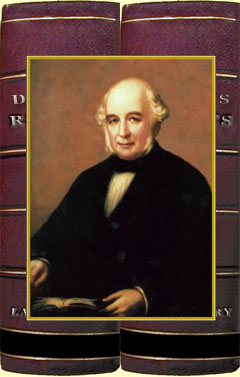
Since I'm in the middle of discussing Judge Hiram Denio's opinion in Lemmon v. People, I thought I'd provide a photo and brief bio. The following is from the New York State Courts site:

"Born in Rome, New York, on May 21, 1799, Hiram Denio commenced his legal studies at the age of 17 with Judge Joshua Hathaway of Rome and later studied in the office of Storrs & White in Whitesboro. After admission to the bar in 1821, Denio established a private practice with Wheeler Barnes in Rome. While in Rome, he was appointed County District Attorney, serving in this position from 1825 to 1834. In 1826, he relocated to Utica, forming another legal practice, this time with E.A. Wetmore. In 1834 he was appointed Circuit Judge and Vice-Chancellor for the 5th Circuit. However, four years later, he was forced to resign due to illness, returning to private practice once more. He served as Bank Commissioner from 1838 to 1840. In 1845 Judge Denio assumed the position of Reporter, publishing five volumes of the Reports before leaving the post in 1848. Appointed to fill a vacancy on the Court of Appeals in June 1853, he was reelected twice, serving as Chief Judge from 1856 through 1857. Considered one of the foremost judges in New York, he retired in 1866. Judge Denio served as trustee of Hamilton College from 1835 until his death. In 1859, Madison University (now Colgate University) awarded him the honorary degree of LLD. With William Tracy, he edited an edition of the revised statutes of New York published in 1852. Judge Denio died in Utica, New York, on November 5, 1871."

Lemmon v. People VII

Next, Judge Denio turned to the first of the objections raised by Mr. Lemmon. The New York law, was is argued, violated the Privileges and Immunities Clause, which provides that "The Citizens of each State shall be entitled to all Privileges and Immunities of Citizens in the several States."

To address this argument, Judge Denio engaged in a long and scholarly review of the history of the Clause, starting with the inclusion of its predecessor in the Articles of Confederation. He drew the conclusion that the meaning of the Clause “is, that in a given State, every citizen of every of other State shall have the same privileges and immunities – that is, the same rights – which the citizens of that State shall possess.” 20 N.Y. at 608. On the other hand, the Clause did not grant to citizens of other States more rights than the State granted to its own citizens. “But where the laws of the several States differ, a citizen of one State asserting rights in another, must claim them according to the laws of the last mentioned State, not according to those which obtain in his own.” 20 N.Y. at 609.

In this context, Judge Denio denied that the Clause had anything “to do with the doctrine of international comity.” Under that doctrine, one State may defer to the laws of another, but it depends in part upon “the presumed assent of the legislative authority of the particular State in which the right is claimed; and an express denial of the right by that authority is decisive against the claim.” 20 N.Y. at 609. Here, there was such "an express denial" because the statutory history demonstrated that the New York legislature had already decisively spoken.

My reading of the decision leads me to conclude that Judge Denio was an extremely smart and clever lawyer. The discussion of comity together with the Privileges and Immunities Clause is at first somewhat surprising, because the doctrine of comity does not depend on the Clause. It is a flexible, quasi-equitable doctrine that typically comes into play in international relations (as Judge Denio concedes), where the Clause does not exist.

It is in the discussion immediately following that we see why the Judge has joined the two. By eliminating the flexibility of comity, which might have permitted the Virginians to keep their slaves provided they remained in New York only temporarily, Judge Denio was able to reduce the choice-of-law question implicit in the Privileges and Immunities Clause to an either-or, all-or-nothing proposition. This leads to a classic reductio ad absurdum, which the Judge paints with relish:

“If the owner of these slaves is not in like manner bound [by New York law, as New York citizens are], it is because . . . [Mrs. Lemmon] has brought with her, or sent with them [the slaves], laws of Virginia, and is entitled to have those laws enforced in the courts, notwithstanding the mandate of our own laws to the contrary. But the position of [Mrs. Lemmon] proves too much. The privileges and immunities secured to the citizens of each State by the Constitution are not limited by time, or by the purpose for which, in a particular case, they may be desired, but are permanent and absolute in their character. Hence, if [Mrs. Lemmon] can claim exemption from the operation of the statute . . . on the ground that she is a citizen of a State where slavery is allowed, and that our courts are obliged to respect the title which those laws confer, she may retain slaves here during her pleasure; and, as one of the chief attributes of property is the power to use it, and to sell or dispose of it, I do not see how she could be debarred of these rights within our jurisdiction as long as she may choose to exercise them. She could not, perhaps, sell them to a citizen of New York, who would at all events be bound by our laws, but any other citizen of a slave State – who would equally bring with him the immunities and privileges of his own State – might lawfully traffic in the slave property.”

20 N.Y. at 609-10.

Having demonstrated that the alternative would transform New York into a slave market, Judge Denio drew the obvious conclusion:

“The answer to the claim in that aspect has already been given. It is that the owner cannot lawfully do anything which our laws do not permit to be done by one of our own citizens, and as a citizen of this State cannot bring a slave within its limits except under the condition that he shall immediately become free, the owner of those slaves could not do it without involving herself in the same consequences.”

20 N.Y. at 611.

Friday, December 22, 2006

Lemmon v. People VI

Judge Hiram Denio’s opinion in favor of affirmance -- that is, in favor of declaring the eight slaves free -- lacks the passionate denunciations of slavery we have seen in Justice Wright’s. It is a model of dispassionate and impartial scholarship. Nonetheless – and I may be imagining it – I picture Judge Denio silently smiling from time to time as he writes his opinion.

Justice Denio began his constitutional discussion by arguing that the Fugitive Slave Clause supported the constitutionality of the statute and thus the eight slaves' freedom. The Clause, the judge deduced, supported the conclusion that “the authors of the Constitution [assumed] that the fact of a federative Union would not of itself create a duty on the part of the States which should abolish slavery to respect the rights of the owners of slaves escaping thence from the States where it continued to exist.” 20 N.Y. at 604. In other words, the Framers implicitly recognized that a State could declare all slaves who came within its jurisdiction free, unless the Constitution provided otherwise. Despite this assumption, the Framers constrained free States only as to escaped slaves, not as to slaves whose masters brought them voluntarily into the jurisdiction:

“Reading the provision for the rendition of fugitive slaves, in the light which these considerations afford, it is impossible not to perceive that the [Constitutional] Convention assumed the general principle to be that the escape of a slave from a State in which he was lawfully held to service into one which had abolished slavery would ipso facto transform him into a free man. This was recognized as the legal consequence of a slave going into a State where slavery did not exist, even though it were without the consent and against the will of the owner. A fortiori he would be free if the master voluntarily brought him into a free State for any purpose of his own. But the provision in the Constitution extended no further than the case of fugitives.”

20 N.Y. at 606.

Sitting alone in his chambers, Judge Denio puts down his pen and reviews his handiwork. He leans back in his chair and smiles, savoring the irony. Round one to freedom.
Related Posts with Thumbnails